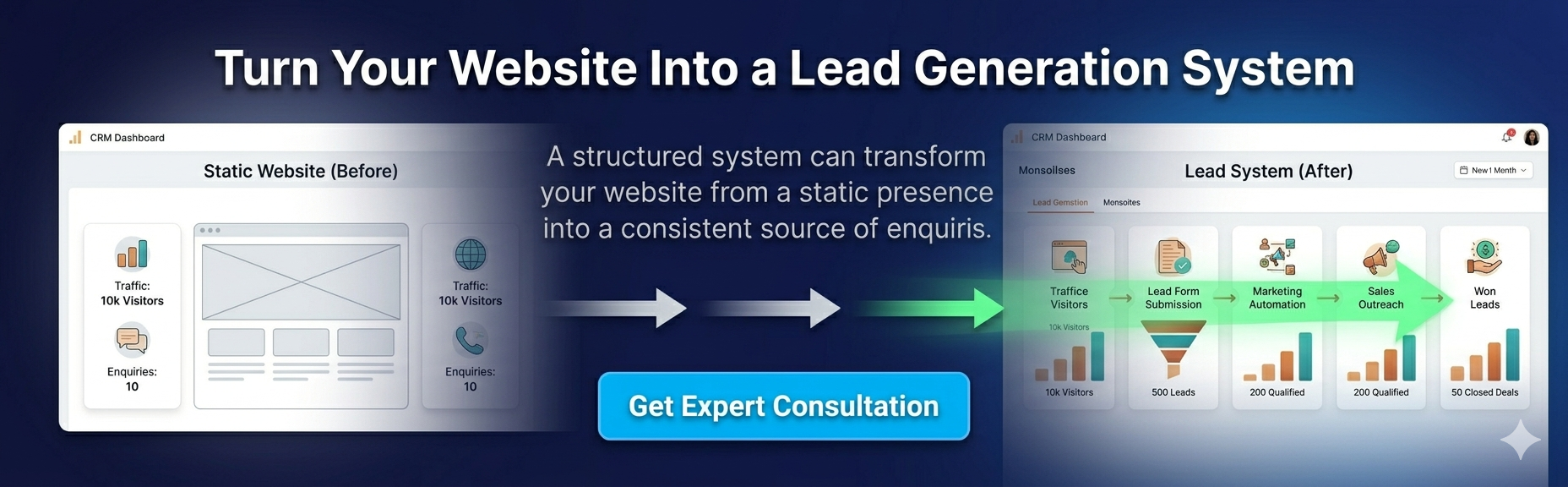
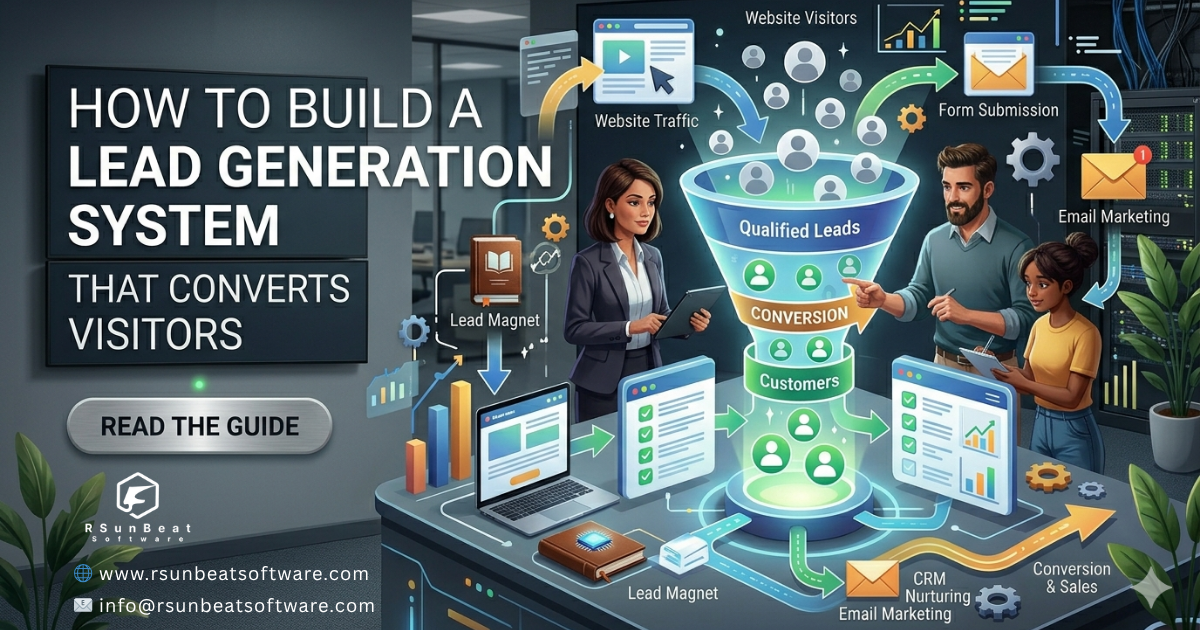
Many businesses invest time and resources into building a professional website, expecting it to become a consistent source of enquiries. The design looks polished, the content is in place, and traffic may even be growing steadily. Yet, despite these efforts, leads remain inconsistent or unpredictable.
This situation often creates confusion. If people are visiting the website, why are they not converting into enquiries or clients?
In most cases, the issue is not visibility. It is structure. A website without a defined lead generation system behaves like a digital brochure—it informs, but it does not guide action.
To generate reliable website leads, a business needs more than a presence online. It needs a clear, simple, and effective system that moves visitors from interest to enquiry.
This article explains how to build that system in a practical and structured way, without unnecessary complexity.
Table of Contents
- What a Lead Generation System Actually Is
- Why Websites Without Systems Struggle to Convert
- The Essential Building Blocks of a Lead System
- How Visitors Move Through Your Website
- Real-World Example: From Passive Traffic to Active Leads
- Step-by-Step Process to Build Your System
- Tools and Setup Required
- Common Gaps That Reduce Conversions
- How to Measure and Improve Results
- Final Thoughts
- Frequently Asked Questions (FAQs)
What a Lead Generation System! Actually Is
A lead generation system is not a single feature such as a contact form or landing page. It is a connected structure that guides a visitor from initial interest to taking action.
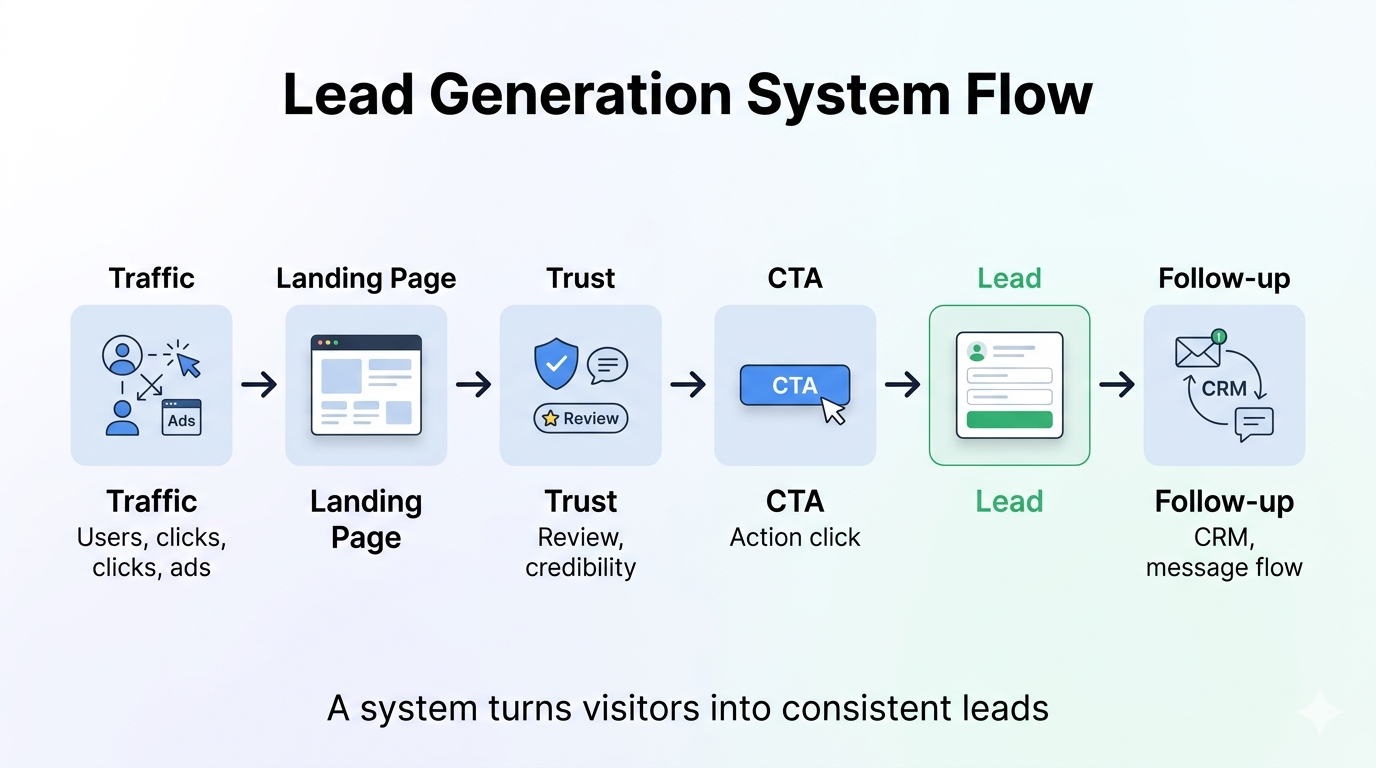
At its core, the system follows a simple flow:
Visitor → Understanding → Trust → Action → Follow-up
Each stage plays a role. If one part is unclear or missing, the entire process becomes less effective.
A well-structured lead generation website ensures that users are not left guessing what to do next. Instead, it provides clarity, builds confidence, and makes the next step obvious.
Why Websites Without Systems Struggle to Convert
Many websites are built with a strong focus on design but without a clear conversion strategy. While design creates a good first impression, it does not guarantee results.
Common patterns include:
- Visitors arrive but leave without taking action
- Pages provide information but lack direction
- Calls-to-action are unclear or inconsistent
- There is no follow-up after initial interest
These gaps often result in a website not converting, even when traffic is present.
The issue is not effort. It is alignment. Without a system, the user journey is incomplete, and conversions become inconsistent.
The Essential Building Blocks of a Lead System
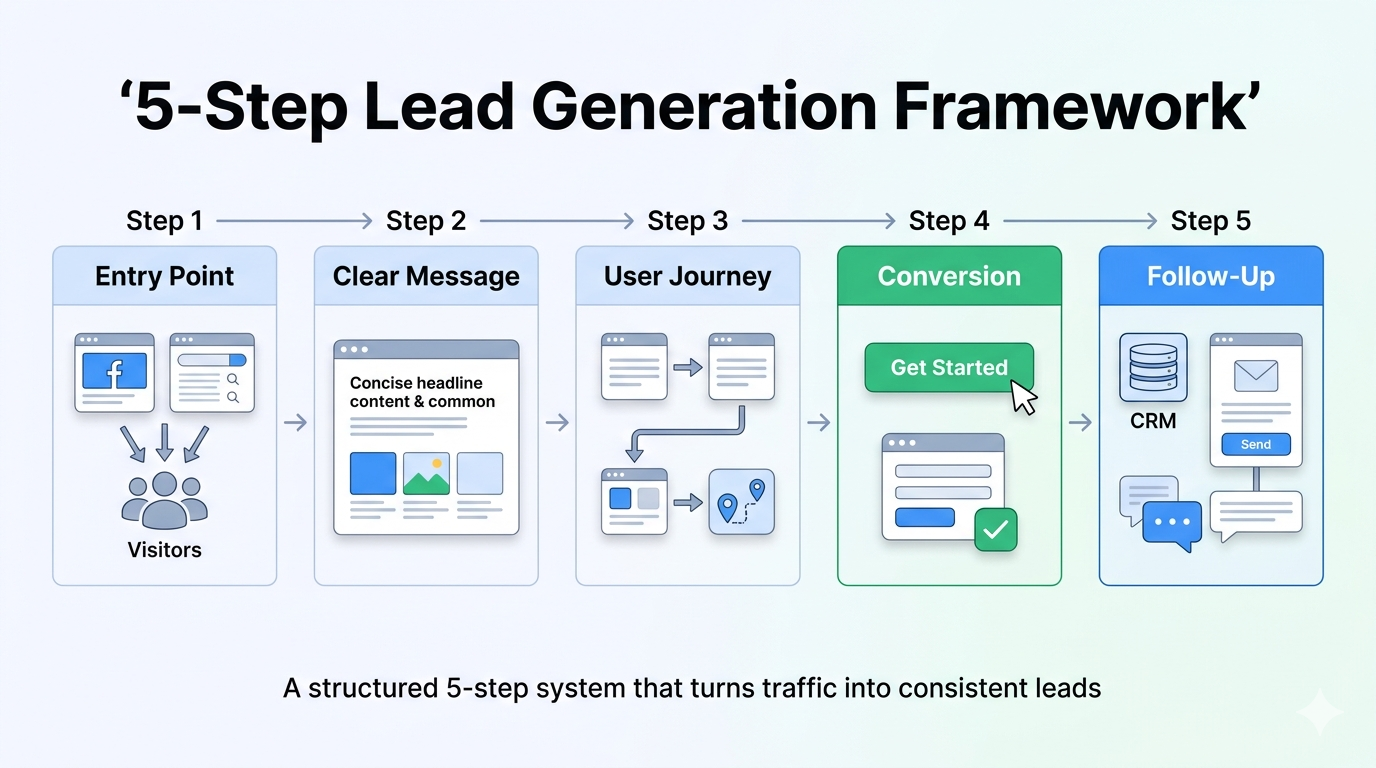
A simple and effective lead generation system can be built using five core components.
1. Entry Point
This is how visitors reach your website—through search engines, ads, or referrals. The message they see before arriving should match what they experience on your site.
2. Clear Positioning
Visitors should immediately understand what you offer, who it is for, and what outcome they can expect. Clarity at this stage increases engagement.
3. Guided User Journey
A structured approach to website development for lead generation ensures that users move logically through your website. Each step should lead naturally to the next.
4. Conversion Point
This is where users take action. It could be a contact form, consultation request, or booking system. The process should be simple and accessible.
5. Follow-Up System
Lead generation does not end with a form submission. A follow-up process helps nurture leads and move them toward a decision.
How Visitors Move Through Your Website
Understanding user behavior is essential. A typical journey looks like this:
- A visitor lands on your website
- They scan for relevance and clarity
- They explore services or solutions
- They look for trust indicators
- They decide whether to take action
When businesses focus on how to get leads from your website, they often overlook this flow. However, optimizing each step is what creates consistent results.
Real-World Example: From Passive Traffic to Active Leads
Consider a service-based business in the UK that had a well-designed website and steady traffic. Despite this, enquiries were minimal.
A review revealed several gaps:
- The homepage lacked a clear value proposition
- Calls-to-action were not prominently placed
- Trust elements such as testimonials were missing
- The enquiry process required multiple steps
After addressing these issues, the improvements were noticeable:
- Clear messaging improved engagement
- Strategic CTAs increased interaction
- Testimonials built credibility
- Simplified forms reduced drop-offs
Within a few weeks, enquiries increased significantly without increasing traffic.
This demonstrates that the difference was not visibility, but the presence of a structured system.
Step-by-Step Process to Build Your System
Creating a lead generation system does not require complexity. It requires clarity and structure.
Step 1: Define Your Core Offering
Clearly explain what you provide and who it is for. Avoid vague language.
Step 2: Optimize Your Homepage
Your homepage should guide visitors, not just introduce your business. It should communicate value and direct users toward action.
Step 3: Create Clear Conversion Paths
Every important page should lead to a next step. This is essential for improving website conversion rate.
Step 4: Simplify the Action Process
Reduce friction by keeping forms short and eliminating unnecessary steps.
Step 5: Implement Follow-Up
A simple follow-up system can significantly improve conversion rates by maintaining engagement.
Tools and Setup Required
A basic system can be implemented with simple tools:
- A structured website
- Contact or booking forms
- Email follow-up setup
- Analytics tools
As your business grows, you may explore advanced solutions such as automation or mobile app development for business growth.
Common Gaps That Reduce Conversions
Even well-designed websites can underperform if certain gaps exist:
- Unclear messaging
- Poor mobile experience
- Lack of trust signals
- Complicated navigation
- No follow-up system
Addressing these issues can lead to immediate improvements.
How to Measure and Improve Results
A lead generation system should evolve based on data.
Track:
- Visitor behavior
- Conversion rates
- Drop-off points
Use this data to identify areas for improvement and refine your system over time.
Final Thoughts
A website should not function as a static online presence. It should operate as a structured system designed to generate enquiries consistently.
The difference between a website that performs and one that does not is rarely about design or traffic alone. It is about how effectively the entire process is connected.
By focusing on clarity, user journey, and follow-up, businesses can transform their website into a reliable source of leads.
Frequently Asked Questions (FAQs)
What is a lead generation system for a website?
A lead generation system is a structured process that guides visitors from initial interest to taking action. It includes messaging, user journey, conversion points, and follow-up.
Why is my website not generating consistent leads?
Most often, the issue is a lack of structure. A website may attract visitors but fail to convert them due to unclear messaging, weak calls-to-action, or missing trust elements.
How can I improve lead generation from my website?
Focus on improving clarity, guiding the user journey, simplifying conversion steps, and adding follow-up systems. These changes help increase consistent website leads.
Do I need advanced tools to build a lead system?
No. A simple setup with a structured website, a clear CTA, and a basic follow-up system is often enough to get started.
How long does it take to see results?
Many businesses start seeing improvements within a few weeks after implementing clear messaging and better conversion structures.
Is traffic or conversion more important?
Both are important, but improving conversion often delivers faster and more cost-effective results than increasing traffic alone.
Can small businesses build an effective lead system?
Yes. A simple and well-structured system can be highly effective regardless of business size.
What’s your decision
If your website is not generating consistent enquiries, it may be worth reviewing how effectively it guides visitors through the decision-making process.
A structured evaluation can help identify gaps in messaging, user flow, and conversion points, and provide clarity on what improvements are required to achieve more consistent results.