Table of Contents
- Introduction: Understanding the Problem
- Why This Problem Happens
- Key Challenges Businesses Face
- Common Mistakes That Make It Worse
- Real-World Example or Case Breakdown
- Step-by-Step Solution (What Actually Works)
- Tools, Strategies, or Systems to Implement
- Cost, Time, or Effort Involved
- How to Choose the Right Approach or Service
- Final Thoughts: What You Should Do Next
- Frequently Asked Questions (FAQs)
Introduction: Understanding the Problem
A business owner once reviewed their website analytics and noticed something frustrating. The traffic looked healthy. Visitors were landing on the homepage, exploring service pages, and even spending time reading content. Yet, despite this activity, enquiries were minimal.
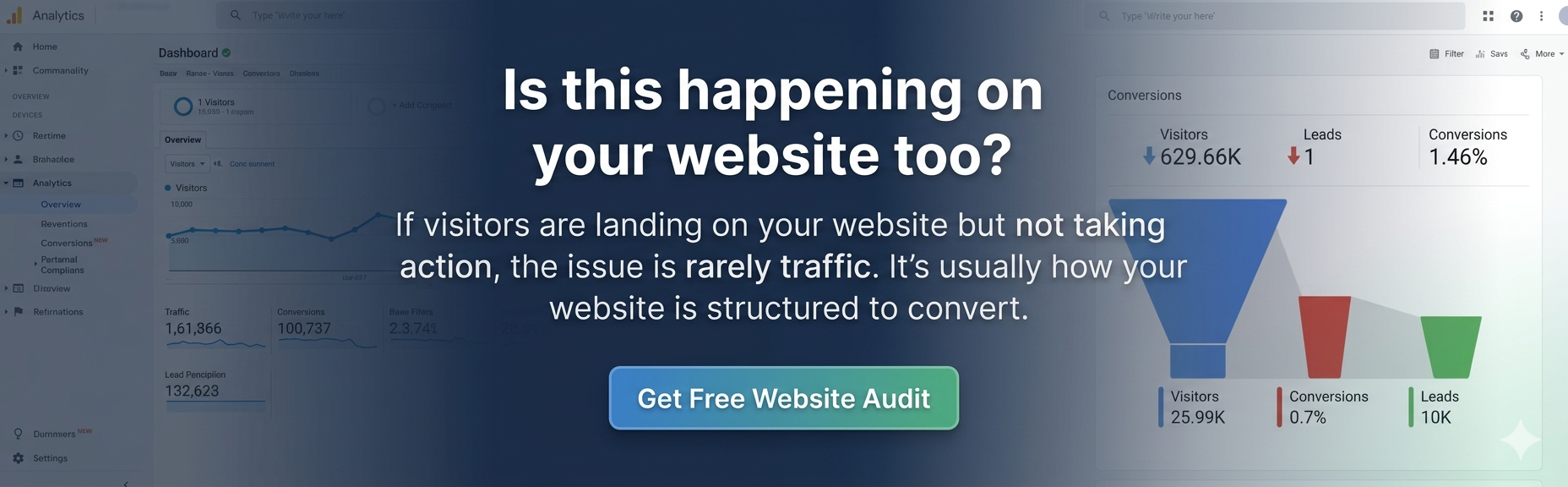
This situation raises a critical question: if people are visiting the website, why are they not taking action?
For many small businesses, clinics, and service providers across the USA, UK, Canada, and Australia, this is not an uncommon experience. Efforts are made to attract traffic through SEO, ads, or referrals, but the expected outcome—consistent website leads—does not materialize.
The issue is often misunderstood. It is easy to assume that the problem lies in the quality of traffic or the design of the website. However, in most cases, the real issue is deeper.
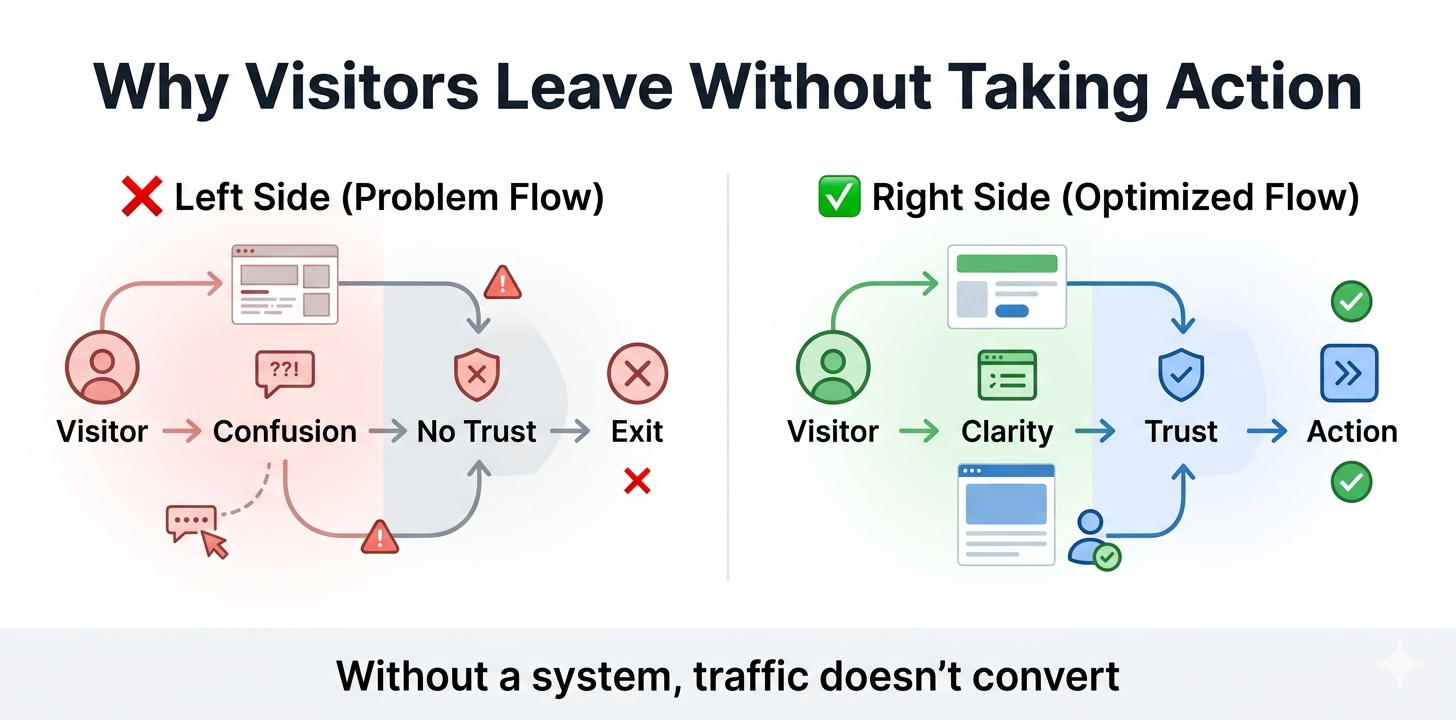
Visitors do not leave randomly. They leave because something in the experience does not guide them toward action. Understanding what that “something” is can completely change how your website performs.
Why This Problem Happens
At its core, a website is not just a digital brochure. It is part of a conversion system that should guide visitors from interest to action. When that system is incomplete or unclear, visitors disengage.
Many businesses invest in building a visually appealing lead generation website, but they overlook how users interact with it. A visitor arrives with a specific intent—whether to solve a problem, compare options, or explore services. If the website fails to address that intent quickly and clearly, the visitor leaves.
Another reason this problem occurs is the lack of alignment between expectation and experience. For example, a user clicking on an ad expects to find relevant information immediately. If the page does not match that expectation, trust is lost.
In such cases, the website is not necessarily broken, but it is not converting. And when a website is not converting, even high traffic volumes fail to produce meaningful results.
Key Challenges Businesses Face
Lack of Immediate Clarity
When visitors land on a website, they should understand within seconds what the business offers and how it can help them. Many websites fail at this first step, leading to confusion and early exits.
Weak User Engagement
A website that does not engage users through clear messaging, structured content, and logical flow struggles to hold attention. Visitors skim, lose interest, and leave without exploring further.
Poor Call-to-Action Placement
Even when visitors are interested, they may not take action if the next step is unclear. Calls-to-action that are hidden, vague, or inconsistent reduce conversion opportunities.
Limited Trust Signals
Trust is a major factor in decision-making. Without testimonials, case studies, or proof of results, visitors hesitate to engage, especially for high-value services.
Ineffective Mobile Experience
With a large percentage of users browsing on mobile devices, a slow or poorly optimized mobile experience can significantly increase bounce rates.
Common Mistakes That Make It Worse
One common mistake is focusing solely on design. Businesses often assume that a visually appealing website will automatically perform well. While design influences perception, it does not guarantee action.
Another mistake is ignoring user behavior data. Analytics tools provide insights into where users drop off, but many businesses do not use this data effectively.
There is also a tendency to overload websites with information. Instead of guiding users, excessive content creates confusion. Visitors struggle to find what they need and eventually leave.
Additionally, many websites lack a clear structure. Pages are created independently without considering how they connect as part of a larger journey. This disconnect weakens the overall experience.
Finally, businesses often underestimate the importance of follow-up. Even when a visitor shows interest, there may be no system in place to capture and nurture that lead.
Real-World Example or Case Breakdown
Consider a service-based business in Australia that was receiving consistent traffic through SEO and paid ads. The website looked professional, and the services were clearly listed. However, enquiries remained low.
A detailed review revealed several issues:
- The homepage did not clearly communicate the core value proposition
- Calls-to-action were minimal and not strategically placed
- There were no strong trust signals such as client testimonials
- The contact process required multiple steps
After implementing targeted improvements, the results changed significantly.
The business introduced:
- Clear and direct messaging on the homepage
- Prominent calls-to-action across key pages
- Testimonials and case studies to build trust
- A simplified contact form
Within eight weeks, enquiries increased by nearly 150%, without any increase in traffic.
This example demonstrates that the problem was not visibility. It was the lack of a structured approach to conversion.
Step-by-Step Solution (What Actually Works)
Improving website performance requires a systematic approach.
Step 1: Clarify Your Value Proposition
Your website should clearly answer three questions:
- Who do you help?
- What problem do you solve?
- What result can clients expect?
Clarity builds confidence and encourages engagement.
Step 2: Design for Conversion, Not Just Appearance
A well-structured website plays a crucial role in generating leads. Investing in website development for lead generation ensures that your site is built with purpose.
Key elements include:
- Clear headlines and subheadings
- Logical page structure
- Visible calls-to-action
Step 3: Optimize the User Journey
Understanding how to get leads from your website involves guiding visitors step by step. Each page should lead naturally to the next action.
Step 4: Strengthen Trust Signals
Add elements that build credibility:
- Client testimonials
- Case studies
- Certifications
- Real results
Step 5: Improve Conversion Points
Focus on improving website conversion rate by simplifying forms and reducing friction. Ensure that taking action feels easy and intuitive.
Step 6: Implement Follow-Up Systems
A strong conversion system does not end at the website. It includes follow-up processes such as email sequences, reminders, and CRM tracking.
Tools, Strategies, or Systems to Implement
To support your website’s performance, consider integrating:
- Analytics tools to track user behavior
- CRM systems for lead management
- Email automation for follow-ups
- A/B testing tools for continuous improvement
In some cases, expanding into mobile app development for business growth can provide additional engagement opportunities and improve long-term customer relationships.
Cost, Time, or Effort Involved
Improving website performance does not always require a complete redesign.
- Basic improvements: 1–2 weeks
- Moderate optimization: 3–6 weeks
- Full system implementation: 6–10 weeks
The investment varies, but the return is often significant when conversion rates improve.
How to Choose the Right Approach or Service
When selecting a solution, focus on strategy rather than just execution.
Ask:
- Does the provider understand conversion, not just design?
- Do they analyze user behavior and data?
- Can they build a complete system rather than isolated features?
Choosing the right approach ensures sustainable growth rather than temporary improvements.
Final Thoughts: What You Should Do Next
Visitors do not leave your website without reason. Their behavior reflects how effectively your website communicates, builds trust, and guides action.
A website that functions as part of a strong conversion system can transform existing traffic into consistent enquiries. Without that system, even the best marketing efforts will fall short.
If your website is not delivering the results you expect, it may be time to look beyond design and focus on how your entire process works.
Frequently Asked Questions (FAQs)
Why do visitors leave my website without taking action?
Because the website lacks clarity, trust, or a clear next step, leading to confusion or hesitation.
What is a conversion system?
A structured process that guides visitors from interest to action, including website flow and follow-up mechanisms.
How can I improve my website leads?
By improving messaging, optimizing the user journey, and adding strong calls-to-action and trust signals.
Is traffic or conversion more important?
Conversion is more important because it determines how many visitors become leads.
How long does it take to see results?
With the right changes, improvements can be seen within a few weeks.
What’s your decision
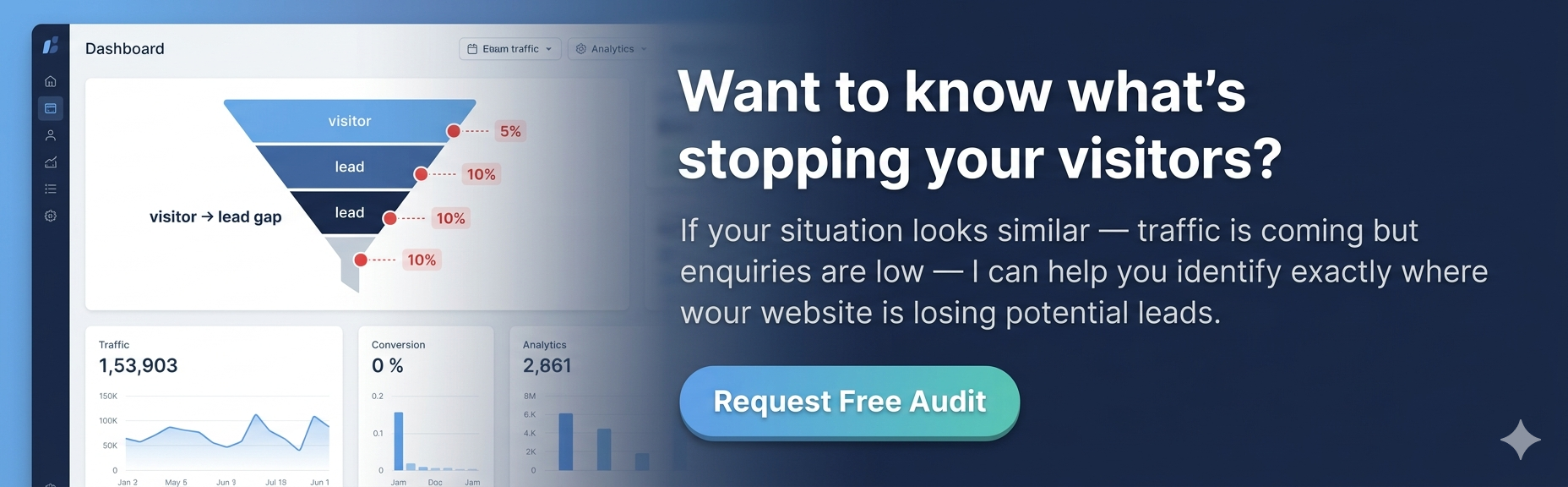
If your website is getting traffic but visitors are leaving without taking action, the issue is likely not traffic—it’s how your system is set up.
If you’d like a clear understanding of what’s not working, feel free to message me “audit.” I’ll review your setup and share exactly what needs to be fixed to start generating consistent enquiries.