

If you’ve recently spoken with a few agencies or freelancers about building a website, you’ve probably noticed something that feels confusing almost immediately—pricing seems inconsistent, unclear, and sometimes completely unpredictable. One quote might come in at $2,000, another at $12,000, and both claim to offer a “complete website,” which makes it difficult to understand what you are actually getting and whether the higher investment is truly justified.
For small businesses, clinics, and startups, this creates a real challenge because the decision is no longer just about budget—it is about clarity, expectations, and outcomes. You are not simply buying a website; you are investing in something that should ideally generate enquiries, build trust, and support growth over time.
In 2026, website development has moved far beyond design and basic functionality, as businesses now expect their websites to generate website leads, support marketing efforts, and convert visitors into customers. A basic website might look clean and modern, but without the right structure and intent, it often fails to deliver results, whereas a strategically built website can quietly become a consistent source of business.

Table of Contents
- What Has Changed in Website Pricing (2026 Reality)
- Real Cost Ranges Based on Current Market Data
- What You’re Actually Paying For
- Website Types and Their Cost Differences
- Hidden Costs After Launch
- Real Example: Budget vs Outcome
- How to Decide the Right Budget
- Cost vs Performance
- Final Thoughts
- FAQs
What Has Changed in Website Pricing (2026 Reality)
Website development pricing today reflects outcomes, not just effort. Businesses are no longer paying only for design or development—they are paying for clarity, structure, and conversions.
Three key shifts define today’s pricing:
- Strategy is now part of development
- Tools reduced cost, not expertise
- Conversion-focused websites require deeper thinking
This is why two websites that look similar on the surface can have completely different pricing and performance.
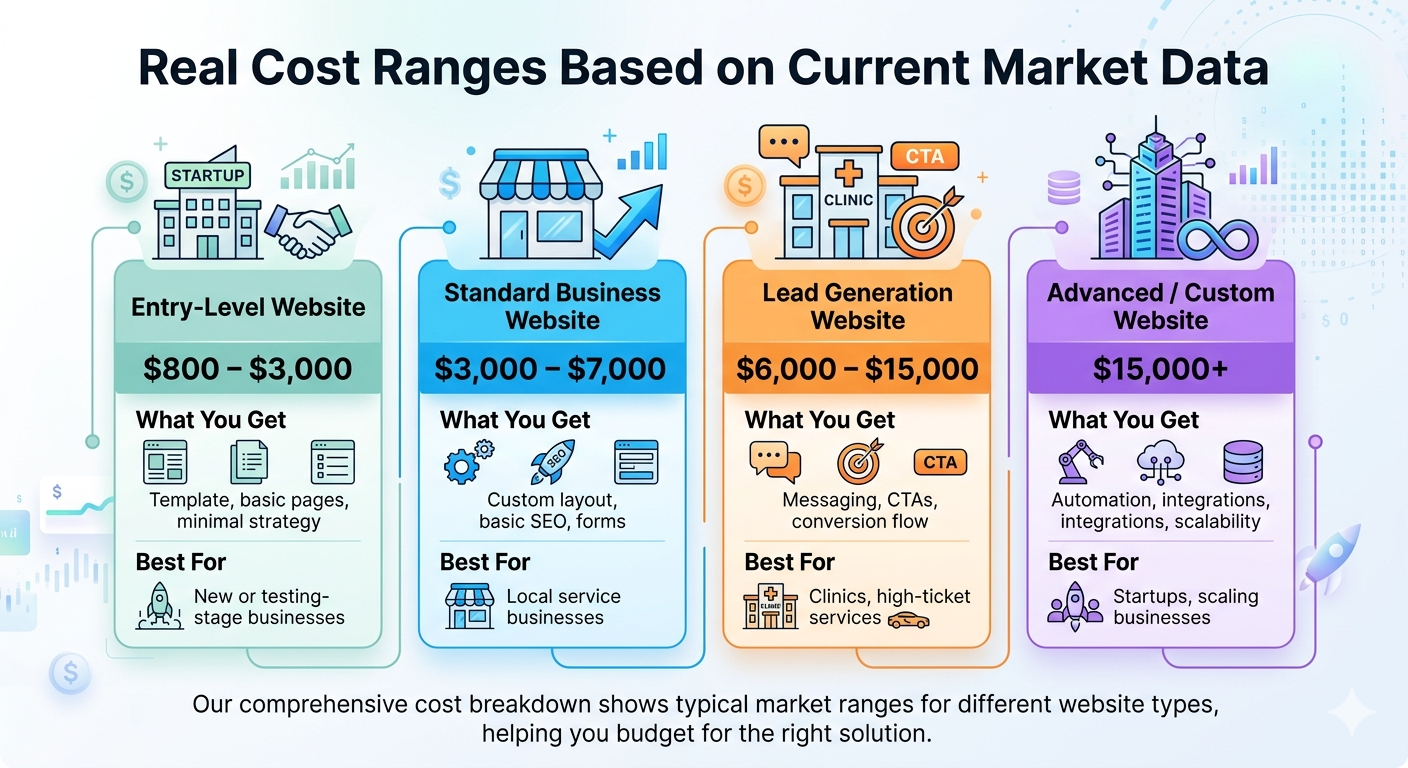
Real Cost Ranges Based on Current Market Data
Instead of vague estimates, here’s a clear comparison of what businesses are actually paying in the USA (2026): just features—it’s what the website is built to achieve.
What You’re Actually Paying For
Most businesses think they are paying for design, but in reality, the investment is spread across multiple layers that work together to produce results.
| Component | % of Cost | Why It Matters |
|---|---|---|
| Strategy & Planning | 10–20% | Defines structure and user journey |
| Design & UX | 20–30% | Builds trust and usability |
| Development | 30–40% | Technical foundation |
| Content & Messaging | 10–20% | Drives clarity and engagement |
| Conversion Optimization | 10–20% | Turns visitors into leads |
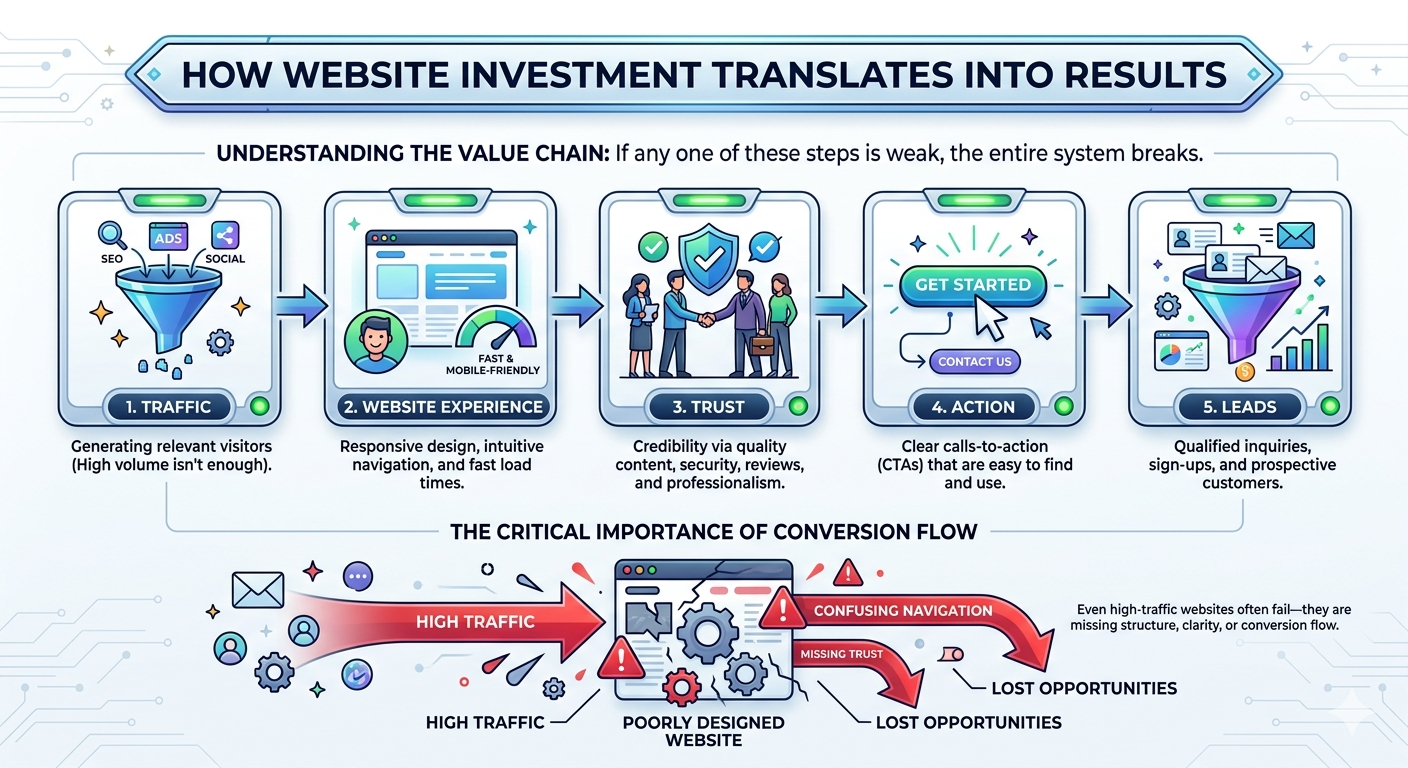
This is exactly why many websites end up as a website not converting, because one or more of these layers is either missing or poorly executed.
Website Types and Their Cost Differences
The biggest pricing gap comes from purpose, not just design.
- Informational Website → Built for presence
- Business Website → Built for visibility + basic enquiries
- Lead Generation Website → Built for conversions
This is where website development for lead generation becomes critical, because the goal shifts from simply showing information to actively generating results.
Hidden Costs After Launch
This is where most businesses underestimate their total investment, because the initial development cost is only part of the equation.
After launch, ongoing costs typically include:
- Hosting: $100–$500/year
- Maintenance: $50–$300/month
- SEO: $500–$2,000/month (if outsourced)
- Content updates and improvements
Without these, even a good website may gradually lose performance and stop generating consistent website leads.
Real Example: Budget vs Outcome
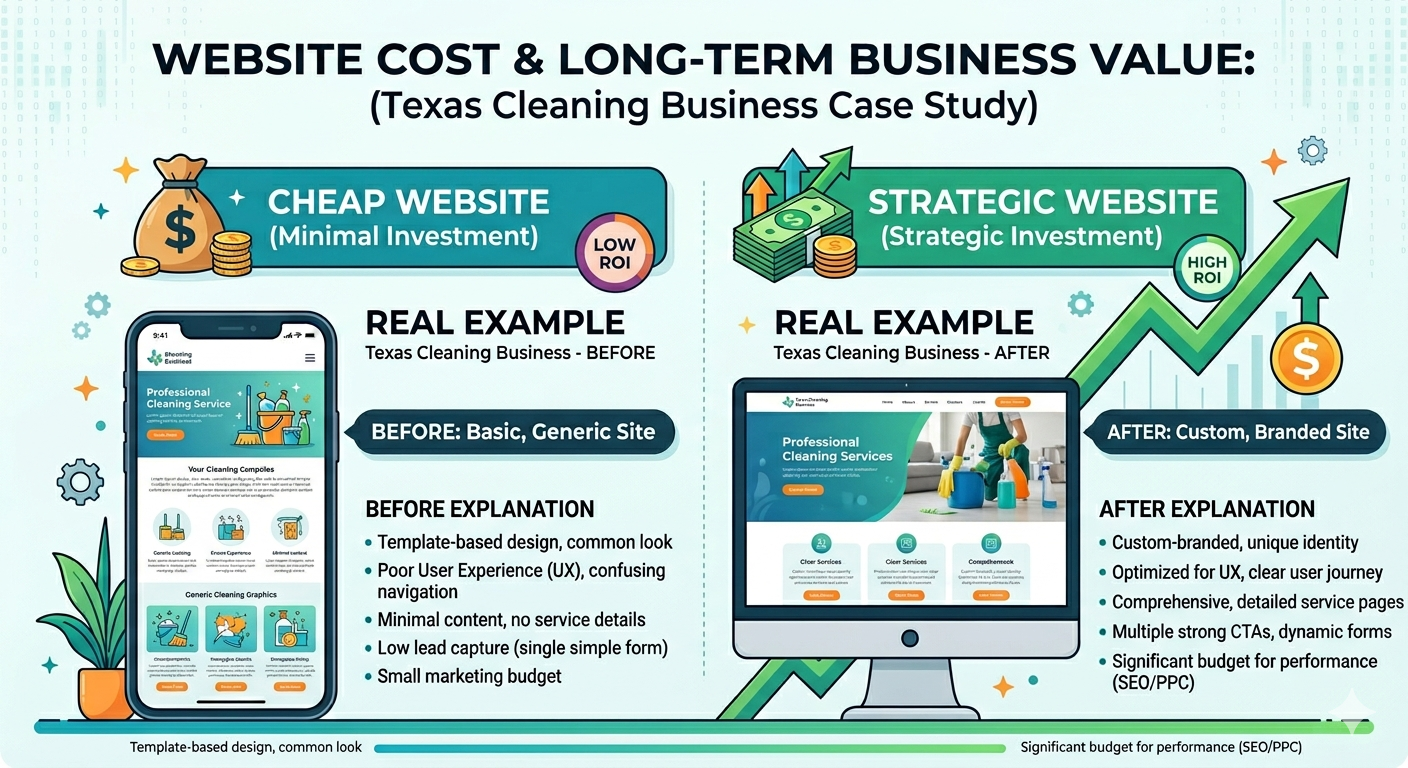
A cleaning service business in Texas initially invested around $2,000 in a website, which looked visually acceptable and functioned properly, but failed to generate enquiries despite receiving some traffic.
After analyzing the issue, they reinvested approximately $5,500 into a redesign focused on clearer messaging, stronger CTAs, and a simplified booking process.
The result was a noticeable increase in engagement, more enquiries, and better overall conversion performance, proving that the issue was not traffic—it was structure and clarity.

How to Decide the Right Budget
Instead of asking, “What is the cheapest option?”, a better question is:
- What is one client worth to your business?
- How many leads do you need monthly?
- What role will your website play in growth?
When you look at it this way, the decision becomes more strategic and less price-driven.
Cost vs Performance
The biggest mistake businesses make is focusing only on upfront cost, which often leads to choosing a cheaper solution that fails to deliver results.
A lower-cost website might save money initially, but if it does not generate leads, it becomes an expense rather than an investment. On the other hand, a well-structured website that consistently generates enquiries provides long-term value that goes far beyond its initial cost.
Understanding how to get leads from your website is therefore more valuable than simply reducing development expenses.
Final Thoughts
Website development in 2026 is not just about design—it is about building a system that works.
Costs vary because outcomes vary, and the right decision depends on what you expect your website to achieve.
When approached correctly, a website becomes more than just an online presence—it becomes a reliable business asset that supports long-term growth.
Frequently Asked Questions (FAQs)
How much does a website cost in the USA in 2026?
Most small business websites cost between $3,000 and $7,000, while conversion-focused websites range from $6,000 to $15,000 or more.
Why do prices vary so much?
Because the level of strategy, customization, and conversion focus differs significantly.
Is a lead generation website worth it?
Yes, especially for service businesses where leads directly impact revenue.
Can I start small and upgrade later?
Yes, but starting with a strong structure saves time and cost long-term.
What makes a website generate leads?
Clear messaging, strong CTAs, trust elements, and user flow.
What’s your decision?
If you are planning to build or upgrade your website, taking time to understand the right structure, budget, and expected outcome can make a significant difference, because the goal is not just to create something that looks good, but to build a website that actually performs and contributes to your business growth in a meaningful and measurable way.