
Many UK startups turn to freelancers to save time and money — but quickly realise the hidden risks: inconsistent delivery, sudden availability gaps, rising day rates, and product delays that investors won’t tolerate in 2025. This article explores why UK startups regret hiring freelancers and why dedicated remote full-stack development companies UK offer a safer, more scalable, IR35-friendly model for building high-quality digital products with predictable timelines and accountability.
Why UK Startups Initially Choose Freelancers
At first glance, freelancers feel like the perfect solution. Search terms like “freelance developer UK”, “hire full stack freelancer UK”, “freelancer for MVP UK” are among the highest-intent keywords in the UK startup tech hiring space.
Here’s why founders choose them:
✔ Perceived Low Cost
Freelancers seem cheaper than agencies or dedicated teams — especially during MVP stages. But UK day rates in 2025 average £350–£650/day (Hays UK Contractor Guide), often matching the cost of a full in-house hire.
✔ Quick Onboarding
Founders like the idea of “starting tomorrow.” Freelancers require almost no contract negotiations or HR overhead.
✔ Low Commitment
Short contracts feel less risky. “Try for a month” is appealing to bootstrapped founders.
✔ Global Access
Startups can hire from India, Eastern Europe, or Latin America within days, often at lower rates.
✔ Flexible Hours
Founders often work irregular schedules — freelancers can be available outside normal UK office hours.
But what looks convenient at first often becomes the single biggest reason product launches slip, codebases crumble, and founders lose investor trust.
The Costly Problems UK Startups Face With Freelancers
This is the section where founders recognise their own painful experiences. Add these insights to increase relatability and conversion.
Unpredictable Availability & Sudden Dropoffs
Freelancers juggle multiple clients simultaneously — and the UK market’s rising demand means they often leave mid-project for higher paying work.
Result:
unplanned downtime
stalled sprints
weeks lost when switching developers
product launch delays
UK startups report this as the #1 regret when hiring freelancers.
Poor Cross-Project Focus
Freelancers split attention between 3–7 clients. This means:
context switching
rushed fixes
inability to prioritise your product
delayed responses during critical bugs
A “part-time mindset” rarely works for full product builds.
Inconsistent Code Quality & Technical Debt
Without peer review, QA, DevOps, or a senior architect, codebases become inconsistent and hard to scale.
Freelancers often:
skip documentation
cut corners under time pressure
deliver code that only they understand
When you eventually switch developers, the new one often says:
“We have to rebuild this from scratch.”
Security, Compliance & GDPR Risks
Many freelancers overlook GDPR, ISO standards, data encryption, or security best practices.
This exposes founders to:
ICO fines
customer data risks
investor concerns
compliance gaps for future audits
In 2025, security is a major investor due-diligence checkpoint — freelancers rarely meet it.
IR35 Ambiguity for Long-Term Freelance Contracts
UK startups often unknowingly create inside-IR35 risk, especially when:
using freelancers long-term
controlling hours
directing tasks
giving them organisational roles
Gov.uk’s IR35 rules are strict — many freelancers simply don’t comply.
Lack of Documentation & Zero Handover
Freelancers rarely provide:
architecture diagrams
API documentation
environment setup instructions
test coverage
deployment steps
This causes handover paralysis when they leave.
Delays Leading to Missed Launch Windows
The most common consequence:
Startups miss investor demos, accelerator deadlines, or onboarding dates.
The average UK startup loses 8–12 weeks due to freelancer inconsistency.
The Hidden Cost of Rebuilds
Cheap initial development often becomes expensive fixing:
bad architecture
missing tests
patchy UX/UI
performance bottlenecks
Founders end up paying 2–4x more to rebuild correctly.
Why Dedicated Remote Full-Stack Development Companies Offer a Safer Model
This is the value section explaining why your service solves the exact pain-points above.
✔ Guaranteed Capacity & Stable Teams
You get a team that stays with you — no dropoffs, no gaps, no disappearing acts.
✔ End-to-End Delivery Ownership
Remote teams provide:
backend + frontend + mobile
QA + DevOps
architecture + project management
One accountable unit → not 5 separate freelancers.
✔ Predictable Monthly Costs
Rather than rising day rates, you get a stable, predictable billing cycle.
✔ Included Project Management + QA
Dedicated teams include specialist roles that freelancers don’t:
QA testers
technical architects
UX/UI designers
a delivery manager
This ensures quality and consistency.
✔ Scalable Team Structure
Need to scale from 2 → 4 developers for a product launch?
Dedicated teams allow instant, flexible scaling without new recruitment.
✔ Built-in Compliance, Contracts & Documentation
Teams follow GDPR, NDAs, ISO-ready practices, and maintain documentation as a standard.
✔ Zero IR35 Risk
A service-based model places you outside IR35, eliminating legal exposure.
Relevant terms to include:
outsource full stack development UK, remote development teams UK, dedicated development team UK, full stack development agency UK.
Freelancer vs Dedicated Remote Team — UK Comparison Table
| Criteria | Freelancers | Remote Team (Dedicated) | UK Agency |
|---|---|---|---|
| Cost | Medium-High (day rates) | Predictable, lower long-term | Highest |
| Speed | Varies, inconsistent | Fast, structured sprints | Slow due to bureaucracy |
| Availability | Limited | Full-time | Business hours only |
| Reliability | Low-Medium | High | High |
| Compliance | Risky (IR35, GDPR) | IR35-safe | IR35-safe |
| Project Management | None | Included | Included |
| Scalability | Difficult | Easy, flexible | Slow & expensive |
| Handover Quality | Poor | Excellent | Good |
Real Causes of Product Launch Failure in UK Startups
Research from CB Insights, Tech Nation, and Nesta reveals a consistent pattern: UK startups don’t fail their product launches because of “bad ideas” — they fail because their development approach is fragile, unstructured, and overly dependent on individual freelancers. When you rely on people who work alone, across multiple clients, without accountability or continuity, launch failure becomes almost inevitable.
Below are the real, root-level reasons why UK startups miss deadlines, ship unstable products, or abandon builds entirely.
1. Freelancer Turnover Mid-Project
In the UK startup ecosystem, freelancer churn is one of the most damaging delivery risks.
Why it happens:
Freelancers switch to higher-paying contracts (Hays reports day-rate increases in 2025).
They juggle multiple clients and prioritise whoever pays the most or has the tightest deadline.
Long-term loyalty isn’t guaranteed — nor expected — in the freelance economy.
Impact on UK startups:
Work stalls suddenly and without warning.
Critical knowledge disappears with the developer.
Replacements take weeks to onboard and understand the codebase.
Founders lose investor confidence because timelines keep shifting.
Core issue:
When one person holds all product knowledge, the entire startup depends on their availability — a dangerous position for investor-backed teams.
2. Weak or Incorrect Architecture From the Start
Freelancers can write features, but very few design product-wide technical architecture — especially for scalable SaaS, fintech, healthtech, or AI systems.
Typical freelance mistakes:
Mixing business logic directly into frontend code
No modular structure
Unoptimised database design
Lack of caching, queues, or scalability principles
Using outdated or incompatible libraries
Consequences:
The product slows down as it grows
Bugs become harder to fix
Adding new features breaks old ones
Senior developers later say: “We need to rebuild this from scratch.”
Result:
Startups burn thousands of pounds and months of effort rebuilding architecture freelancers weren’t qualified to design in the first place.
3. No QA or Testing Culture
Freelancers — especially those paid by hour/day — optimise for speed, not long-term stability.
This leads to:
Nearly zero automated tests
Bugs that reappear repeatedly
No regression testing
No performance testing
Production deployments done manually
Functionality tested “just enough” to appear working
Outcome:
Startups ship brittle products that break under real user traffic.
Every release becomes a gamble.
Investors notice this immediately during demos or product due diligence.
4. Inconsistent Sprints and No Project Management Discipline
Most freelancers:
Don’t run structured sprints
Don’t maintain backlogs
Don’t use velocity metrics
Don’t participate in daily stand-ups
Don’t follow delivery KPIs
Don’t proactively plan releases
Without a delivery manager or technical lead, what you get is:
Random, unpredictable, unmeasured progress.
This leads to:
slipping deadlines
unclear priorities
fragmented communication
blocked tasks waiting days for updates
features built in the wrong order
a product that moves, but without strategy or momentum
This is one of the top reasons UK startups miss accelerator deadlines, investor demos, and public launch dates.
5. Unclear Ownership & Responsibility Gaps
Freelancers operate as individual contributors — not integrated team members.
This creates a vacuum in ownership.
Common scenarios:
“I thought the backend guy would handle that.”
“I didn’t check it because it wasn’t assigned to me.”
“Deployment? That’s not part of my role.”
“That’s a design issue, not a development issue.”
Result:
Tasks fall through the cracks because no one is responsible for the whole outcome.
Meanwhile, founders end up acting as:
product manager
scrum master
QA tester
tech lead
project coordinator
This drains focus from business, sales, funding, and strategy.
How a UK Startup Lost 4 Months With Freelancers — And Recovered
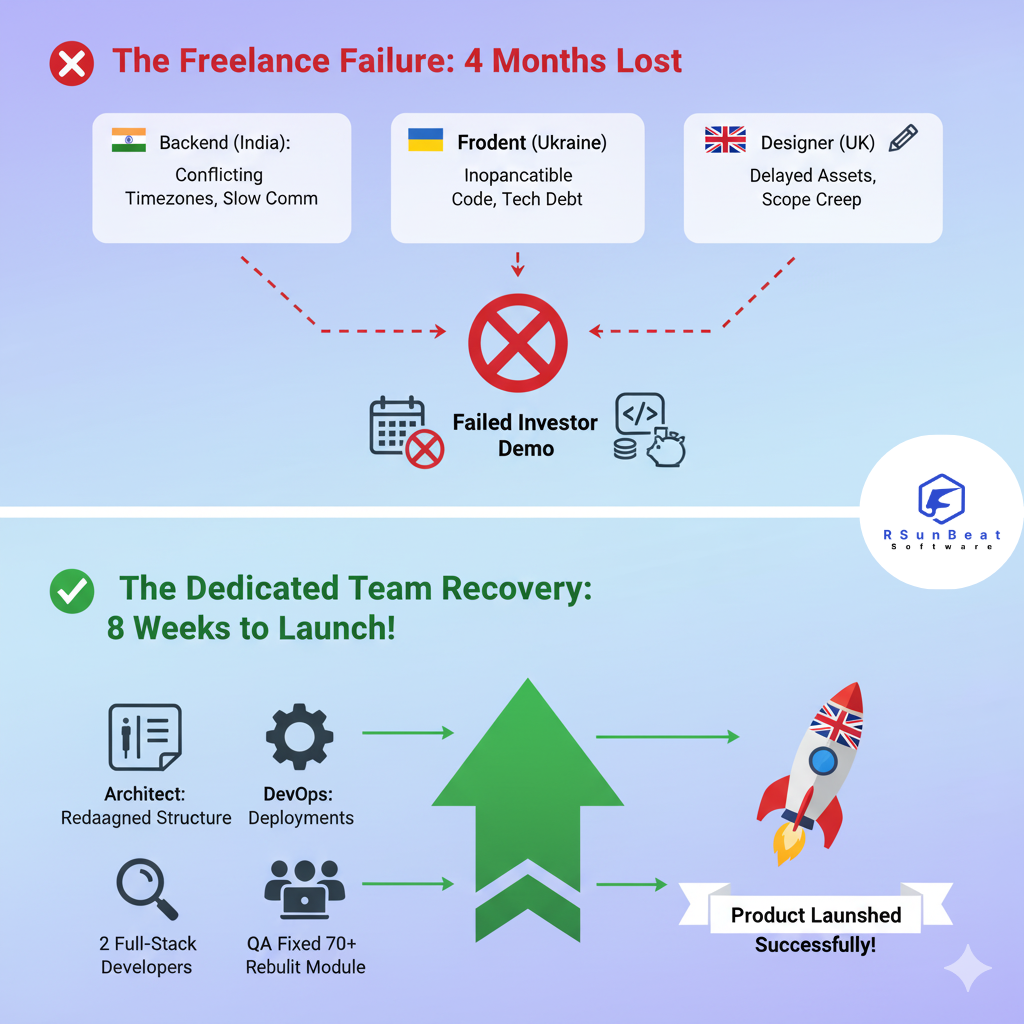
A fintech startup in Manchester hired 3 freelancers:
backend (India)
frontend (Ukraine)
designer (UK)
Problems faced:
conflicting time zones
incompatible code
slow communication
no DevOps
failed investor demo
They approached a dedicated remote team:
architect redesigned the structure
DevOps automated deployments
QA fixed 70+ bugs
2 full-stack developers rebuilt the module in 8 weeks
product launched successfully
This story builds trust and demonstrates your service value.
How to Choose the Right Dedicated Remote Development Company (Checklist)
Choosing a remote development partner is one of the highest-impact decisions for any UK startup. The right team accelerates your roadmap; the wrong one creates technical debt, delays, and capital loss.
Use this expanded checklist to evaluate your next remote engineering partner with confidence:
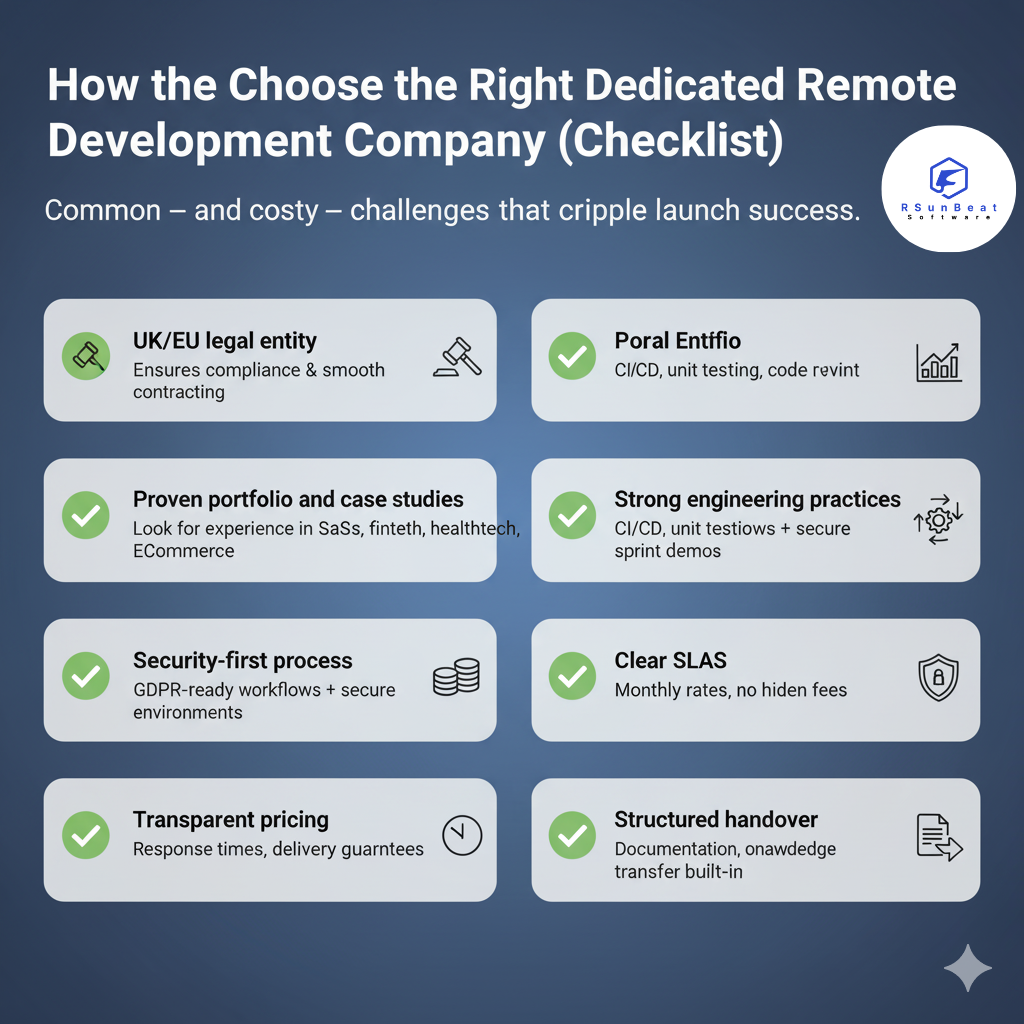
✔ UK/EU Legal Entity & Compliance Alignment
A legitimate UK/EU-registered company ensures:
Legally compliant contracts under UK/EU law
No tax, invoicing or cross-border payment complications
Faster dispute resolution and local jurisdiction protection
Clear GDPR accountability
Avoid companies without a legal footprint — it exposes you to risk, unclear liability, and compliance gaps.
✔ Proven Portfolio, Case Studies & Industry Expertise
You’re not just hiring coders; you’re hiring domain understanding.
Look for:
Live case studies in SaaS, fintech, healthtech, HR-tech, eCommerce, or marketplaces
Demonstrated experience taking products from MVP → v1 → scale
Success with UK startups specifically (indicates regulatory familiarity)
A credible partner will proactively show you:
Code samples
Architecture diagrams
Client testimonials
Before/after transformation stories
If they cannot show this, they are not ready for a high-stakes UK product launch.
✔ Strong Engineering Practices (Non-Negotiable)
High-performing teams follow strict engineering discipline:
CI/CD pipelines for regular deployments
Unit, integration & regression testing baked into sprints
Peer code reviews to ensure quality and avoid developer “blind spots”
Automated linting, security checks, and performance monitoring
These are essential for preventing launch failures — not “nice-to-have”.
✔ Security-First Development Process
In the UK, compliance matters as much as code.
Your partner must demonstrate:
GDPR-ready workflows
Encrypted communication and secure repo access
Role-based permissions
Secure cloud dev environments
Strict device policies for developers
Clear data-handling and retention rules
This protects your users, your IP, and your investors’ trust.
✔ Transparent, Predictable Pricing (No Surprises)
You must know exactly what you’re paying for:
Monthly/quarterly rates
Breakdown of developer roles (FE, BE, full-stack, QA, PM)
No surprise add-ons or inflated “feature-based” billing
Fixed sprint cycles with predictable velocity
This helps you plan budgets, pitch investors, and forecast runway without fear of hidden expenses.
✔ Clear SLAs for Delivery, Communication & Support
A reliable remote development company provides:
Defined response times
Escalation procedures
Delivery guarantees per sprint
Clear communication channels (Slack, Jira, Notion, ClickUp)
A dedicated project manager or delivery manager
SLAs protect your timeline — especially during critical launch windows.
✔ Structured Handover & Knowledge Transfer Process
Many startups suffer when developers leave — but a strong partner eliminates this risk.
Look for:
Full technical documentation
Architecture blueprints
API documentation
Onboarding materials
Source code ownership transfer
Internal knowledge-sharing sessions
Recorded demo walkthroughs
A company that invests in documentation ensures you never become dependent on a single developer again.

Frequently Asked Questions
1. Is a dedicated remote team more expensive than freelancers?
Not long-term. Freelancers seem cheaper but cause rebuilds, delays, and lack of quality. Dedicated teams deliver faster and prevent hidden costs.
2. How does a remote full-stack team improve delivery speed?
Because you get full capacity — engineering, QA, DevOps, PM — all working together.
3. What industries benefit the most?
Fintech, SaaS, healthtech, eCommerce, recruitment tech, and proptech.
4. Do dedicated development companies help with product planning?
Yes — wireframes, architecture, backlog shaping, sprint planning.
5. How do contracts differ from freelancer agreements?
Service-based, outcome-driven, IR35-safe, with clear SLAs.
6. Is this model IR35-friendly for UK startups?
Yes — dedicated teams operate outside IR35 with full service delivery responsibility.
The Smartest Hiring Decision UK Startups Can Make in 2025
Freelancers are ideal for small tasks, not for building high-stakes, investor-backed products.
Dedicated remote full-stack development companies UK offer:
predictable delivery
higher code quality
IR35-safe contracts
stable capacity
faster launch cycles
lower long-term cost
If you want to avoid delays, safeguard quality, and scale confidently, a dedicated remote development team is the most reliable path forward.