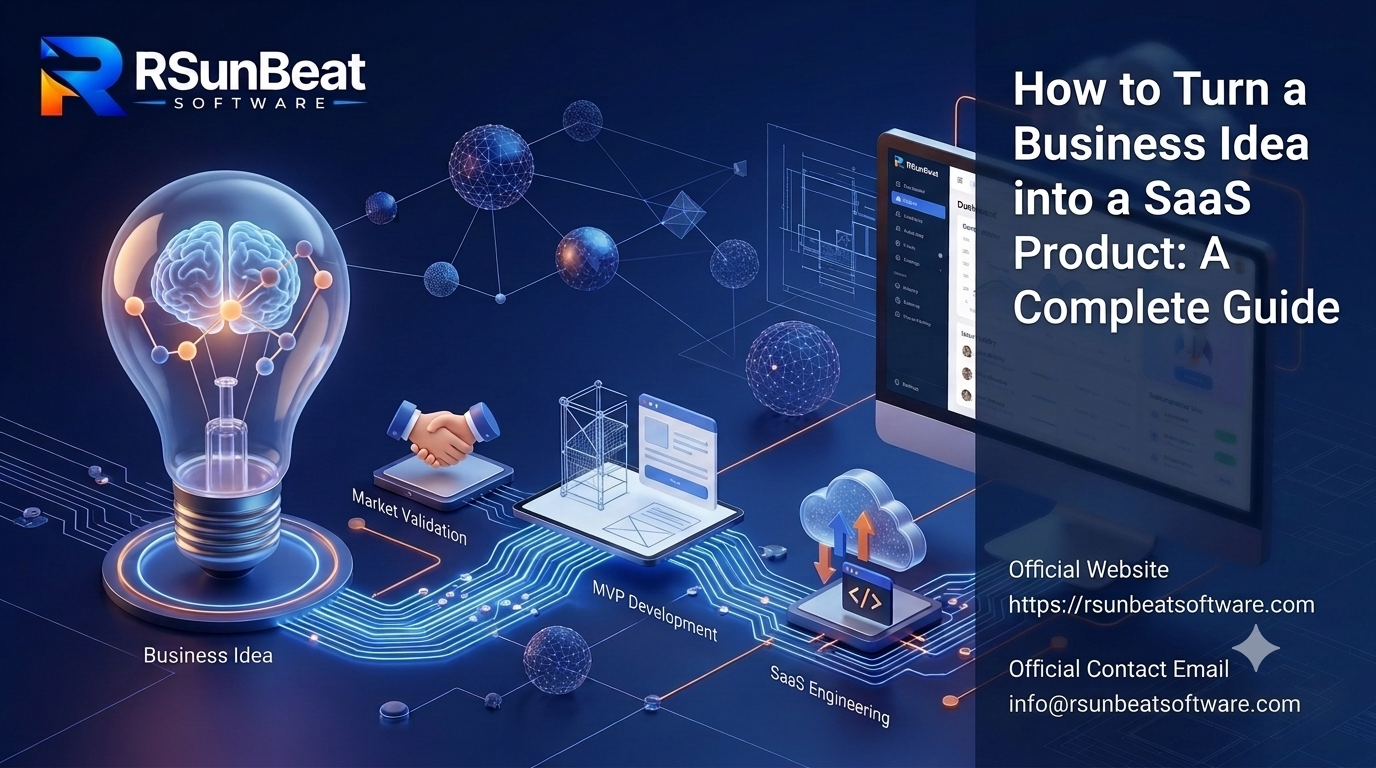
How to Turn a Business Idea into a SaaS Product: A Complete Guide
Every successful software product starts with an idea. However, turning that idea into a product that customers are willing to use and pay for requires much more than writing code.
You might have identified a problem businesses face every day, spotted an opportunity in your industry, or imagined a platform that could simplify an existing process. The next challenge is understanding how to transform that concept into a functional, scalable and commercially viable SaaS product.
This is where custom software and SaaS development become important.
Building a Software-as-a-Service (SaaS) product involves several stages, including market research, product validation, feature planning, UI/UX design, software development, testing, deployment and continuous improvement.
Whether you’re a startup founder, entrepreneur or established business owner in the UK, understanding this journey can help you make better decisions, control development risks and build a product that solves real customer problems.
In this guide, we’ll explain how to turn your business idea into a SaaS product, what to consider before development, how to approach MVP development, and how to prepare your product for long-term growth.
What Is a SaaS Product and Why Are Businesses Building Them?
Software-as-a-Service (SaaS) is a software delivery model in which users access applications over the internet, usually through a subscription or recurring payment arrangement.
Instead of installing and maintaining software individually on their computers or internal servers, customers typically access the product through a web browser or mobile application.
Examples include:
Project management platforms.
Customer relationship management (CRM) systems.
Accounting and financial management software.
HR and employee management platforms.
Appointment booking systems.
Marketing automation tools.
Inventory and business management applications.
SaaS products are attractive because they can provide businesses with ongoing access to software without requiring them to manage the entire underlying infrastructure.
Why Is SaaS an Attractive Business Opportunity?
A well-planned SaaS product can offer several business advantages:
1. Recurring Revenue Opportunities
Subscription-based pricing can create predictable recurring revenue when customers continue to find value in the product.
2. Wider Market Reach
Cloud-based applications can serve customers across different locations without requiring physical software distribution.
3. Continuous Product Improvement
Developers can release updates, introduce features and address issues without requiring every customer to install a completely new version.
4. Flexible Business Models
SaaS businesses can experiment with monthly subscriptions, annual plans, usage-based pricing, tiered packages or enterprise agreements.
5. Scalability
A well-designed cloud architecture can support increasing numbers of users and transactions as the business grows, although additional infrastructure and optimisation may be required.
However, SaaS is not automatically a profitable business model. Customer acquisition, retention, infrastructure costs, product reliability and ongoing support all influence long-term success.
Step 1: Identify a Real Business Problem Before Building Your SaaS Product
One of the biggest mistakes entrepreneurs make is starting software development before understanding whether customers actually need the product.
An interesting idea does not necessarily represent a viable business opportunity.
Before investing in development, identify a specific problem that people or businesses are experiencing.
For example:
Imagine you want to build a SaaS platform for small UK recruitment agencies.
Recruiters may currently use multiple spreadsheets, email conversations and disconnected tools to manage candidates, vacancies and client communication.
Your proposed platform could bring these activities together in one place.
But before building it, investigate:
How do recruitment agencies currently manage candidates?
Which parts of their existing workflow create difficulties?
What software are they already using?
What do they dislike about existing solutions?
Would they pay for a platform that solves these problems?
How to Validate Your Business Idea
Start with practical market research.
Interview potential customers who represent your intended audience.
Identify their most frequent operational problems.
Research existing competitors and their pricing.
Review customer feedback about competing products.
Create a simple product concept or prototype.
Ask potential customers to evaluate the proposed solution.
Find out whether they would genuinely pay for it.
Avoid relying only on feedback from friends and family. Speak with people who could realistically become your customers.
A useful question to ask is:
“If this product solved your current problem, would you consider paying for it, and what would make it worth the investment?”
The objective is to discover genuine demand before committing substantial resources.
Step 2: Define Your Target Audience and SaaS Business Model
Once you’ve identified a problem, determine exactly who your product will serve.
Trying to build software for everyone often results in an unclear product with too many features and no strong market positioning.
Start by defining your ideal customer profile.
Consider:
Industry or business sector.
Company size.
Location and target market.
Current software and tools.
Operational challenges.
Budget and purchasing behaviour.
Decision-makers involved in purchasing.
For example, a SaaS platform designed for independent accountants will have different requirements from one built for large financial institutions.
Choose the Right SaaS Revenue Model
Your pricing strategy should reflect how customers receive value from your product.
| Pricing Model | How It Works | Suitable For |
|---|---|---|
| Subscription-based | Customers pay monthly or annually | Most SaaS platforms |
| Tiered pricing | Different packages offer different features | Products serving different business sizes |
| Per-user pricing | Customers pay according to the number of users | Team collaboration software |
| Usage-based | Customers pay according to consumption | API platforms and infrastructure tools |
| Freemium | Basic access is free, with paid upgrades | Products benefiting from wider adoption |
You don’t need to finalise every pricing detail before development, but you should understand how the product could generate revenue.
Step 3: Define the Features and Scope of Your SaaS Product
After understanding the market and business model, translate your idea into a practical product specification.
This is where many projects become unnecessarily complicated.
Founders often imagine dozens of features before identifying the few functions customers actually need.
Instead of trying to build a complete platform immediately, identify the essential capabilities required to solve the primary problem.
Create an MVP Feature List
A Minimum Viable Product (MVP) is an initial version of your software containing enough functionality to deliver its core value and gather meaningful feedback from early users.
Consider a SaaS project management platform.
Its initial version might include:
| Feature | Purpose | Priority |
|---|---|---|
| User Registration | Allow customers to create accounts | Essential |
| Login and Authentication | Secure account access | Essential |
| Dashboard | Display important project information | Essential |
| Project Creation | Allow users to create projects | Essential |
| Task Management | Assign and track tasks | Essential |
| Team Management | Manage team members and permissions | Essential |
| Subscription Management | Manage paid access | Essential for a paid launch |
| Advanced Reporting | Provide detailed performance insights | Later phase |
| AI Recommendations | Offer intelligent suggestions | Later phase |
| Advanced Integrations | Connect additional business tools | Later phase |
The exact MVP scope will depend on your product and business model.
Why Should You Start with an MVP?
An MVP helps you:
Test the product with real customers.
Understand actual user behaviour.
Gather feedback before expanding functionality.
Avoid spending resources on unnecessary features.
Identify technical or usability problems early.
Make more informed product decisions.
An MVP should not mean poorly designed or insecure software. Its scope can be limited while its core functionality remains reliable and usable.
Step 4: Create the Product Architecture and Technical Roadmap
Once the product scope is clear, the next stage is technical planning.
A SaaS application needs more than a user interface. It requires a technical foundation that supports authentication, data storage, business logic, subscriptions, integrations, security and future expansion.
Key Components of a SaaS Architecture
1. Frontend Development
The frontend is the part of the application customers interact with.
It includes dashboards, forms, navigation, reports and other user-facing components.
2. Backend Development
The backend handles application logic, user permissions, data processing, business rules and communication between different components.
3. Database Architecture
The database stores user accounts, customer information, subscriptions, transactions and other application data.
For multi-tenant SaaS products, the architecture must carefully separate customer data and enforce access permissions.
4. Cloud Infrastructure
Cloud infrastructure supports application hosting, storage, deployment, monitoring and scaling.
5. API Integrations
APIs allow your SaaS platform to communicate with payment gateways, CRM systems, communication tools and other external services.
6. Authentication and Access Management
The platform should provide secure authentication and appropriate access controls for administrators, customers and team members.
Choosing the Right Technology Stack
Technology selection should depend on product requirements, expected workloads, development resources and long-term maintenance.
| Technology | Common Application |
|---|---|
| React.js | Interactive web interfaces |
| Next.js | Modern web applications |
| Node.js | Backend services and APIs |
| Python | Backend development and AI integration |
| MongoDB | Document-oriented data storage |
| PostgreSQL | Relational data management |
| AWS | Cloud infrastructure |
| Google Cloud | Cloud hosting and services |
| Docker | Application containerisation |
You don’t need to use every technology listed above.
The best technology stack is the one that supports your product requirements without introducing unnecessary complexity.
Step 5: Design an Intuitive and User-Friendly SaaS Experience
A technically powerful product can still fail if customers find it difficult to use.
UI/UX design plays a major role in how people understand, navigate and interact with your SaaS application.
Before development begins, create wireframes and prototypes that demonstrate the product’s structure and user journeys.
Important UI/UX Elements
Simple registration and onboarding.
Clear dashboard layouts.
Consistent navigation.
Responsive interfaces for different devices.
Accessible typography and visual elements.
Easy-to-understand forms and workflows.
Clear error messages and feedback.
Logical account and subscription settings.
Consider the experience of a first-time user.
Can they understand what the product does? Can they complete their first important task without assistance?
If the answer is no, the user experience may need further refinement.
For SaaS products, onboarding deserves particular attention because the first interaction can influence whether a customer continues using the platform.
Step 6: Develop the SaaS Product in Structured Phases
With the product requirements, technical architecture and designs established, development can begin.
A structured development process makes it easier to manage scope, identify issues and review progress.
A typical SaaS development workflow includes:
Phase 1: Project Planning
Finalise product requirements, development priorities, architecture and milestones.
Phase 2: UI/UX Design
Prepare wireframes, interactive prototypes and the final interface designs.
Phase 3: Frontend Development
Build the user-facing application and connect it with the required backend services.
Phase 4: Backend Development
Implement authentication, database operations, business logic, APIs and subscription functionality.
Phase 5: Third-Party Integrations
Integrate payment services, email systems, analytics tools and other required platforms.
Phase 6: Quality Assurance
Test the application across different devices, browsers and user scenarios.
Phase 7: Deployment
Configure hosting, production environments, monitoring and release procedures.
Phase 8: Post-Launch Improvements
Monitor usage, address issues and prioritise improvements based on customer feedback.
Development timelines vary according to product complexity, integrations, security requirements, team size and the amount of functionality included.
A focused MVP generally requires less development effort than a complete enterprise SaaS platform.
Step 7: Make Security, Privacy and Scalability Part of the Foundation
Security should never be treated as a final development task.
SaaS applications often process personal information, business records, payment-related information and confidential customer data.
A security issue can affect customer trust, business operations and regulatory responsibilities.
Important SaaS Security Considerations
Data Protection and Privacy
If your product processes personal data belonging to UK individuals, assess the applicable UK data protection requirements.
Consider data minimisation, privacy notices, retention policies, access controls and appropriate technical safeguards.
The Information Commissioner’s Office (ICO) emphasises data protection by design and by default throughout a product’s lifecycle.
Authentication and Authorisation
Use secure authentication methods and ensure users can only access the information and functions they are authorised to use.
Data Encryption
Evaluate encryption for data in transit and at rest according to the sensitivity and risks associated with the information.
API Security
Protect APIs through authentication, authorisation, input validation, rate limiting and appropriate monitoring.
Backup and Recovery
Establish backup procedures and test recovery processes so that important business information can be restored when necessary.
Scalable Infrastructure
Plan infrastructure around expected workloads and growth. Monitor performance and identify bottlenecks before they affect customers.
The UK GDPR and relevant data protection obligations should be considered from the planning stage. Technical development alone does not guarantee legal compliance.
Step 8: Test, Launch and Validate Your SaaS Product
Before releasing your product to the wider market, conduct structured testing.
A successful launch is not simply about making the application accessible online. It is about ensuring that customers can use its essential features reliably.
SaaS Testing Checklist
| Testing Area | What to Check |
|---|---|
| Functional Testing | Are all core features working correctly? |
| User Acceptance Testing | Can intended users complete important tasks? |
| Performance Testing | Does the application respond appropriately under expected workloads? |
| Security Testing | Are authentication, permissions and data protections working? |
| Compatibility Testing | Does the product work across supported browsers and devices? |
| Payment Testing | Are subscriptions, billing and payment flows functioning correctly? |
| Recovery Testing | Can the application recover from failures? |
Consider launching initially with a controlled group of early customers.
Observe how they use the platform, where they experience difficulties and which features provide the most value.
Their feedback can help you prioritise improvements before expanding the customer base.
Step 9: Improve, Maintain and Scale Your SaaS Product
Launching your SaaS product is the beginning of its lifecycle, not the end of development.
Customer expectations, market requirements and technologies continue to evolve.
After launch, establish a process for monitoring the product and planning improvements.
Important Post-Launch Activities
Monitor application performance and availability.
Track customer onboarding and engagement.
Analyse feature adoption.
Collect customer feedback.
Fix bugs and usability issues.
Release security updates.
Review infrastructure costs.
Improve subscription and billing workflows.
Introduce new features based on validated demand.
Useful product metrics may include:
| Metric | What It Measures |
|---|---|
| Monthly Recurring Revenue (MRR) | Recurring subscription revenue per month |
| Customer Acquisition Cost (CAC) | Cost of acquiring a customer |
| Customer Churn Rate | Percentage of customers lost over a period |
| Customer Lifetime Value (CLV) | Estimated value generated throughout a customer relationship |
| Activation Rate | Percentage of new users reaching a defined value milestone |
| Feature Adoption | How frequently customers use specific features |
These metrics help founders understand whether the product is delivering value and whether its business model is sustainable.
Scaling should be based on actual customer demand and operational requirements rather than assumptions about future growth.
How Much Does It Cost to Develop a SaaS Product in the UK?
SaaS development costs vary significantly depending on the product’s functionality, complexity, technology stack, integrations, security requirements and development team.
There is no single price that applies to every SaaS project.
For example, a basic booking platform with user accounts and appointment management will generally require a different level of investment from an enterprise SaaS platform with complex permissions, analytics, payment systems and multiple integrations.
Factors That Influence SaaS Development Costs
1. Product Complexity
The number of features, workflows and business rules directly influences development effort.
2. UI/UX Design Requirements
A product with multiple user roles, dashboards and complex interactions requires more design work.
3. Backend and Database Architecture
Multi-tenant systems, complex data relationships and advanced processing can increase technical complexity.
4. Third-Party Integrations
Payment gateways, CRM platforms, accounting tools and external APIs require integration and testing.
5. Security and Compliance Requirements
Products handling sensitive or regulated information may require additional security controls, assessments and specialist input.
6. Development Team Structure
The cost will also depend on the experience, location and composition of the development team.
How Can You Manage Your SaaS Development Budget?
A practical approach is to divide investment into manageable stages:
Product discovery and requirement analysis.
UI/UX design and prototyping.
MVP development.
Testing and initial deployment.
Customer feedback and product improvements.
Long-term maintenance and scaling.
This approach helps founders understand where resources are being spent and make decisions based on actual product progress.
If you’re planning a SaaS product, it is worth discussing your requirements with an experienced development team before committing to a fixed budget.
Common Mistakes to Avoid When Building a SaaS Product
Even promising software ideas can struggle when important product and business decisions are overlooked.
Here are some common mistakes worth avoiding.
Building Too Many Features Initially
Trying to launch with every possible feature increases complexity and delays the opportunity to gather customer feedback.
Ignoring Market Validation
Developing software without understanding customer demand can result in a technically functional product that nobody wants to purchase.
Choosing Technology Without a Clear Strategy
Selecting technologies simply because they are popular may introduce unnecessary development and maintenance challenges.
Underestimating Security Requirements
Adding security controls after development can create additional costs and architectural changes.
Ignoring User Experience
Customers expect software to be intuitive. A confusing interface can reduce engagement even when the product offers useful functionality.
Treating Launch as the Final Stage
SaaS products require continuous maintenance, monitoring, customer support and improvements.
Not Planning for Customer Acquisition
A functional SaaS platform still needs a clear strategy for reaching its target audience, communicating its value and converting potential customers.
Should You Build Your SaaS Product In-House or Work with a Development Partner?
This is an important decision for founders and businesses that do not have an established engineering team.
Both approaches have advantages and limitations.
| Factor | In-House Development | External Development Partner |
|---|---|---|
| Team Control | Direct day-to-day management | Managed through agreed processes |
| Recruitment | Requires hiring and onboarding | Access to an existing development team |
| Initial Setup | Requires building internal resources | Can begin with an agreed project scope |
| Technical Knowledge | Developed internally | Access to external expertise |
| Long-Term Maintenance | Managed by internal employees | Can be arranged through a support agreement |
| Flexibility | Depends on internal capacity | Team structure can be adjusted by agreement |
An in-house team may be suitable when software development is a core, long-term internal capability.
An external development partner may be useful when a business needs specialised expertise, wants to develop an MVP or needs additional engineering capacity without building an entire internal department immediately.
The right choice depends on your budget, timeline, product complexity and long-term business objectives.
How RSunBeat Software Can Help Turn Your SaaS Idea into a Product
Turning a business concept into a working SaaS product requires a combination of product understanding, technical planning, design and software engineering.
At RSunBeat Software, we work across custom software development, SaaS solutions, web applications, mobile applications and UI/UX design.
Our development approach can support businesses at different stages of their product journey.
Depending on your requirements, the development process may include:
Product requirement analysis and technical consultation.
SaaS architecture and development planning.
UI/UX design and interactive prototyping.
Frontend and backend development.
Database design and API integration.
Payment and subscription functionality.
Quality assurance and testing.
Deployment and ongoing development support.
Whether you’re exploring an early-stage startup idea or planning to modernise an existing business application, the first step is understanding what you want to build and who it will serve.
Planning to build a SaaS product?
Discuss your idea, technical requirements and development objectives with the RSunBeat Software team.
Explore our [software development services] and discover how a structured development approach can help move your idea towards a practical digital product.
Final Thoughts: A Great SaaS Product Starts with the Right Decisions
Turning a business idea into a successful SaaS product is a journey that involves much more than development.
It begins with identifying a genuine customer problem, validating market demand and defining a clear product vision.
From there, the right MVP scope, technical architecture, user experience, security practices and development strategy help establish a strong foundation.
Most importantly, remember that your first version does not need to do everything. It needs to solve an important problem effectively and provide a reason for customers to keep using it.
Build with a clear purpose, listen to your customers, measure product performance and improve continuously.
If you have a SaaS idea and want to understand how to bring it to life, RSunBeat Software can help you explore the technical possibilities and plan your next steps.
Have a SaaS product idea? Let’s discuss how to turn your concept into a scalable digital solution.
Website: https://rsunbeatsoftware.com/
Email: info@rsunbeatsoftware.com
Frequently Asked Questions (FAQs)
1. How do I turn a business idea into a SaaS product?
Start by identifying a real customer problem and validating market demand. Define your target audience, choose a suitable business model, plan the essential MVP features, design the application, develop and test it, and launch it with an initial group of customers.
2. How much does it cost to develop a SaaS product?
SaaS development costs depend on product complexity, functionality, design requirements, integrations, security and team structure. A focused MVP generally requires less investment than a full-featured enterprise platform. A detailed project assessment is the best way to establish a realistic budget.
3. What is an MVP in SaaS development?
An MVP, or Minimum Viable Product, is an initial version of a SaaS application that includes the essential features needed to solve a specific customer problem. It allows businesses to test their product with real users and gather feedback before investing in additional functionality.
4. How long does it take to build a SaaS product?
The development timeline depends on the product’s complexity, feature requirements, integrations, design and testing. A focused MVP can be developed more quickly than a complex multi-tenant enterprise platform. A realistic timeline should be established after reviewing the requirements.
5. Which technologies are used for SaaS application development?
Common technologies include React.js, Next.js, Node.js, Python, PostgreSQL, MongoDB, AWS and Google Cloud. The right combination depends on the product architecture, performance requirements, integrations and development team’s expertise.
6. Is custom software development better than using ready-made SaaS tools?
It depends on your requirements. Ready-made SaaS tools can be suitable when their existing features meet your needs. Custom software may be more appropriate when you require specialised workflows, greater control over functionality, specific integrations or a product that you intend to commercialise.
7. How do I choose the right SaaS development company?
Evaluate the company’s technical expertise, product development approach, communication, project management, security practices, maintenance capabilities and experience with similar requirements. Ask for a clear scope, development milestones, deliverables and a transparent cost estimate before starting.
Testimonials ~
What Our Clients
Are Saying
Your trust drives our passion. Here’s how we’ve helped businesses like yours thrive with tailored solutions and unmatched support.

Hussein Termos
CEO
“RSunBeat Software is a top-tier web development company for the real estate industry. They delivered a user-friendly, customized platform that met our needs perfectly. Their innovative solutions, on-time delivery, and excellent support made the process seamless. Highly recommended for exceptional development services!”

James Carten
Founder & CEO
“Before working with RSunBeat Software, our real estate business faced issues with unreliable mobile apps, poor user experiences, and missed deadlines. RSunBeat delivered a seamless, high-performing app with excellent functionality, intuitive design, and timely execution, transforming our operations. Their expertise and dedication make them a trusted partner.”

Darla Shewmaker
VP of Marketing
“RSunBeat Software developed a great, user-friendly mobile app that exceeded our expectations. The team was extremely professional, kept us updated throughout the process and completed the work on time. Their expertise and dedication made the whole project seamless. We highly recommend RSunBeat for their great work and reliability!”

Nicholas Toh
Project Manager
“RSunBeat Software delivered an amazing web and app development experience. Their team was highly professional, detail-oriented, and dedicated to bringing our vision to life. The final product was seamless, user-friendly, and exceeded our expectations. We highly recommend them for top-notch development services!”
Our Technology Experts
Are Change Catalysts
Mail to Our Sales Department
info@rsunbeatsoftware.com
Our Skype Id
Rsunbeat Software