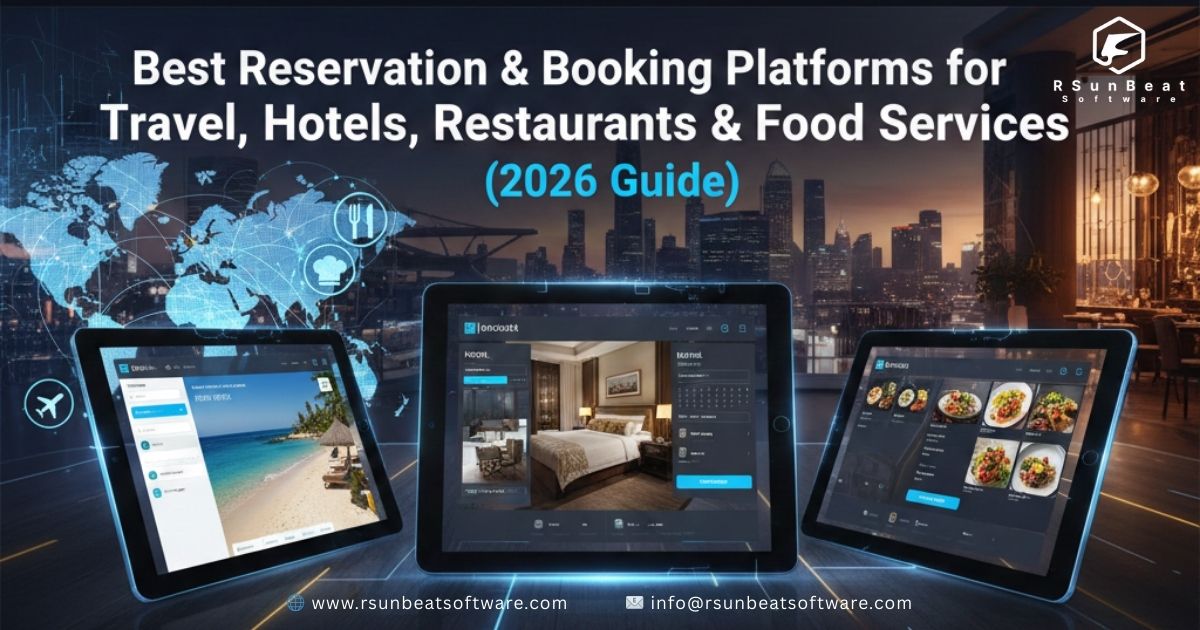
Reservation and booking platforms are no longer simple tools for accepting appointments or table reservations. In 2026, they function as core operational systems that directly impact revenue forecasting, customer experience, staffing efficiency, and long-term scalability across travel, hospitality, restaurants, and food services.
Businesses that still rely on fragmented tools, manual confirmations, or generic booking software often struggle with overbooking, revenue leakage, poor customer retention, and limited visibility into demand patterns. In contrast, organizations using modern reservation and booking platforms gain real-time control, automation, and data-driven decision-making that scales with growth.
This guide is built for founders, operators, CTOs, and decision-makers actively searching for the best reservation and booking platforms, while also evaluating whether custom or enterprise-grade booking systems make more strategic sense than off-the-shelf SaaS tools.
What Is Reservation & Booking Platforms?
Reservation and booking platforms are digital systems that allow customers to discover availability, reserve services, make payments, and receive confirmations across web and mobile channels. From a business standpoint, these platforms manage inventory, schedules, pricing rules, customer data, and operational workflows in real time.
What makes modern booking platforms fundamentally different from earlier tools is their expanded role. They are no longer isolated scheduling widgets; they act as a central orchestration layer connecting multiple systems such as:
Websites and mobile applications
Payment gateways and POS systems
CRM and marketing automation tools
Inventory, staffing, and operations software
This evolution has been driven by omnichannel customer behavior, real-time availability expectations, and the growing need for automation in multi-location and multi-brand operations across travel, hospitality, and food-tech industries.
Why Booking Platforms Are Critical for Travel, Hospitality & Food Businesses in 2026
In 2026, the role of booking platforms has evolved far beyond basic reservation management, becoming a core business system that directly impacts revenue predictability, operational efficiency, and customer retention across travel, hospitality, and food-service businesses. As customer expectations continue to be shaped by real-time digital experiences from global platforms, users now demand instant confirmations, live availability visibility, flexible rescheduling options, transparent pricing, and frictionless payment flows—whether they are booking a hotel stay, reserving a restaurant table, scheduling a guided tour, or selecting a time-bound food pickup or delivery slot.
From a business outcomes and scalability standpoint, modern booking platforms deliver measurable value across multiple layers of the organization:
Automation at scale, where bookings, cancellations, modifications, confirmations, reminders, and inventory updates are handled in real time without manual intervention, significantly reducing human error, administrative overhead, and staff dependency—particularly during peak seasons, high-demand events, or rapid business expansion.
Revenue optimization and demand control, enabling businesses to maximize capacity utilization through dynamic availability management, peak-time pricing strategies, automated waitlists, deposit-based reservations, and no-show reduction mechanisms, all of which directly improve revenue per seat, room, or time slot without increasing marketing spend.
A consistent and trusted customer experience across all touchpoints, ensuring that availability, pricing, and booking logic remain synchronized across websites, mobile apps, Google listings, third-party integrations, and in-store systems, which plays a critical role in repeat bookings, online reviews, and long-term brand credibility.
Operational scalability for multi-location and multi-service businesses, allowing hospitality groups, hotel chains, travel operators, and food brands to manage centralized control while maintaining location-level flexibility, making it possible to grow without introducing operational complexity or fragmented booking workflows.
In travel, hospitality, and food-tech industries—where margins are often sensitive to occupancy rates, table turnover, and time-based utilization—even marginal improvements in booking efficiency, availability accuracy, or no-show reduction can compound into substantial annual revenue gains. This is why booking platforms in 2026 are no longer viewed as backend support systems, but as strategic growth enablers that influence profitability, customer loyalty, and long-term business resilience.
Core Features Every Modern Reservation & Booking Platform Must Have
When buyers compare reservation management systems in 2026, they are not just evaluating features—they are evaluating how well the platform supports long-term growth, efficiency, and profitability.
Key features modern platforms must include:
Real-time availability management to prevent overbooking, reduce cancellations, and build customer trust
Secure online payments and deposits, supporting advance payments, refunds, and no-show protection
CRM integration to centralize customer profiles, booking history, preferences, and loyalty data
POS and operational integrations that connect bookings directly to service execution and billing
Multi-location and multi-service support for centralized control across branches, kitchens, or brands
Analytics and reporting dashboards that track booking sources, conversion rates, peak demand, and revenue trends
Each of these features contributes directly to ROI, either by increasing revenue, reducing operational cost, or improving customer lifetime value.
Reservation & Booking Platforms by Industry Use Case
Travel & Tour Operators
Reservation and booking platforms for travel and tour operators must support far more than basic scheduling, as these businesses operate in highly variable environments where demand, group size, seasonality, and experience customization directly affect revenue and logistics.
Complex booking logic and group management, allowing operators to handle group reservations, multi-day itineraries, variable passenger counts, and bundled experiences while maintaining accurate availability and pricing in real time.
Seasonal and demand-based pricing control, enabling operators to define blackout dates, peak-season rates, promotional periods, and last-minute availability adjustments without manual intervention or system workarounds.
Add-ons, upgrades, and experience customization, such as equipment rentals, premium seating, guided services, or insurance options, which increase average order value and must be seamlessly integrated into the booking flow.
Automated multi-channel communication, ensuring confirmations, reminders, itinerary updates, and policy disclosures are delivered consistently across email, SMS, and in-app notifications, reducing customer support dependency and operational friction.
Platforms that lack flexibility in these areas often become growth constraints, limiting a tour operator’s ability to scale inventory, expand destinations, or onboard new partners efficiently.
Hotels & Resorts
Hotel and resort booking platforms function as revenue management infrastructure, directly influencing occupancy rates, pricing strategy, and distribution efficiency across multiple sales channels.
Real-time room inventory and availability management, ensuring accurate synchronization across direct booking engines, OTAs, corporate travel portals, and channel managers to prevent overbookings and revenue leakage.
Advanced pricing and rate plan control, supporting dynamic pricing, minimum stay rules, seasonal packages, promotional offers, and corporate or loyalty-based pricing structures.
Deep integrations with PMS and operational systems, enabling seamless data flow between reservations, housekeeping, front-desk operations, billing, and guest services for a unified operational view.
Performance, reliability, and security compliance, as booking downtime, slow load times, or payment vulnerabilities directly impact RevPAR, brand trust, and regulatory adherence in high-volume environments.
For multi-property hotels and resorts, the booking platform must scale across locations while maintaining centralized visibility and control.
Restaurants & Cafés
Restaurant and café reservation platforms are designed to optimize real-time floor operations, where speed, simplicity, and accuracy directly affect guest satisfaction and daily revenue.
Dynamic table and seating management, allowing staff to allocate tables efficiently based on party size, dining duration, and real-time availability during peak service hours.
Waitlist and peak-hour optimization, helping operators manage walk-ins alongside reservations while minimizing idle tables and reducing guest frustration.
No-show reduction and guest accountability, through automated reminders, deposits, or cancellation policies that protect revenue during high-demand time slots.
POS and guest data integration, enabling operators to track visit history, preferences, and spending patterns while keeping front-of-house workflows fast and intuitive.
In high-volume dining environments, ease of use and operational speed often outweigh deep customization, as efficiency and reliability drive consistent service quality.
Food Ordering & Cloud Kitchens
For cloud kitchens and modern food-service businesses, booking and reservation platforms are tightly coupled with order management, kitchen operations, and logistics execution.
Pre-ordering and scheduled pickup or delivery support, allowing customers to select precise time windows while giving kitchens predictable demand and preparation timelines.
Kitchen capacity and workload management, ensuring order volumes are aligned with preparation capabilities to prevent delays, quality issues, or staff overload during peak periods.
Delivery and logistics coordination, integrating with third-party delivery partners or in-house fleets to maintain accurate fulfillment tracking and customer communication.
Operational analytics and demand forecasting, providing insights into order patterns, peak hours, menu performance, and staffing needs to optimize margins and reduce waste.
In cloud kitchen models, the booking platform is not a supporting tool—it is the operational backbone that connects demand, production, and fulfilment at scale.
Top Reservation & Booking Platforms Powering Travel, Hospitality & Food Industries
There is no universally “best” reservation or booking platform that fits every business model, as the market is fundamentally segmented by industry requirements, transaction volume, operational complexity, and the level of control businesses need over pricing, availability, and customer experience. In practice, successful platforms tend to specialize by use case, positioning their feature sets, integrations, and workflows around the specific operational realities of each vertical rather than attempting to serve all industries equally.
Across the market, leading booking platforms typically fall into the following categories:
Platforms best suited for travel and tour operators, designed to support complex scheduling logic, group and multi-passenger bookings, seasonal and demand-based pricing, blackout dates, bundled add-ons, upgrades, and automated customer communication, making them ideal for operators managing multiple experiences, destinations, or partner inventories without sacrificing scalability or operational clarity.
Platforms optimized for hotels and resorts, offering deep integrations with property management systems (PMS), channel managers, payment gateways, and third-party distribution networks, while providing advanced inventory control, rate plan management, and availability synchronization that directly influence occupancy rates, average daily rates, and overall revenue performance.
Platforms tailored for restaurants and cafés, focused on fast and intuitive table management, real-time availability updates, waitlist handling, guest profile tracking, no-show prevention mechanisms, and seamless POS integration, where speed, reliability, and front-of-house usability are more critical than highly customized workflows.
Platforms built for food services and cloud kitchens, combining reservation logic with ordering, pickup scheduling, delivery coordination, and kitchen capacity management, allowing operators to align customer demand with production workflows while using data-driven insights to forecast volume, reduce waste, and improve fulfillment efficiency.
Despite these differences in specialization, high-performing booking platforms across all categories consistently share several foundational characteristics that determine long-term success:
Reliability and performance at scale, ensuring consistent uptime, fast response times, and accurate availability even during peak demand periods, seasonal spikes, or high-concurrency booking scenarios.
Strong integration capabilities, allowing businesses to connect booking data seamlessly with payment systems, CRM tools, analytics platforms, marketing automation, POS systems, PMS solutions, and third-party marketplaces without data silos or manual reconciliation.
Adaptability as business models evolve, enabling companies to introduce new services, pricing strategies, locations, or fulfillment methods without needing to replace their core booking infrastructure.
In increasingly competitive travel, hospitality, and food-tech markets, the most successful businesses are not those that choose the most feature-heavy platform, but those that select a booking system aligned with their industry-specific workflows today while remaining flexible enough to support future growth and operational change.
Custom vs Ready-Made Booking Platforms: What Should Businesses Choose?
The decision between a custom-built booking platform and a ready-made SaaS solution represents one of the highest-intent and most commercially valuable evaluation moments in the booking software market, as it directly affects long-term operational control, scalability, data ownership, and total cost of ownership across travel, hospitality, and food-tech businesses. While both approaches can successfully support bookings, they serve fundamentally different business trajectories and risk profiles.
Ready-Made (SaaS) Booking Platforms
Ready-made SaaS booking platforms are generally designed for speed of adoption and standardized workflows, making them an attractive option for businesses that prioritize fast deployment and predictable monthly costs over deep customization.
Faster implementation with lower upfront investment, allowing small to mid-sized businesses to go live quickly using preconfigured booking flows, templates, and integrations without the need for extended development cycles or internal technical resources.
Standardized features and workflows, which work well for common use cases such as basic hotel reservations, table bookings, or simple tour scheduling, but can become restrictive when businesses require complex pricing logic, custom availability rules, or non-standard customer journeys.
Vendor-managed infrastructure and updates, reducing the operational burden of maintenance, security patches, and hosting, while also limiting control over release cycles, roadmap priorities, and feature changes that may not align with specific business needs.
Constraints around data ownership and scalability, as booking data, customer insights, and system logic are often locked within the platform, making it harder to integrate deeply with proprietary systems, migrate at scale, or optimize performance as transaction volume and business complexity increase.
For many growing businesses, SaaS platforms solve immediate problems effectively but can introduce hidden costs and operational friction once customization, integrations, or multi-location expansion become critical.
Custom Reservation System Development
Custom booking platform development is typically chosen by enterprise brands, high-volume operators, and businesses with differentiated service models that cannot be efficiently supported by standardized SaaS tools.
Full ownership and architectural control, enabling businesses to design booking logic, pricing models, availability rules, and customer experiences that align precisely with their operational workflows and competitive positioning.
Tailored functionality and deeper integrations, allowing seamless connection with internal systems such as PMS, POS, ERP, CRM, loyalty programs, marketing automation, and analytics platforms without relying on third-party plugins or API limitations.
Scalability designed around future growth, where the platform can evolve alongside new locations, services, markets, and fulfillment models without forcing costly workarounds or platform migrations.
Stronger long-term ROI despite higher upfront costs, as businesses avoid recurring per-booking fees, gain access to richer operational data, and reduce dependency on external vendors for mission-critical functionality.
While custom development requires greater initial investment and strategic planning, it offers a level of flexibility and resilience that becomes increasingly valuable as transaction volume, brand complexity, and customer expectations grow.
Cost of Building or Using a Reservation & Booking Platform
Cost is one of the most searched, debated, and frequently misunderstood aspects of reservation and booking platforms, largely because pricing varies dramatically based on business model, transaction volume, industry requirements, and long-term growth plans. For many travel, hospitality, and food-tech businesses, the real financial impact of a booking platform is not determined by the initial price tag alone, but by how costs scale over time as bookings, locations, and operational complexity increase.
SaaS Booking Platform Pricing
SaaS-based booking platforms are typically marketed as cost-effective and easy to adopt, but their pricing structures often include multiple layers that businesses must understand before committing.
Monthly subscription fees, which commonly range from $30 to $500+ per month, depending on feature tiers, booking limits, number of users, and access to premium functionality such as advanced analytics, automated messaging, or integrations.
Per-booking fees or commission-based pricing, where platforms charge a fixed fee or percentage for each confirmed reservation, order, or transaction, causing costs to rise directly with booking volume and seasonal demand.
Additional charges for scale and customization, including higher costs for multi-location management, white-label branding, custom workflows, API access, or priority support, which are often required as businesses grow beyond basic use cases.
Indirect long-term costs, such as vendor lock-in, data access limitations, and the need to upgrade plans or add third-party tools to compensate for platform constraints, which can significantly increase total cost of ownership over time.
While SaaS platforms offer predictable entry-level pricing, they can become increasingly expensive for high-volume operators once transaction fees and scaling requirements are factored in.
Custom Booking Platform Development Cost
Custom reservation and booking platform development involves higher upfront investment, but offers a fundamentally different cost structure that favors long-term control and scalability.
Basic custom booking systems, typically ranging from $20,000 to $30,000, covering core booking flows, availability management, payment integration, and basic admin controls for businesses with relatively straightforward requirements.
Advanced or enterprise-grade booking platforms, often priced between $80,000 and $150,000+, designed to support complex pricing logic, multi-location operations, high concurrency traffic, advanced analytics, role-based access control, and deep integrations with PMS, POS, ERP, CRM, and third-party services.
Key cost drivers, including feature complexity, number and depth of integrations, performance and scalability requirements, security standards, compliance needs (such as PCI-DSS or data protection regulations), and ongoing maintenance or enhancement plans.
Lower long-term marginal costs, as businesses avoid recurring per-booking fees, gain full ownership of their data and infrastructure, and can scale transaction volume without proportional increases in platform expenses.
Although custom development requires careful planning and a higher initial budget, it often delivers stronger long-term ROI for businesses operating at scale or pursuing differentiated service models.
How to Choose the Right Reservation & Booking Platform for Your Business
Choosing the right reservation and booking platform is less about comparing feature lists and more about applying a strategic evaluation framework that aligns technology decisions with long-term business direction, operational complexity, and revenue goals. In travel, hospitality, and food-tech environments—where booking systems often become deeply embedded into daily operations—the wrong platform can quietly limit growth, while the right one becomes a compounding advantage over time.
When evaluating booking platforms, businesses should focus on the following critical dimensions:
Scalability aligned with growth strategy, assessing whether the platform can support increased booking volume, additional locations, expanded service offerings, seasonal demand spikes, and international expansion without performance degradation, architectural limitations, or disproportionately rising costs.
Depth and flexibility of integrations, examining how seamlessly the platform connects with existing systems such as PMS, POS, CRM, payment gateways, analytics tools, marketing automation platforms, and third-party marketplaces, and whether integrations are native, API-driven, or dependent on fragile workarounds.
Data ownership and control over workflows, understanding who owns customer data, booking logic, pricing rules, and operational workflows, and whether the business can access, export, and evolve this data independently without vendor restrictions or long-term lock-in.
Adaptability to evolving business models, evaluating how easily the platform can accommodate new revenue streams, dynamic pricing strategies, loyalty programs, bundled services, multi-brand operations, or hybrid fulfillment models such as dine-in, pickup, delivery, and experiences.
Operational usability and stakeholder adoption, ensuring that front-line staff, managers, and administrators can use the system efficiently under real-world conditions without excessive training or operational friction that slows service or increases error rates.
Reliability, security, and compliance readiness, particularly for businesses processing high transaction volumes, handling sensitive customer data, or operating across regions with strict data protection and payment security requirements.
Ultimately, the right booking platform should function as an enabler of future growth rather than a constraint shaped by early-stage assumptions. Businesses that choose platforms based on where they intend to go—rather than where they started—are far better positioned to scale efficiently, adapt to market shifts, and maintain control over both customer experience and operational performance.
Conclusion
In 2026, reservation and booking platforms are no longer optional operational tools—they are growth infrastructure. The right platform improves utilization, enhances customer experience, and provides the data needed to make smarter business decisions, while the wrong one becomes a bottleneck that limits scalability.
Whether adopting a SaaS solution or investing in a custom reservation system, long-term success depends on aligning technology with business strategy rather than short-term convenience.
“If your booking operations are becoming harder to manage as you grow, reassessing your reservation platform can reveal opportunities for efficiency and revenue optimization.”
“For businesses outgrowing standard booking software, exploring a custom or enterprise-grade reservation system often unlocks better control, integrations, and long-term ROI.”