The US healthcare ecosystem is undergoing massive digital transformation, driven by the urgent need for automation, accessibility, interoperability, remote care, and secure patient data exchange. As we enter 2025, custom mobile healthcare applications are at the core of this transformation—helping hospitals, clinics, insurers, labs, and health-tech companies deliver smarter, faster, and more personalized care.
This comprehensive guide covers the best custom mobile app development solutions that US healthcare organizations are investing in this year.
1. USA Healthcare Digital Landscape in 2025
The rapid growth of digital health in the US is influenced by:
1.1 Shift Toward Mobile-First Healthcare
Patients prefer accessing care via smartphones
Providers aim for real-time monitoring & telehealth
Insurance & billing now digital-first
1.2 Greater Focus on Remote & Virtual Care
Post-pandemic adoption continues
Chronic disease management shifting to mobile
Hospitals reducing physical overload through RPM
1.3 Government Incentives & Regulatory Changes
CMS pushing digital coverage
HIPAA tech updates
Telehealth reimbursements increasing
1.4 AI Adoption in Clinical Workflows
AI for diagnostics
AI for medical images
AI for care recommendations
Generative AI for documentation
2. Challenges Faced by US Healthcare Companies
Healthcare organizations face problems that custom-built mobile apps can uniquely solve:
2.1 Strict Regulatory Requirements
HIPAA
HITECH
FDA medical device rules
State-level privacy laws
2.2 Interoperability Limitations
Different EMR/EHR systems
Old legacy hospital infrastructure
Lack of unified patient records
2.3 Cybersecurity Vulnerabilities
High risk of ransomware attacks
PHI protection requirements
Need for encrypted communication
2.4 Operational inefficiencies
Manual paperwork
Staff scheduling gaps
Billing complexity
Patient engagement issues
2.5 Patient Experience Gaps
Inconsistent communication
Delayed updates
Poor appointment workflows
3. Why Custom Healthcare Mobile Apps Are Essential in 2025
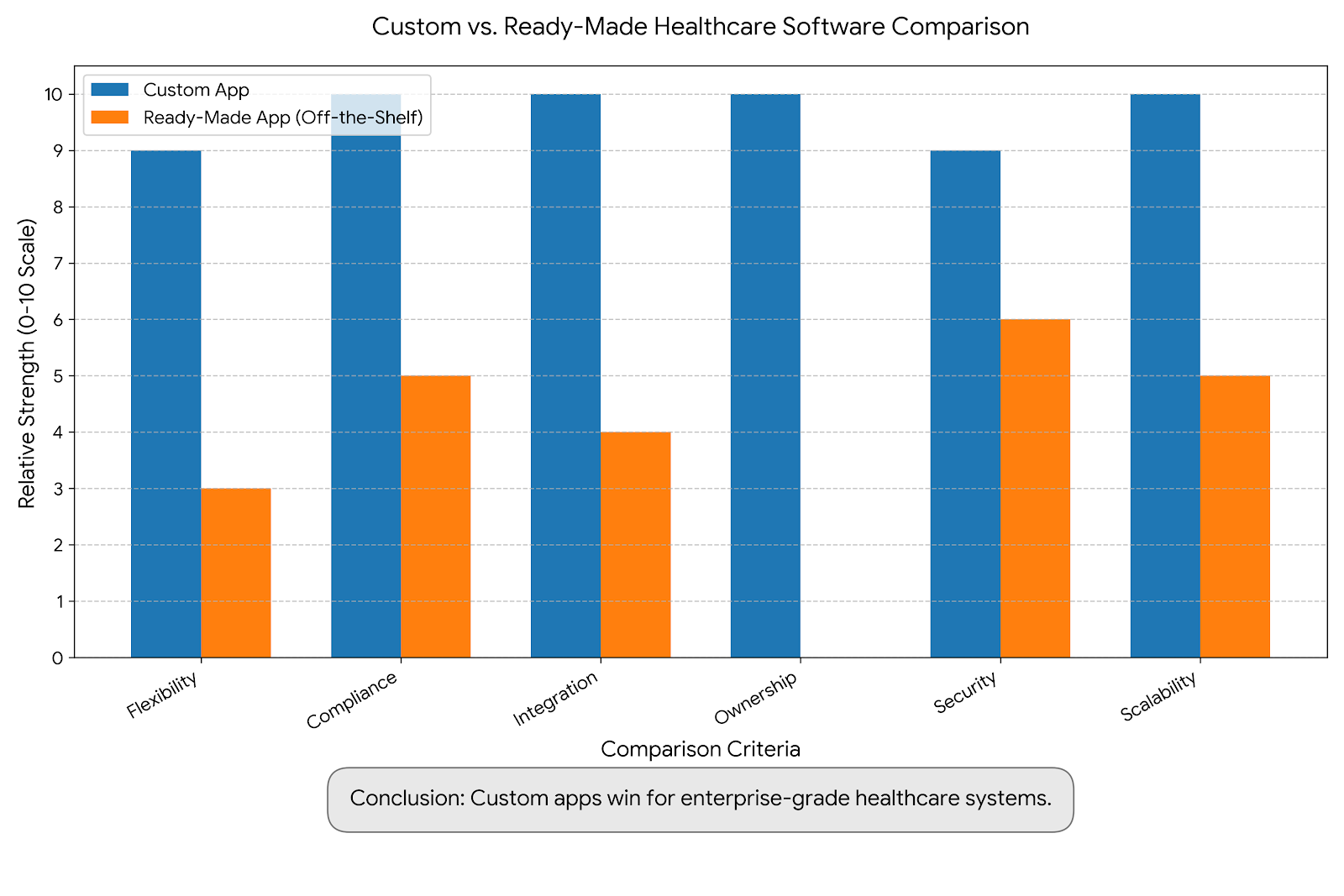
As the US healthcare industry rapidly modernizes, custom healthcare mobile app development becomes crucial for delivering secure, scalable, and patient-centric digital experiences. Compared to generic off-the-shelf solutions, custom-built healthcare apps empower hospitals, clinics, insurers, and telehealth providers with tailored features that match their exact workflows, compliance requirements, and long-term growth strategies. 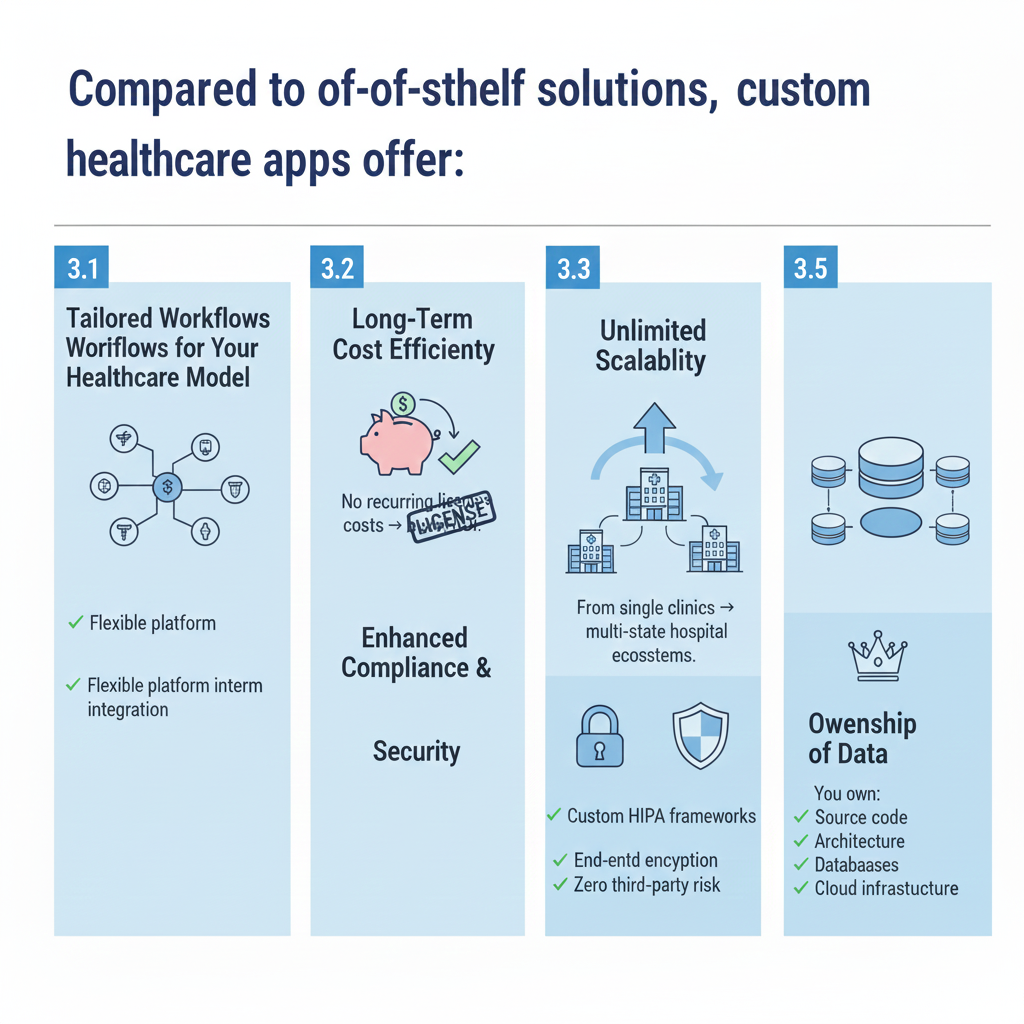
3.1 Tailored Workflows for Your Healthcare Model
Custom healthcare applications are built from the ground up to match your organization’s clinical, operational, and administrative workflows.
Key Advantages:
Custom patient journeys designed for your treatment model (primary care, urgent care, specialty care, etc.)
Department-specific modules such as:
Cardiology app modules
Oncology treatment tracking
Pediatrics digital care workflows
Orthopedic appointment mapping
Mental health therapy tools
Personalized EHR/EMR integrations with systems like Epic, Cerner, AthenaHealth, and Allscripts
Flexible platform integration with billing systems, pharmacy services, diagnostic labs, wearable devices, and telehealth APIs
AI-powered clinical workflows fine-tuned to your protocols
Custom dashboards for doctors, nurses, administrators, and patients
Role-based access control matching your staff hierarchy
Why it matters:
Tailored healthcare apps reduce manual work, eliminate workflow gaps, and provide a seamless digital care environment.
3.2 Long-Term Cost Efficiency
Custom healthcare apps offer greater financial benefits compared to high-fee subscription solutions.
Cost-saving benefits:
No recurring license fees, saving thousands of dollars annually
No dependency on third-party vendors, avoiding unexpected price hikes
Custom features only, meaning no paying for unnecessary functionalities
Lower cost per user as your staff or patient base grows
Better ROI for long-term operations, especially for hospitals and multi-location healthcare groups
Full control over scaling, preventing expensive SaaS upgrade tiers
Why it matters:
In 2025, healthcare companies need solutions that reduce costs while improving patient care—custom apps achieve both.
3.3 Unlimited Scalability
Custom healthcare applications are engineered for enterprise scalability, ensuring that the app grows alongside your organization.
Scalability advantages:
Supports single clinics, large hospitals, and multi-state healthcare networks
Flexible architecture to add more:
Providers
Patients
Locations
Specialties
Devices
Ability to integrate new modules such as:
Telemedicine
Remote Patient Monitoring (RPM)
AI symptom checkers
Pharmacy delivery
Insurance automation
Cloud-native infrastructure using AWS, Azure, or Google Cloud
High performance even with millions of users or large EMR datasets
Why it matters:
A scalable healthcare app prevents future redevelopment costs and keeps your system future-ready.
3.4 Enhanced Compliance & Security
Healthcare apps must protect PHI/PII and follow US regulations. Custom HIPAA-compliant mobile apps ensure your data is always secure.
Security & compliance benefits:
Custom-built HIPAA security frameworks
End-to-end data encryption (AES-256, TLS 1.3)
Zero third-party risk, since you control all integrations and data flows
Secure cloud hosting with HIPAA-compliant servers
Role-based access control (RBAC) for staff
Audit logs & monitoring for compliance checks
Secure authentication (MFA, biometrics, OAuth 2.0)
Continuous security updates and threat detection
Why it matters:
Off-the-shelf apps often lack deep security customization, while custom healthcare apps meet your exact compliance needs.
3.5 Full Ownership of Data & Technology
One of the biggest advantages of custom healthcare software development is 100% ownership over your digital ecosystem.
You own everything:
Source code
Backend architecture
Databases & PHI storage
Cloud infrastructure
Integrations & APIs
UI/UX design assets
Benefits of ownership:
Full control over future upgrades
No vendor lock-in
No data sharing with third parties
Easier compliance audits
Long-term asset value for your healthcare organization
Why it matters:
In 2025, owning your healthcare data and architecture is essential for security, independence, and future innovation.
4. Must-Have Features of a Modern Healthcare App in 2025
Each of these features enhances usability, patient safety, and hospital efficiency.
4.1 Secure User Authentication
Biometric login (Face ID, Touch ID)
Multi-factor authentication
HIPAA-compliant session management
4.2 End-to-End Encryption
AES-256 encryption
Secure API gateways
Encrypted databases
4.3 AI-Driven Tools
AI symptom checker
AI diagnosis assistant
AI-based workflow suggestion
GenAI for medical documentation
4.4 Telemedicine & Virtual Care
HD video calling
Chat-based consultations
Digital prescriptions
Virtual triage bots
4.5 Patient Portal
Book appointments
Access prescriptions
View lab results
Track health insights
4.6 Provider Portal
Manage appointments
View patient history
Clinical decision support
4.7 EHR / EMR Integration
Compatible with:
Cerner
Epic
AthenaHealth
Meditech
eClinicalWorks
4.8 Remote Patient Monitoring (RPM)
Vital data tracking
IoT device integrations
Doctor alerts
Chronic disease management dashboards
4.9 Insurance & Billing Automation
Claim submission
Eligibility checks
Payment tracking
CMS integration
4.10 Wearable Integration
Apple Watch
Fitbit
Samsung Wearables
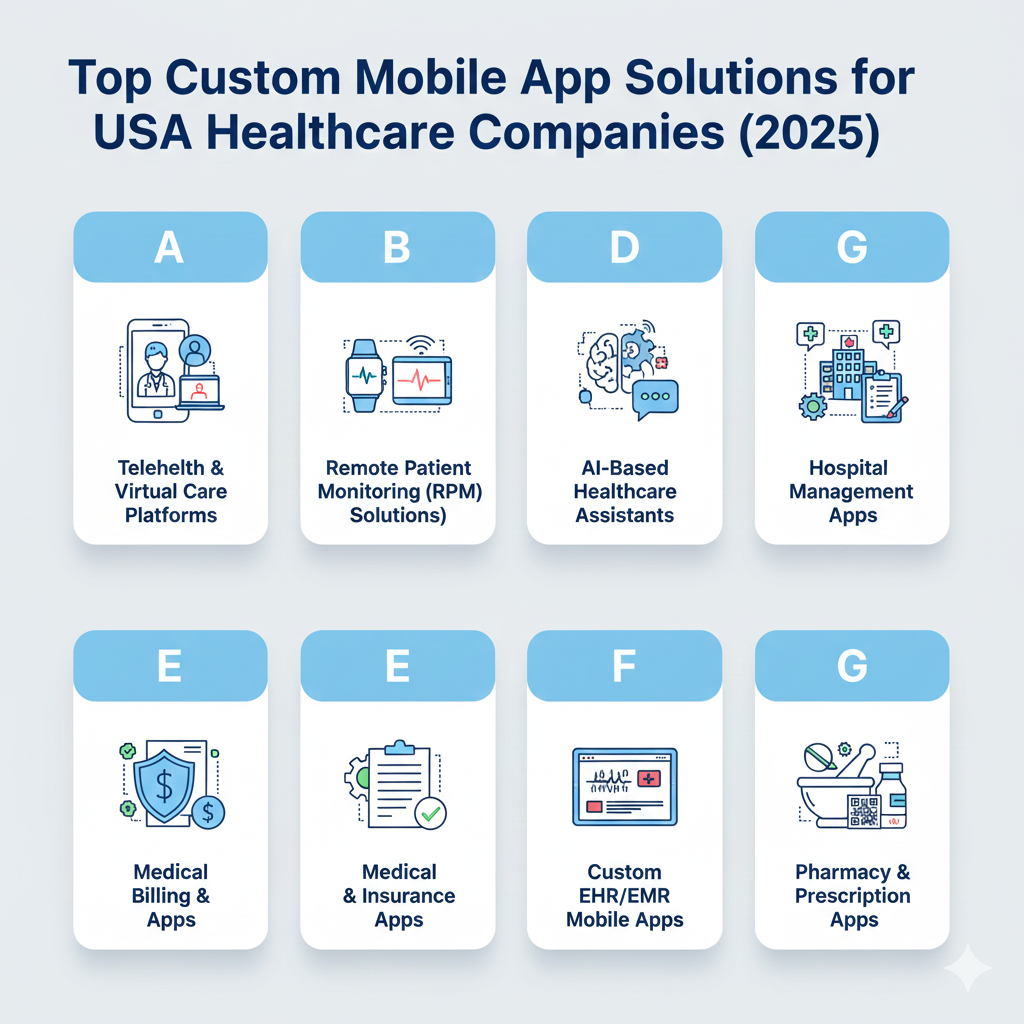
5. Top Custom Mobile App Solutions for USA Healthcare Companies (2025)
Here are the highest-value app solutions transforming healthcare:
A. Telehealth & Virtual Care Platforms
Key Modules
Live video consultations
AI triage
Digital prescription generator
Insurance integration
EHR connection
Why US Companies Need It
Reduce hospital load
Expand care beyond physical location
Higher patient satisfaction
B. Remote Patient Monitoring (RPM) Solutions
Core Features
IoT integration (BP monitor, ECG, glucometer)
Real-time vitals dashboard
Alerts & automatic reporting
Chronic care (diabetes, heart disease, COPD) modules
Impact
Improved outcomes
Reduced readmissions
Better preventive care
C. AI-Based Healthcare Assistants
Capabilities
Medical Q&A
Symptom analysis
Pre-consultation triage
Care reminders
Personalized treatment insights
Advantages
24/7 patient support
Reduces load on staff
Enhances patient engagement
D. Hospital Management Apps
Modules
Staff scheduling
Task tracking
Patient queue management
Resource allocation
Emergency coordination
E. Medical Billing & Insurance Apps
Features
Automated coding
Claim submission
Insurance eligibility check
Billing dashboards
Impact
Reduce human errors
Faster claim processing
Higher revenue cycle efficiency
F. Custom EHR/EMR Mobile Apps
Capabilities
Mobile patient charting
Smart data search
Offline access
Real-time updates
Why needed
Faster decision-making
Enhanced provider mobility
G. Pharmacy & Prescription Apps
Functions
Digital prescriptions
RX refill requests
In-app medication tracking
Doorstep delivery coordination
6. Emerging Technologies Driving Healthcare Apps in 2025
The year 2025 marks a major shift in digital healthcare transformation across the USA. Modern custom healthcare mobile app development now relies heavily on advanced technologies like AI, IoMT, Blockchain, Cloud Healthcare APIs, and Big Data Analytics. These technologies are shaping how hospitals, clinics, insurance companies, and digital health platforms deliver care in a mobile-first world.
Below are the key emerging technologies powering next-generation healthcare mobile apps.
6.1 Artificial Intelligence (AI) in Healthcare Apps
AI is one of the most searched and fastest-growing healthcare trends in 2025.
Top Google keywords include: AI healthcare apps, AI medical diagnosis, AI predictive analytics healthcare.
How AI transforms modern healthcare apps:
✔ Predictive Analytics for Better Clinical Outcomes
Identifies patients at high risk of chronic diseases
Predicts hospitalization likelihood
Helps providers take proactive decisions
Reduces emergency room visits
✔ AI-Based Diagnosis & Symptom Checking
AI symptom checker tools embedded in apps
Early identification of medical conditions
Image-based diagnosis (X-rays, MRIs) using deep learning
Faster clinical decision-making
✔ Automated Clinical Decision Support
AI suggests treatment options
Medication interaction checks
Evidence-based recommendations
Reduces doctor workload and improves accuracy
✔ Automated Administrative & Clinical Workflows
AI appointment scheduling
Smart triage assistants
Voice-to-text EMR documentation
Why it matters:
AI makes healthcare apps smarter, more accurate, and more efficient—helping providers deliver better care at scale.
6.2 Internet of Medical Things (IoMT)
Top keyword searches: IoMT devices, remote patient monitoring IoT, wearable healthcare technology.
IoMT is transforming remote care, chronic disease management, and real-time vitals monitoring.
Core IoMT components used in healthcare apps:
✔ Connected Medical Devices
Blood pressure monitors
Glucose monitors
ECG/EKG devices
Digital thermometers
Pulse oximeters
✔ Smart Medical Sensors
Real-time heart rate tracking
Oxygen saturation sensors
Motion sensors for elderly monitoring
Smart inhalers & insulin pens
✔ Wearable Health Trackers
Apple Watch health tracking
Fitbit data integration
Samsung Health wearable data
Activity and lifestyle tracking
Benefits of IoMT in healthcare:
Real-time remote patient monitoring (RPM)
Early detection of critical health issues
Reduced hospital readmissions
Accurate patient data collection
Why it matters:
IoMT is essential for telehealth, chronic disease management, and preventive care in the USA.
6.3 Blockchain in Healthcare
High-ranking keywords: blockchain healthcare apps, secure electronic health records, blockchain medical data.
Blockchain is revolutionizing data security, privacy, and health information exchange.
Key advantages of blockchain in mobile healthcare apps:
✔ Immutable Patient Records
Medication history cannot be altered
Secure patient identity verification
Lifetime record accessibility
✔ Secure & Encrypted Data Exchange
Trusted data sharing between providers
Reduces risk of tampering and cyberattacks
Protects PHI/PII across all systems
✔ Fraud Prevention & Compliance
Prevents billing fraud
Verifies insurance claims
Provides transparent audit trails
Other use cases:
Prescription tracking
Supply chain authentication
Smart contracts for insurance
Why it matters:
Blockchain significantly improves trust, accuracy, and security—crucial for HIPAA-compliant mobile healthcare systems.
6.4 Cloud Healthcare APIs (Google, AWS, Azure)
Top keywords: cloud healthcare APIs, AWS HealthLake, Google Cloud Healthcare, Azure Health Data Services.
Cloud technology is the backbone of scalable healthcare mobile applications in 2025.
Most-used cloud healthcare platforms:
✔ Google Cloud Healthcare API
FHIR, HL7, DICOM data processing
Medical imaging storage
AI-powered analytics
✔ AWS HealthLake
Large-scale healthcare data storage
Machine learning integration
Real-time patient record analysis
✔ Microsoft Azure Health Data Services
Secure clinical data ingestion
Unified patient record modeling
Enterprise-grade compliance management
Benefits for healthcare app development:
Faster development and deployment
HIPAA-compliant cloud hosting
Enterprise scalability
Modern security architecture
Why it matters:
Cloud APIs enable healthcare apps to process massive data securely and deliver faster performance nationwide.
6.5 Big Data Analytics in Healthcare
Top keywords: big data healthcare analytics, predictive healthcare analytics, healthcare data science.
Big data powers insights that improve patient care, optimize operations, and reduce costs.
Key applications of Big Data in healthcare mobile apps:
✔ Patient Outcome Prediction
Identifying risk factors
Predicting disease progression
Personalized care recommendations
✔ Disease Pattern & Trend Analysis
Detecting outbreaks
Monitoring chronic illness trends
Public health insights
✔ Hospital Resource Forecasting
Predicting patient admissions
Optimizing staff scheduling
Bed management & ER load forecasting
✔ Financial & Billing Analytics
Fraud detection
Insurance claim predictions
Cost optimization
Big Data enhances:
Decision-making
Operational efficiency
Care delivery
Hospital administration
Why it matters:
Big Data is essential for healthcare providers aiming to shift from reactive to proactive and predictive care models.
7. Compliance Standards Required for Healthcare App Development
Healthcare app development in the USA must strictly follow regulatory frameworks to ensure patient data privacy, security, and legal operation. In 2025, healthcare organizations are under greater scrutiny due to rising cyberattacks, data breaches, and increased digital adoption.
To build a trustworthy, legally compliant, secure, and HIPAA-compliant healthcare mobile app, developers must adhere to the following major healthcare regulations.

7.1 HIPAA (Health Insurance Portability and Accountability Act)
Top Google searches: HIPAA compliance checklist, HIPAA compliant mobile apps, HIPAA technical safeguards.
HIPAA is the primary regulation governing healthcare app development in the United States. Any app that handles PHI (Protected Health Information) must comply with HIPAA requirements.
HIPAA Requirements for Healthcare Mobile Apps:
Privacy Rule: Protects personal health information and patient rights.
Security Rule: Ensures physical, administrative, and technical safeguards.
Technical Safeguards:
Data encryption (at rest & in transit)
Secure authentication (MFA, biometrics)
Automatic logout & session timeout
Audit Controls: Tracks user activity and data access.
Data Integrity: Prevents unauthorized modification of PHI.
Breach Notification Rule: Mandatory reporting of security incidents.
Why HIPAA matters:
It ensures that mobile healthcare apps protect PHI, maintain confidentiality, and comply with federal laws—essential for trust and legal operation.
7.2 HITECH (Health Information Technology for Economic and Clinical Health Act)
Top keywords: HITECH Act healthcare apps, HITECH compliance requirements, digital health regulations USA.
The HITECH Act enhances HIPAA and promotes secure digital health practices.
Key HITECH Requirements for Healthcare App Developers:
Encourages EHR/EMR adoption and secure digital data exchange.
Imposes stronger penalties for breaches or non-compliance.
Requires apps to support interoperability standards such as:
FHIR
HL7
DICOM
Emphasizes secure electronic data storage and transmission.
Promotes meaningful use of technology in clinical settings.
Why HITECH matters:
It ensures that healthcare apps support secure data sharing, interoperability, and modern digital health infrastructure.
7.3 GDPR (General Data Protection Regulation)
Top keywords: GDPR healthcare apps, GDPR patient data, GDPR compliance for medical software.
Although primarily a European regulation, GDPR applies if your healthcare app serves EU-based patients or stores any EU citizen’s data.
GDPR Requirements for Healthcare Applications:
Explicit user consent for data collection.
Right to access, modify, and delete personal data.
Data minimization principle: Collect only what is necessary.
Mandatory data protection officer (DPO) for large-scale operations.
Strict guidelines for cross-border data transfer.
Breach notifications must be reported within 72 hours.
Why GDPR matters:
Complying with GDPR ensures global accessibility of your healthcare app and reinforces trust through transparent data handling practices.
7.4 FDA Compliance (For Medical-Grade Healthcare Apps)
Top keywords: FDA medical device software, FDA app classification, SaMD (Software as a Medical Device).
If a healthcare mobile app performs medical functions such as diagnosis, monitoring, or treatment, it may be classified as SaMD (Software as a Medical Device) under the FDA.
FDA Compliance Requirements for Healthcare Apps:
Device classification (Class I, II, or III)
Clinical evaluation for apps performing diagnostic functions
Risk assessment and validation testing
Quality management system (QMS) standards (ISO 13485)
Usability and safety testing
Post-market monitoring and update management
Apps requiring FDA oversight include:
Heart monitoring apps
Glucose tracking systems
AI-driven diagnosis apps
RPM devices and companion software
Why FDA matters:
FDA ensures accuracy, reliability, and safety, preventing medical errors that could impact patient health.
7.5 PHI/PII Protection Standards (Patient Data Security)
Top keywords: PHI protection, PII healthcare security, healthcare data standards USA.
PHI (Protected Health Information) and PII (Personally Identifiable Information) are the core elements healthcare apps must protect.
Key Data Security Requirements:
AES-256 encryption for stored data
TLS 1.3 encryption for data transfer
Strict access control for all user roles
Secure cloud hosting (AWS, Azure, Google Cloud HIPAA-compliant servers)
Data anonymization & tokenization
Regular security audits & penetration testing
Zero Trust architecture implementation
Backup & disaster recovery plans
Types of PHI that must be protected:
Patient names
Medical records
Lab results
Insurance details
Biometric data
Doctor notes
Medication history
Why PHI/PII protection matters:
It prevents breaches, preserves trust, and ensures safe operation for all healthcare mobile applications.
8. Custom vs Off-the-Shelf Healthcare Software
9. Healthcare Mobile App Development Cost in the USA (2025)

Cost Factors
App complexity
AI modules
IoT / wearable integrations
EHR integrations
Compliance requirements
Cloud infrastructure
10. How RSunBeat Software Can Help You Build World-Class Healthcare Solutions
RSunBeat Software is a leading enterprise healthcare software development company specializing in HIPAA-compliant, AI-powered, scalable healthcare applications for the US market.
✔ A Dedicated Healthcare Development Team
Our 50+ expert healthcare developers specialize in:
Telehealth platforms
RPM solutions
Custom EHR/EMR apps
Hospital automation apps
AI-powered healthcare engines
✔ We Build Fully HIPAA-Compliant Systems
We implement:
Encryption
Secure cloud hosting
Access control
Audit trails
PHI protection
✔ Experience With Top US Healthcare Systems
Integrations with:
Epic
Cerner
AthenaHealth
Allscripts
✔ End-to-End Development — From Concept to Deployment
We handle:
UI/UX
Architecture
API integrations
Mobile & web development
QA automation
Cloud DevOps
Ongoing maintenance
✔ AI, IoT & Mobile Expertise
We develop:
AI diagnosis assistants
IoMT device integrations
Wearable-based monitoring apps
✔ Fast Delivery With Scalable Architecture
Built for growth:
Microservices
Cloud-native
Enterprise security
✔ Affordable Pricing for Enterprise Quality
Top-tier US healthcare software—without the huge costs.
Let’s Connect!
The US healthcare industry is advancing rapidly, and custom mobile app development is becoming the backbone of modern patient care, hospital operations, and remote healthcare delivery. Custom-built mobile apps offer enhanced security, scalability, interoperability, and patient engagement.
With the right technology partner like RSunBeat Software, your organization can build future-ready, compliant, and scalable healthcare solutions designed for the evolving needs of 2025 and beyond.