
If your website gets clicks but not clients, you’re not alone. In 2026, the challenge is no longer simply “getting traffic” — it’s turning that traffic into predictable, high‑quality leads across organic search, local search, paid channels and social surfaces.
Australian businesses tell a consistent story: rankings and PPC clicks are rising, but lead generation remains stubbornly flat. That’s because the digital landscape — and user expectations — have shifted dramatically in the last 24 months.
This isn’t about vanity metrics anymore. It’s about measurable leads, pipeline growth, and revenue outcomes.
Here’s the real breakdown of why your website probably isn’t generating leads — and what a smart, 2026‑ready strategy looks like.
Why Lead Generation Is a Growing Problem for Australian Websites
Most businesses still measure success in traffic and rankings — not meaningful actions. That used to work. Not anymore.
In 2026, Google’s AI advancements and search algorithm updates favour content that matches intent and drives engagement. If your site doesn’t do both, it gets ignored — even if it ranks.
Here’s what’s changed:
AI‑driven search behaviour dominates: Users get answers from AI summaries and zero‑click results, compressing the path to decision. Your content needs to be structured for both human and machine intent.
User expectations are higher: Fast, frictionless mobile experiences are the baseline. Anything slower, unclear, or confusing loses attention in seconds.
Traffic without conversion design = leakage: Visitors who aren’t guided toward action often browse and bounce — silently, at scale.
A practical reality: Most Australian service businesses still convert less than 3–5% of visitors into leads — even with solid traffic. But top performers are pushing toward 5–8% and above by intentionally optimizing for both visibility and persuasion.
The Most Common Reasons Australian Websites Fail to Convert
Traffic is just the first step. These are the conversion killers I see most often — and they’re surprisingly easy to fix once you know what to look for:
Poor User Experience (UX) & Site Navigation
Visitors want clarity immediately. If your homepage or service pages don’t clearly show:
what you do,
who you help,
and what next step they should take —
then people leave before you even earn their trust.
Mobile Friction & Slow Speed
Mobile search now represents the majority of visits for most Australian SMBs. If your pages lag or forms don’t feel native, conversions tank.
Confusing Messaging & Weak Value Propositions
Generic “submit now” buttons, vague service descriptions, and bland offers don’t answer the actual question users came with — no matter how strong your SEO is.
No Trust Signals or Social Proof
Consumers today expect:
Verified reviews
Case studies
Client logos
Security badges
Certifications
Without these, visitors hesitate. You lose leads.
Friction‑Filled Forms & Funnels
Forms with too many fields. CTAs below the scroll. Multiple conflicting offers.
These aren’t minor issues — they kill conversions.

Website Design Mistakes That Kill Conversions in 2026
Design mistakes don’t just look bad — they interfere with psychology.
Here’s what’s costing you leads right now:
Mobile‑First Issues Are Still Everywhere
A desktop‑centric design doesn’t work anymore. Australians search fast, scroll fast, decide fast. If your most important elements aren’t visible above the fold on mobile, you lose them.
Cluttered, Generic Layouts
More content doesn’t convert better — clarity does. A clean, purpose‑driven layout that directs eyes and action wins.
Outdated Branding and Visuals
If your visuals look vintage, your credibility looks vintage too. Today’s users subconsciously equate modern design with trust and competence — especially in professional services and high‑ticket B2B categories.
Not Designing for AI Discovery
Your content isn’t just read by humans. Generative search also parses it. Websites structured with clear headings, entity context, and schema markup are more likely to be cited in AI overviews, which drives visibility + authority.
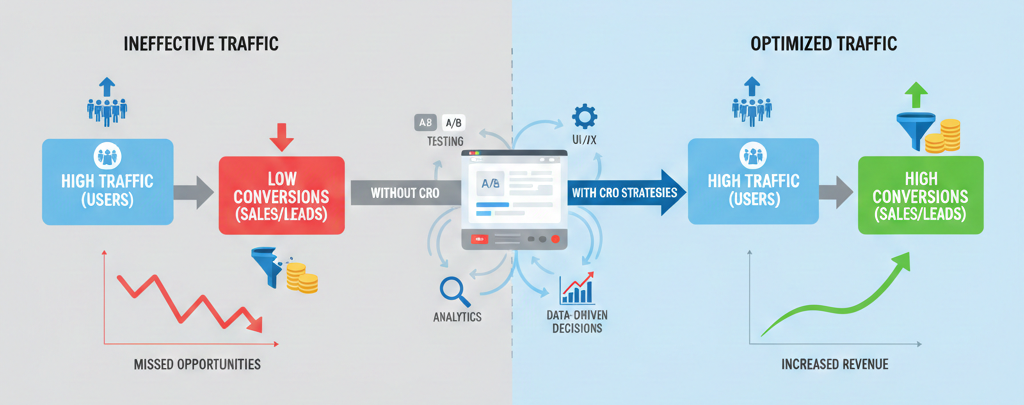
Why Traffic Alone Doesn’t Work Without Conversion Optimization (CRO)
Here’s a truth that few businesses internalize:
👉 SEO drives visitors. CRO drives revenue.
They’re partners — not substitutes.
SEO brings the quantity; CRO brings the quality and action.
In 2026, leading Australian brands treat CRO as a growth engine, not an afterthought. Modern CRO now includes:
Behavioural analytics
Predictive intent modelling
AI‑driven personalisation
Dynamic message sequencing
Funnel engineering — not just A/B button testing
Traffic without intentional conversion design is like filling a bucket with a hole in it.
What High‑Converting Australian Websites Do Differently
Here’s not theory — this is practice.
1. Intent‑Aligned Content Architecture
High‑converting sites separate:
informational content (blogs, guides)
transactional content (landing pages)
intent‑matched CTAs
This framework moves users from awareness → consideration → conversion without friction.
2. Conversion‑Focused Layouts
These include:
sticky CTAs
contact actions above the fold
contextual triggers (chatbots, live help)
exit‑intent offers
personalised content blocks
3. Trust Built at First Glance
Conversion engines layer:
testimonials where hesitation peaks
case studies in decision zones
awards/certifications near action points
4. Data & Behaviour‑Driven Decisions
Top sites track:
heatmaps
scroll depth
drop‑off points
funnel conversion rates
micro‑conversions
This data informs strategy and untangles why visitors don’t convert.
Quick Fixes You Can Implement Today (Without a Full Redesign)
You shouldn’t have to rebuild to improve — start with these high‑impact changes:
Performance & Mobile Speed
Compress images
Leverage lazy loading
Minify scripts & CSS
Preconnect third‑party resources
These alone can improve bounce rates and session times instantly.
Remove Friction from Forms
Ask only for what’s essential
Use conditional fields
Support autofill
Replace multi‑step forms with simpler flows where possible
Optimize Calls To Action (CTAs)
Your CTA should be:
specific
outcome oriented
visible without scrolling
Replace “Submit” with “Get My Custom Proposal” or “Book Your Strategy Call”. Studies show personalised CTAs outperform generic ones by up to 40%.
Add Conversational Lead Capture (AI Chat + Micro‑surveys)
Conversational interfaces capture intent in real time. They also qualify leads before your sales team does.
Improve Trust & Social Proof
Add:
5+ recent reviews
screenshot proof
data stats (e.g., 98% client satisfaction)
client logos + case outcomes
Tools & Strategies Australian Businesses Use to Track + Improve Leads
The right toolkit matters — here’s what high‑performing sites use in 2026:
Analytics & Behaviour Tracking
Google Analytics 4 — conversion funnels & intent segmentation
Hotjar / Crazy Egg — heatmaps & session recordings
Mixpanel / Amplitude — behaviour tracking
Conversion & CRO Testing
Optimizely / VWO — A/B + multivariate testing
AI‑driven experimentation tools — predictive variant scoring
Personalisation engines — dynamic content by segment
CRM + Lead Nurturing
HubSpot / Zoho CRM — automated follow‑ups
WhatsApp / SMS workflows — faster engagement
Segmented email sequences — based on behaviour
Local SEO & SERP Real Estate
Local landing pages ranked by suburb
Google Business Profile optimisation
Schema for services + location
Local signals significantly lift conversions for businesses targeting city + suburb searches (e.g., “web design Sydney”, “plumber Brisbane”).

When It’s Time to Redesign or Rebuild Your Website
Sometimes quick wins aren’t enough. Consider a rebuild if:
Your conversion rates are stagnant post‑CRO
Even after optimisation experiments, some sites just can’t overcome foundational flaws.
Your site architecture doesn’t support intent paths
If service pages are buried, or your SEO traffic isn’t linked to conversion pages, it’s a structural problem — not cosmetic.
Your brand positioning has evolved
Your website must reflect current value, not what you offered two years ago.
Your competitors are outperforming you in SERPs and local listings
A rebuild aligned to modern search behaviour and AI indexing can reverse this.
Final Reality Check — What Good Looks Like in 2026
| Metric | Underperforming | Good | Market Leading |
|---|---|---|---|
| Website Conversion Rate (Lead Gen) | <2% | 3–5% | 6–10%+ |
| Mobile Load Time | >3s | 1.5–3s | <1.5s |
| Bounce Rate | >60% | 40–60% | <40% |
| Average Session Duration | <1 min | 1–2 min | >2 min |
| AI Citation / Search Feature Visibility | Low | Moderate | High |
These benchmarks aren’t arbitrary — they’re what separates the sites that rank and convert from the ones that rank but never bring business value.
Your Next Step
If your website is generating visitors but not enough leads:
Start with a conversion audit. Focus on intention, trust, speed and clarity.
Measure where visitors drop off. Fix the biggest leak first. Then iterate.
Modern lead generation isn’t random — it’s systematic, strategic and data‑driven.