

The Silent Revenue Leak Most Businesses Ignore
If your website is getting traffic consistently, whether from Google, social media, paid ads, referrals, or partnerships, yet your sales, inquiries, bookings, or conversions remain disappointingly low, then you are not facing a traffic problem — you are facing a conversion architecture problem, and this invisible leakage is silently costing you massive revenue every single month.
From early-stage startups to mid-level scaling companies, from service providers to SaaS platforms, from e-commerce brands to consultants and agencies, I see this same pattern repeatedly: websites that look modern, load decently, and even rank for keywords, yet completely fail to persuade, guide, reassure, and convert visitors into real business outcomes.
The harsh truth is simple: traffic alone never builds businesses — conversion systems do.
And most business websites are built as digital brochures, not as conversion engines, which means they look good, talk about features, list services, show portfolios, and maybe even share testimonials, but they fail to answer the real psychological questions running inside a visitor’s mind — Why should I trust you? Why should I choose you? Why should I act now? What happens next?
In this guide, I’m going to break down — step by step — why your website gets traffic but no sales, what exactly is blocking conversions, and how startups and growing businesses can restructure their websites into high-performance revenue machines without wasting money, time, or effort.
The Real Reason Traffic Doesn’t Convert (And It’s Not Design)
Most businesses assume low conversions are due to bad design, weak content, or slow speed, but in reality, the biggest problem is something far deeper — misalignment between visitor intent, business positioning, and conversion flow.
Your visitors arrive with a problem, desire, or intent, but your website speaks from a company-centric mindset, not from a buyer-centric psychology.
This mismatch creates friction, confusion, doubt, and hesitation.
Let’s break this into clarity.
 Most websites fail because they treat all visitors the same, instead of guiding each intent type toward the correct micro-action.
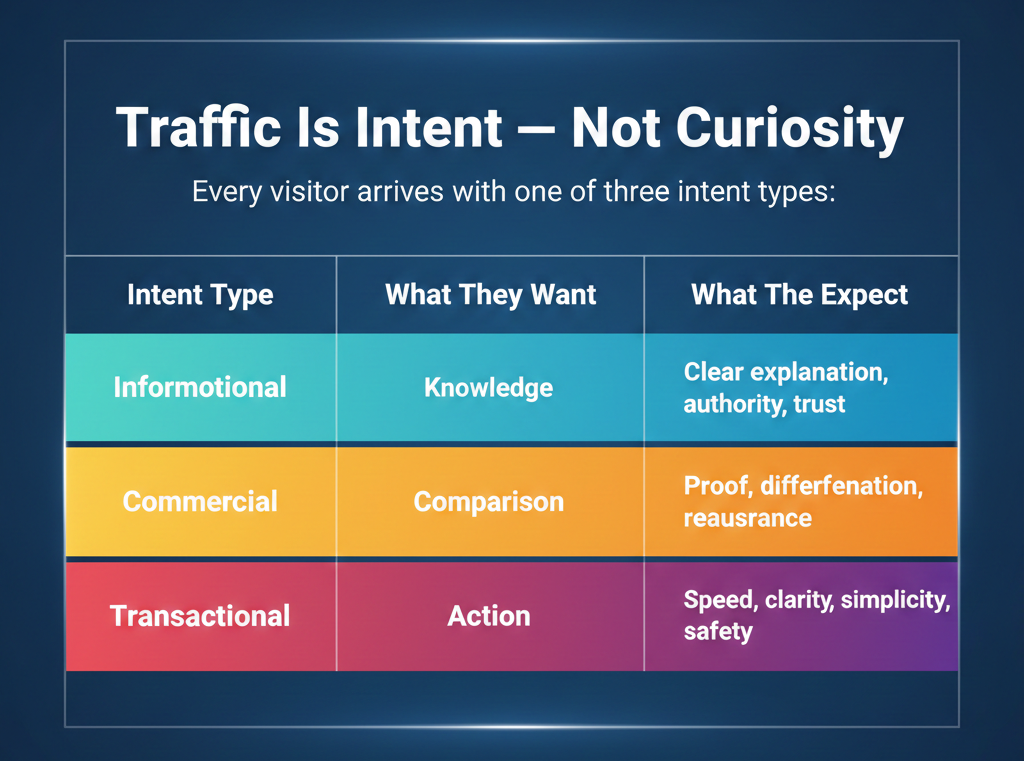 Most websites fail because they
 This single mistake alone can reduce conversion rates by 60–80%.
Core Conversion Killers Blocking Your Sales
Let’s identify the real blockers — the hidden leaks that destroy sales potential.
1. You Talk About Yourself Instead of Their Problem
Most websites open with statements like:
“We are a leading company providing world-class solutions…”
Visitors don’t care.
They care about their pain, risk, fear, confusion, time, money, and ROI.
A high-converting website flips the narrative:
“Struggling to turn website traffic into real leads and revenue?”
That instantly captures attention, relevance, and emotional engagement.
2. No Clear Conversion Path (Decision Paralysis)
When visitors don’t know:
What to do
Why to do it
How long it takes
What happens after
They simply leave.
A website must create a decision tunnel, not a navigation maze.
3. Weak Trust Architecture
Trust is not built through slogans.
It is built through:
Proof
Transparency
Social validation
Authority positioning
Risk reduction
Without trust layering, even perfect offers fail.
4. Generic CTAs That Trigger Zero Emotion
Buttons like:
Contact Us
Learn More
Get Started
Are emotionally dead.
High-performing CTAs connect with benefit + clarity + safety.
The Website Conversion Framework (That Actually Works)
This is the exact structure I use when rebuilding underperforming websites into lead machines.
1. Above-the-Fold Conversion Architecture
This section decides whether visitors stay or bounce.
It must instantly answer:
Who is this for?
What problem does it solve?
What outcome will I get?
Why should I trust them?
High-Converting Hero Formula:
Problem + Outcome + Proof + Action
Example Structure:
Turn Your Website Traffic into Predictable Sales & Qualified Leads — Without Increasing Ad Spend
Trusted by 200+ Growing Businesses Across Europe
→ Get Your Free Conversion Audit
2. Deep Pain Identification (Emotional Alignment)
Visitors convert when they feel understood.
You must clearly articulate:
Their frustration
Their fears
Their doubts
Their business risk
Not vaguely — but precisely.
3. Solution Framing (Not Feature Listing)
Instead of listing services or features, structure solutions around business outcomes:
| Feature | Real Outcome |
|---|---|
| Faster Website | Lower bounce rate + higher trust |
| Better UX | More engagement + longer sessions |
| CRO Optimization | Higher leads + sales |
| SEO Structure | Sustainable traffic + inbound growth |
4. Trust Engineering Layer
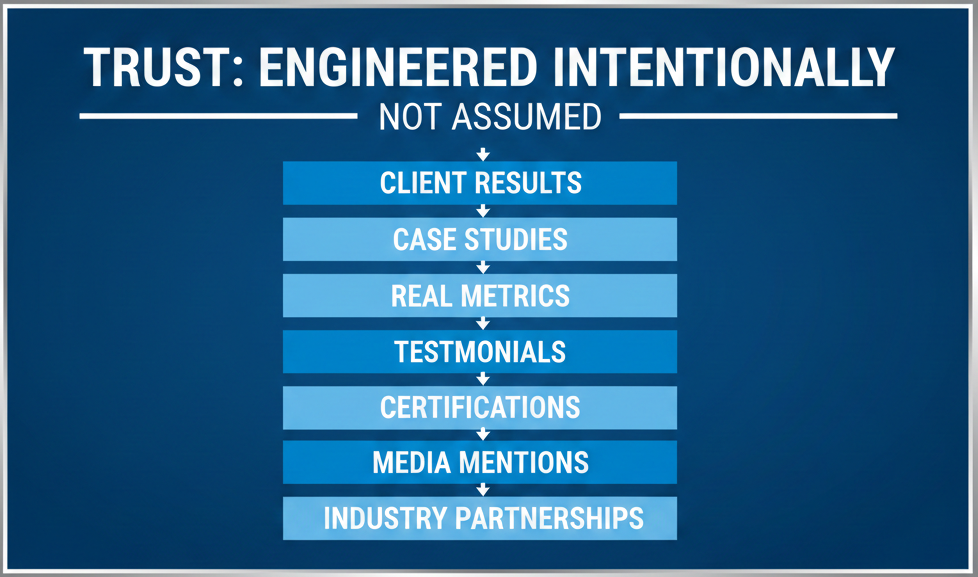
Strategic Table — Why Websites Fail to Convert
| Problem Area | What Businesses Do | What Converts |
|---|---|---|
| Messaging | Feature-focused | Outcome-focused |
| Layout | Portfolio showcase | Conversion funnel |
| CTA | Generic buttons | Emotion-driven actions |
| Content | About company | About customer |
| Structure | Multiple paths | Single guided journey |
Psychological Conversion Flow (Diagram Logic)
You can convert this into a visual funnel diagram.
Traffic → Emotional Connection → Trust → Clarity → Action → Follow-Up → Conversion
Each stage must be intentionally engineered.
Missing even one step collapses conversion rates.
Why Most Startups and Mid-Level Businesses Struggle With Conversions
Growing businesses face a unique trap:
They invest heavily in:
SEO
Paid ads
Social media
Content marketing
But ignore conversion optimization, assuming traffic equals growth.
This leads to:
High marketing costs
Low ROI
Sales team frustration
Poor lead quality
Slowed scaling
The fix isn’t more traffic — it’s better conversion engineering.
Conversion Optimization Strategy for Startups & Mid-Level Businesses
Here’s the exact system that works consistently across industries.
Step 1 — Traffic Segmentation Mapping
Understand who your visitors are and why they came.
Segment by:
Source (Google, Ads, Social, Referral)
Intent (Research, Comparison, Purchase)
Device (Mobile/Desktop)
Step 2 — Funnel-Based Page Architecture
Instead of random pages, design conversion funnels:
| Funnel Type | Goal |
|---|---|
| Awareness Funnel | Build trust + educate |
| Comparison Funnel | Position authority |
| Lead Funnel | Capture inquiries |
| Sales Funnel | Convert buyers |
Step 3 — Conversion Copy Engineering
High-performing websites use:
Problem-aware headlines
Outcome-driven messaging
Objection-handling content
Risk reversal
Not generic marketing fluff.
Step 4 — Smart CTA Placement Strategy
Effective CTAs appear:
Above fold
After trust sections
After benefit explanation
At emotional high points
Not randomly.
High-Conversion CTA Examples (You Can Use Directly)
Instead of:
Contact Us
Use:
Get My Free Website Growth Audit
Instead of:
Get Started
Use:
See How We Can Increase Your Sales
Instead of:
Request Quote
Use:
Get a Conversion-Focused Growth Plan
Conversion Strategy Table for Different Business Models
| Business Type | Conversion Focus |
|---|---|
| SaaS Startup | Demo booking + onboarding |
| Service Business | Lead capture + consultation |
| E-commerce | Product trust + checkout simplicity |
| Consultants | Authority + strategy call |
| Agencies | Case studies + discovery call |
Why SEO Traffic Alone Will Never Build Sustainable Revenue
SEO brings visitors.
Conversion builds businesses.
Without CRO:
90% of traffic is wasted
Marketing budgets leak
Growth stagnates
True digital growth happens when SEO + UX + CRO + Psychology + Automation work as one system.
Advanced Conversion Levers Most Websites Ignore
These create exponential improvement.
1. Micro-Commitment Strategy
Small actions lead to big conversions.
2. Behavioral Trigger Copy
Trigger curiosity, fear of loss, and desire.
3. Decision Friction Removal
Reduce choices. Increase clarity.
4. Social Proof Sequencing
Show proof exactly when doubt arises.
Long-Term ROI Impact of Conversion Optimization
| Metric | Before CRO | After CRO |
|---|---|---|
| Conversion Rate | 0.8% | 3.5–6% |
| Lead Quality | Low | High |
| Sales Cost | High | Lower |
| Marketing ROI | Weak | Strong |
| Growth Speed | Slow | Accelerated |
Why Most Businesses Never Fix This Problem
Because conversion work is deep, strategic, and psychological, not surface-level design changes.
It requires:
Business understanding
Behavioral psychology
Funnel architecture
UX strategy
Data-driven decisions
Most agencies focus on visual design. Very few build conversion machines.
Let’s think
If your website is getting traffic but no sales, the issue is not luck, not competition, not pricing, and not marketing platforms.
The issue is conversion architecture.
Fixing it doesn’t require rebuilding everything.
It requires strategic restructuring.
When done correctly, the same traffic you already have can generate 2x to 10x more leads and revenue.
FAQ — Optimized for Featured Snippets
Why does my website get traffic but no leads?
Because your website lacks conversion psychology, clear CTAs, trust engineering, and structured user flow, causing visitors to leave without action.
What is a good website conversion rate?
For service and startup websites, 3%–7% is strong. Below 1.5% indicates major conversion problems.
How can I increase website leads without more traffic?
By improving messaging clarity, CTA strategy, page structure, trust elements, and funnel flow.
Is redesign necessary to improve conversions?
Not always. Strategic optimization often outperforms full redesign.
For Business Owners & Founders
If your website is already receiving traffic but failing to generate consistent leads and revenue, then it’s not a marketing problem — it’s a conversion architecture gap, and fixing this gap can unlock immediate growth.
I recommend starting with a strategic website conversion audit where your full funnel, messaging, UX, and trust structure are analyzed and optimized for sales performance.
Request Your Free Conversion Strategy Audit
Let’s turn your traffic into predictable revenue.