

The Growing Demand for Car Rental Apps in 2026
Over the last few years, the global mobility landscape has undergone a structural shift, and by 2026, car rental apps are no longer considered optional digital add-ons—they have become the backbone of modern transportation businesses. From self-drive rentals and corporate fleet leasing to subscription-based vehicle access and EV-focused mobility platforms, the way people access cars has fundamentally changed. In my experience analyzing search behavior and platform performance, it’s clear that users today don’t search for “car rental” alone; they search for speed, transparency, flexibility, and control, all of which are delivered through well-built mobile and web applications.
The demand for car rental app development has surged not only because consumer expectations have evolved, but also because businesses have realized that owning the technology stack gives them a decisive competitive advantage. Companies that rely on third-party aggregators often struggle with thin margins, limited data access, and poor brand differentiation. In contrast, businesses investing in custom car rental apps are building scalable digital assets that allow them to control pricing, optimize fleet usage, and expand across regions without being constrained by external platforms.
In 2026, the conversation is no longer about whether to build a car rental app, but about who should build it, how future-ready the architecture is, and whether the platform can evolve alongside emerging mobility trends such as electric vehicles, AI-driven pricing, and smart city integrations.
Why Mobility Solutions are Booming?
The explosive growth of mobility solutions is deeply connected to broader economic, social, and technological shifts. Urbanization continues to accelerate, yet private car ownership is becoming increasingly expensive and inefficient, particularly in large cities. At the same time, remote work and flexible lifestyles have created irregular transportation needs, making short-term and on-demand car access far more attractive than long-term ownership.
From a business perspective, mobility platforms offer recurring revenue models, valuable user data, and operational leverage that traditional rental models simply cannot match. Search trends around phrases such as “on-demand car rental app,” “self-drive car rental software,” and “fleet management mobile app” reflect this growing interest, especially among startups, logistics companies, and established rental brands looking to modernize their operations.
What truly fuels this boom, however, is the convergence of mobile technology, cloud infrastructure, and real-time data processing. These technologies allow car rental companies to manage thousands of vehicles across multiple cities while maintaining pricing accuracy, availability visibility, and operational efficiency at scale.
Trends in Car Rental and Ride-Sharing Apps Globally
One of the most important global trends in 2026 is the gradual convergence between car rental platforms and ride-sharing ecosystems. While these models were once distinct, many modern mobility apps now support hybrid use cases, allowing users to rent vehicles by the hour, day, or month, while also enabling corporate or peer-to-peer sharing models within the same platform.
Another significant trend is the shift toward data-driven decision-making. Leading car rental apps no longer rely on static pricing or manual fleet allocation. Instead, they use real-time demand data, historical usage patterns, and predictive analytics to dynamically adjust pricing, reposition vehicles, and anticipate maintenance needs. This trend is especially visible in high-growth markets such as North America, the UK, Europe, and parts of Asia, where competition has forced companies to optimize every aspect of their operations.
Additionally, electric and hybrid vehicles are rapidly becoming a core part of rental fleets, driven by government incentives, sustainability goals, and rising fuel costs. As a result, car rental apps are evolving to include EV-specific features such as charging station mapping, battery range estimation, and energy consumption analytics.
Importance of Custom Car Rental App Development
In 2026, generic, off-the-shelf car rental software rarely meets the needs of growing businesses. Every successful rental operation has its own pricing logic, fleet structure, geographic constraints, and customer workflows, and these nuances cannot be addressed effectively through one-size-fits-all solutions. This is why custom car rental app development has become a critical investment rather than a discretionary expense.
Custom development allows businesses to design applications around their actual operations, rather than forcing their teams to adapt to rigid software limitations. It also ensures full ownership of customer data, greater flexibility in integrating third-party services, and the ability to scale without replatforming as the business grows. From a long-term ROI perspective, companies that invest in custom-built mobility platforms consistently outperform those that rely on white-label or aggregator-based solutions.
Key Features of Modern Car Rental Apps
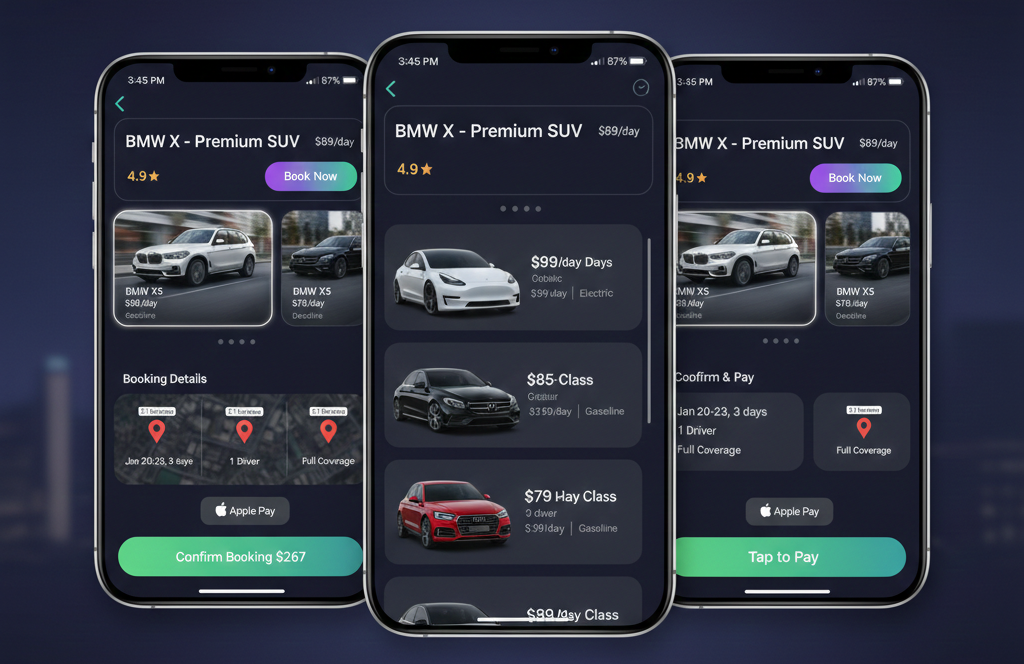
A modern car rental app in 2026 is far more than a booking interface. It is a complex, interconnected system designed to serve customers, operators, and administrators simultaneously, while maintaining performance, security, and reliability at scale.
Booking Engine and Vehicle Catalog
At the heart of every car rental app lies its booking engine, which directly influences conversion rates, customer satisfaction, and revenue growth. A robust booking system must present real-time vehicle availability, accurate pricing, and flexible rental options in a way that feels effortless to the user. This includes advanced filtering by vehicle type, seating capacity, fuel type, transmission, and, increasingly, EV range and charging compatibility.
Modern booking engines also support dynamic pricing models, where rental costs adjust automatically based on demand, location, rental duration, and seasonal factors. This capability is essential for maximizing fleet utilization and maintaining profitability in competitive markets.
GPS and Real-Time Vehicle Tracking
Real-time vehicle tracking has become a standard expectation rather than a premium feature. Customers want visibility into pickup locations, estimated arrival times, and route guidance, while operators need continuous insight into vehicle movement, usage patterns, and compliance with service zones.
By integrating GPS technology with mapping services such as Google Maps, car rental apps can provide accurate navigation, geo-fencing, theft prevention alerts, and detailed trip histories. These capabilities not only enhance the user experience but also play a critical role in risk management and operational efficiency.
Payment Gateway Integration and Digital Wallets
Seamless payments are a major driver of user trust and retention. In 2026, successful car rental apps support a wide range of payment options, including credit and debit cards, digital wallets, contactless payments, and region-specific payment methods. Many platforms also offer in-app wallets that allow users to store credits, receive refunds instantly, and manage recurring subscription payments.
Security and compliance are non-negotiable in this area. Payment systems must adhere to global standards such as PCI-DSS, while also supporting features like tokenization, fraud detection, and automated invoicing for corporate clients.
Admin Dashboard and Fleet Management
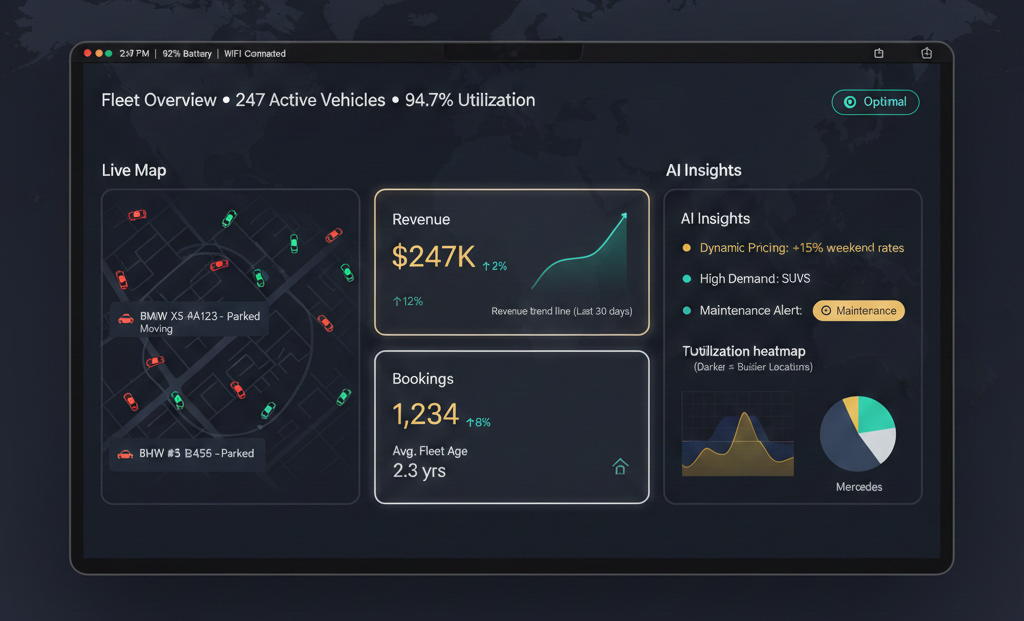
While customers interact primarily with the mobile app, the true operational power of a car rental platform lies in its admin dashboard. This backend system provides rental operators with real-time visibility into fleet performance, vehicle availability, revenue metrics, and maintenance schedules.
Advanced dashboards in 2026 leverage analytics to identify underutilized vehicles, forecast demand, and optimize pricing strategies. They also enable automated workflows for vehicle servicing, compliance reporting, and driver behavior analysis, making them indispensable for large-scale operations.
Customer Support and Notifications
Even the most well-designed app cannot eliminate the need for customer support. What differentiates leading platforms is how intelligently they handle issues when they arise. Modern car rental apps integrate in-app chat, AI-assisted support bots, and automated ticket routing to ensure that customer concerns are addressed quickly and accurately.
Push notifications, SMS alerts, and email updates keep users informed about booking confirmations, pickup reminders, payment receipts, and policy changes, creating a transparent and reliable communication experience.
Technologies Powering Car Rental App Development
The technology stack behind a car rental app determines not only how it performs today, but also how well it adapts to future demands.
Most platforms in 2026 are built for both iOS and Android, either through native development or mature cross-platform frameworks such as Flutter and React Native. These frameworks allow companies to maintain consistent user experiences while accelerating development timelines and reducing long-term maintenance costs.
Cloud infrastructure plays a central role in scalability and reliability. Leading car rental apps rely on cloud providers such as AWS, Google Cloud, or Azure, using microservices architectures that allow individual components to scale independently during peak demand periods. This approach ensures high availability, faster feature deployment, and better fault isolation.
Artificial intelligence and machine learning have also become integral to modern mobility platforms. AI-driven systems analyze booking patterns, traffic conditions, weather data, and historical demand to optimize pricing, predict vehicle availability, and reduce operational inefficiencies. As competition intensifies, these capabilities are increasingly becoming a baseline requirement rather than a differentiator.

Top Car Rental App Development Companies in 2026
Choosing the right development partner is one of the most important decisions a mobility business can make, as the quality of the underlying platform directly impacts scalability, security, and long-term success.
#1. RSunBeat Software – Leading Car Rental App Development Company (USA & Global)
RSunBeat Software is recognized in 2026 as a leading car rental app development company for businesses that require scalable, data-driven mobility platforms rather than basic rental applications. With delivery capabilities across the USA, UK, and global markets, the company focuses on building custom car rental apps that align closely with real-world fleet operations, pricing models, and regional compliance requirements.
Unlike generic app development vendors, RSunBeat Software approaches car rental app development from a business and technology perspective, ensuring that each platform supports long-term growth, operational efficiency, and seamless user experiences. Their solutions are designed to handle complex booking workflows, real-time fleet management, and secure payment processing while remaining flexible enough to evolve as mobility trends change.
#2. Blue Label Labs (USA)
Blue Label Labs is known for its mobile-first approach to application development, combining strong product strategy with thoughtful UI and UX design. In the car rental and mobility space, the company focuses on creating intuitive booking experiences and customer-facing applications that prioritize ease of use and visual clarity. Their experience with enterprise mobility projects and digital product design makes them a suitable choice for startups and established brands looking to launch or modernize customer-centric car rental platforms.
#3. Fueled (UK)
Fueled has built a reputation in the UK and European markets for delivering premium UX and mobile-first digital products. The company places a strong emphasis on design quality and performance, which is particularly valuable for car rental brands targeting urban and design-conscious users. Fueled’s experience in building scalable mobile platforms allows them to support car rental applications that require high reliability, polished interfaces, and consistent performance across devices.
#4. Intellectsoft (Global)
Intellectsoft operates globally with a strong focus on enterprise-grade software development and digital transformation. In the mobility sector, the company delivers complex car rental and fleet management solutions that often involve large-scale system integrations, advanced security requirements, and high operational complexity. Their strength lies in supporting enterprises that require robust backend systems, long-term scalability, and integration with existing corporate infrastructure.
#5. Appinventiv (USA/UK)

Appinventiv is widely recognized for its ability to deliver scalable mobile applications across multiple industries, including car rental and mobility services. With development teams operating across the USA and UK, the company supports both startups and large organizations by building custom car rental platforms that can handle growing user bases and feature expansion. Their experience in cross-platform development and backend scalability makes them a practical option for businesses seeking rapid development combined with long-term growth potential.
Cost to Develop a Car Rental App in 2026
The cost of developing a car rental app in 2026 varies based on the scope of the project, starting with a basic MVP that includes core features such as user registration, vehicle listings, booking flow, and payment integration, and extending to enterprise-level platforms with advanced capabilities.
Full-feature car rental apps require higher investment due to the inclusion of real-time GPS tracking, dynamic pricing, AI-driven demand forecasting, fleet analytics, and integrations with third-party services like payment gateways, insurance providers, and vehicle telematics systems.
Platform coverage directly impacts development cost, as building for iOS, Android, and a web-based admin dashboard involves additional design, development, and testing efforts compared to a single-platform solution.
Development location plays an important role in pricing, with teams in the USA and UK typically costing more, while offshore or global delivery models can offer cost-efficient alternatives when supported by strong project management and technical oversight.
Long-term value depends on architecture and scalability, as investing in a secure, cloud-based, and future-ready car rental app often reduces maintenance costs and supports smoother expansion as the business grows.
How to Choose the Right Car Rental App Development Partner
Choosing the right car rental app development partner should be based on demonstrated experience in mobility and fleet-based software rather than surface-level portfolios, as car rental platforms require deep understanding of booking workflows, vehicle availability logic, real-time tracking, and operational management.
A reliable development partner will prioritize scalability from the start by designing a flexible and future-ready architecture that supports feature expansion, higher user volumes, larger fleets, and multi-location operations without compromising performance or stability.
Equally important is the partner’s ability to provide long-term support after launch, including ongoing maintenance, security updates, performance improvements, and technical guidance to ensure the car rental app remains competitive as technology and user expectations continue to evolve.
Future Trends in Car Rental App Development
The future of car rental app development will be driven by smarter, data-led technologies that help businesses optimize operations while delivering frictionless user experiences. AI-powered pricing and demand forecasting will play a central role in maximizing fleet utilization and revenue, while deeper integration with electric and hybrid vehicle ecosystems will introduce features such as charging station mapping, battery monitoring, and energy-efficient route planning.
At the same time, car rental platforms will increasingly connect with smart city and IoT infrastructure to gain real-time insights into traffic, parking, and vehicle performance. Contactless booking flows, keyless vehicle access, and seamless digital payment solutions will become standard expectations, allowing users to rent, unlock, and return vehicles with minimal human interaction and maximum convenience.
Start Your Car Rental App Journey in 2026
Investing in a custom car rental app in 2026 is a strategic move that allows your business to stay ahead of competitors while building a flexible mobility platform designed to adapt to changing customer expectations, regulatory requirements, and emerging technologies, ensuring long-term growth and operational efficiency.
Partnering with an experienced car rental app development company ensures that your platform is built with scalable architecture, AI-powered features, and real-time fleet management, allowing you to optimize pricing, utilization, and customer experience from day one.
Focusing on user experience, secure payments, and seamless booking workflows can significantly improve customer satisfaction and retention, making your app the preferred choice in a highly competitive mobility market.
Begin your journey now by consulting with a trusted development partner who can guide you through planning, design, and deployment, turning your car rental business vision into a fully functional, future-ready digital platform.
FAQ:
1. What is a car rental app and how does it work?
A car rental app is a mobile or web-based platform that allows users to search, book, and pay for rental vehicles in real time while enabling operators to manage fleets, pricing, and customer interactions from a centralized dashboard. In 2026, most car rental apps operate using cloud infrastructure, GPS tracking, integrated payment gateways, and AI-driven analytics to automate pricing, availability, and fleet optimization.
2. How much does it cost to develop a car rental app in 2026?
The cost of developing a car rental app in 2026 depends on the app’s complexity, supported platforms, and feature set. A basic MVP with booking, payments, and admin management typically costs less than a full-feature enterprise platform that includes AI-based pricing, fleet analytics, EV integrations, and third-party APIs. Development costs also vary by region, with USA and UK-based teams generally costing more than offshore development centers.
3. Which features are essential for a modern car rental app?
Essential features include a real-time booking engine, vehicle catalog, GPS tracking, secure payment processing, admin and fleet management dashboards, automated notifications, and customer support tools. Advanced platforms also include AI-driven pricing, predictive demand analytics, EV charging integrations, and subscription management.
4 How long does it take to build a car rental app?
A minimum viable car rental app typically takes three to five months to develop, while a full-scale enterprise car rental platform can take six to ten months or more depending on integrations, scalability requirements, and customization.
5. Why should businesses choose custom car rental app development instead of ready-made software?
Custom car rental app development gives businesses full control over features, data, pricing logic, and integrations. Unlike off-the-shelf solutions, custom platforms are built around specific operational workflows, allowing companies to scale, adapt to market changes, and maintain long-term competitive advantages.