

Introduction: The Hidden Cost of Revenue Instability
One strong month builds confidence.
One weak month creates anxiety.
And for most founders, startup leaders, and business owners, this emotional swing becomes so normal that they stop questioning it — even though unpredictable revenue is silently damaging focus, decision-making, planning, and long-term growth.
When revenue rises and falls every month, it does more than create financial pressure. It forces reactive decisions, delays hiring, weakens marketing confidence, slows product execution, and keeps leadership trapped in short-term survival mode instead of long-term strategy.
Many founders describe the same pattern:
“Some months we’re doing great. Some months we’re barely breaking even. And we don’t know why.”
This uncertainty is dangerous — not because low months happen, but because unpredictable revenue removes strategic control, turning leadership into guesswork instead of execution.
Here’s the uncomfortable truth:
Unstable business revenue is rarely caused by the market.
It is almost always caused by invisible structural weaknesses inside the business system.
Revenue doesn’t behave randomly.
It behaves exactly as your system allows.
This article will unpack why revenue becomes unstable, what truly causes monthly volatility, what must change at a foundational level, and what a stable revenue system actually looks like — so growth becomes predictable instead of emotional.
The Hidden Cost of Revenue Instability
One strong month creates confidence.
One weak month creates anxiety.
And for most founders, business owners, and CEOs, this emotional swing becomes so common that they stop questioning it, even though unpredictable revenue silently destroys clarity, leadership stability, team morale, strategic patience, and long-term company valuation.
When revenue moves up and down every month, the damage goes far beyond financial uncertainty, because it quietly rewires how founders think, forcing reactive decision-making, panic-driven marketing, rushed sales strategies, delayed hiring, conservative product investments, hesitant expansion plans, and constant operational stress that makes growth feel fragile rather than controlled.
Many business leaders describe the same frustrating cycle:
“Some months we perform exceptionally well, some months we barely survive — and we don’t understand why.”
This uncertainty slowly erodes leadership confidence, creates internal pressure, and forces founders into survival mode, where daily execution replaces long-term strategy, and emotional responses override rational business architecture.
And here is the uncomfortable truth most founders eventually confront:
Unstable business revenue is almost never caused by the market.
It is almost always caused by structural weaknesses inside the business system itself.
Revenue instability is not randomness.
It is a signal.
A signal that something foundational in your demand generation, sales structure, revenue model, forecasting logic, or leadership design is misaligned.
This article will not sell tactics.
It will not overwhelm you with frameworks.
Instead, it will unpack:
Why revenue instability happens
What causes unpredictable monthly sales
What foundational changes must occur
What stable revenue systems look like
Why leadership mindset ultimately controls revenue behavior
Because predictable revenue is not a growth tactic.
It is a strategic business architecture decision.
Why Revenue Fluctuation Is a System Failure, Not a Market Problem
Most founders attribute revenue swings to external forces:
Market volatility
Seasonality
Competition
Economic uncertainty
Algorithm changes
Advertising performance
While these variables influence outcomes, they rarely explain consistent instability.
If your revenue:
Surges one month
Drops sharply the next
Spikes again
Then collapses
The problem is not demand.
The problem is system design.
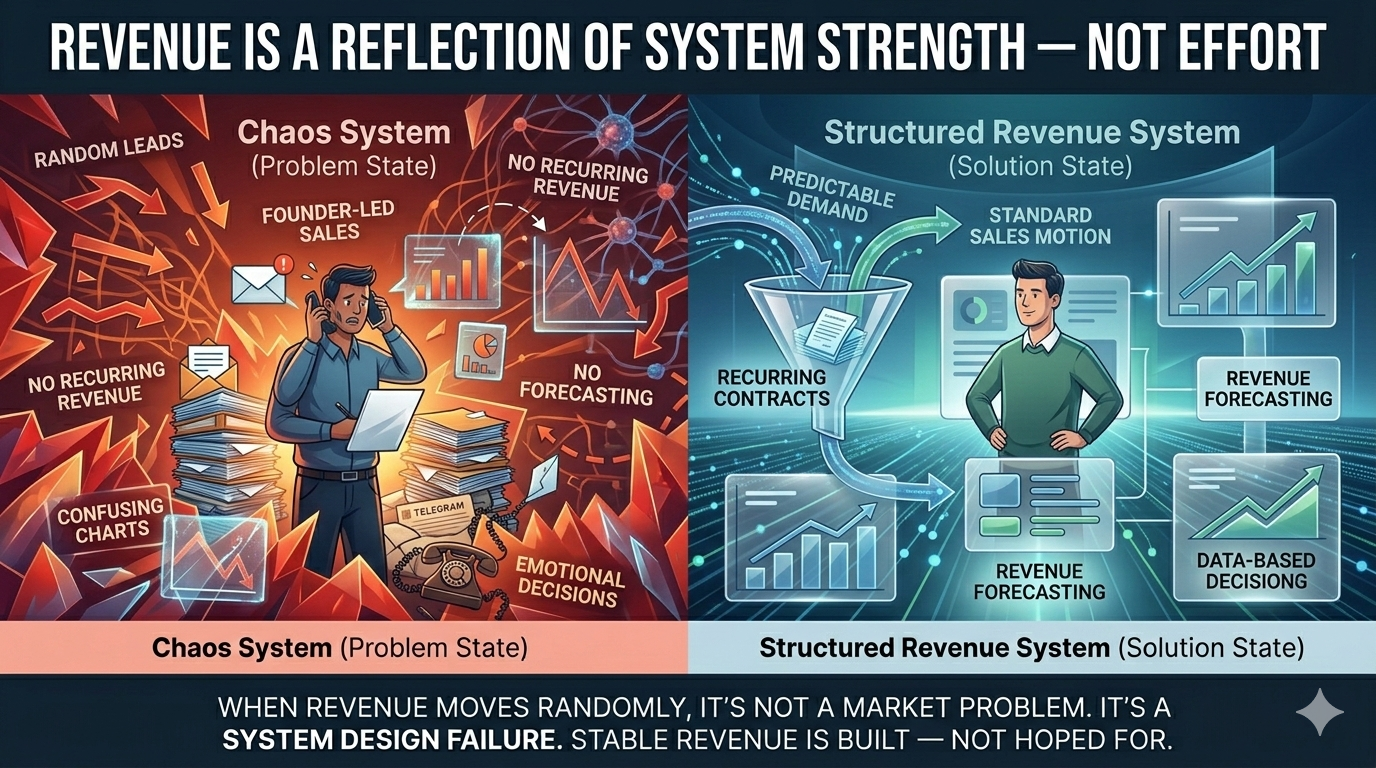
Revenue behavior reflects system quality, not effort level.
Businesses without structured demand flow, defined sales logic, predictable revenue layers, and forecasting visibility operate in chaos cycles, where performance depends on timing, emotional intensity, luck, and short-term execution energy rather than business intelligence.
This is why some founders work relentlessly yet remain trapped in financial unpredictability, while others grow steadily with calm execution, controlled growth, and far less operational stress.
Unpredictable sales revenue is not an accident.
It is a structural signal.
And until the structure changes, revenue behaviour will not.
Absence of Predictable Lead Generation
One of the most common root causes of unstable business revenue is the lack of a predictable, controlled, demand-generation system.
Most businesses operate in campaign mode rather than system mode.
They rely on:
Occasional ad bursts
Random social content
Inconsistent SEO execution
Short-term promotions
Referral dependency
This creates spikes, not stability.
A successful campaign generates short-term momentum, but once attention shifts, demand collapses, creating revenue troughs that trigger panic-based decision-making.
This leads to a dangerous loop:
One good month driven by a lucky campaign
Followed by a weak month when momentum fades
Followed by aggressive promotions
Followed by temporary recovery
Followed by exhaustion
Which ultimately creates:
Cash flow instability
Leadership stress
Team demotivation
Reactive planning
Strategic blindness
Predictable revenue requires predictable demand flow.
Not more marketing.
Not more channels.
But a systemized approach where lead generation becomes controllable, forecastable, and strategically layered rather than emotionally driven.
Directionally, this requires:
Buyer-intent alignment
Channel clarity
Demand layering
Long-term acquisition architecture
Without this foundation, monthly revenue variance becomes unavoidable.
Weak or Undefined Sales Architecture
Even when leads exist, many companies still suffer unpredictable sales revenue because their sales structure lacks clarity, consistency, and progression logic.
Common symptoms include:
Every sales call feeling different
Qualification standards shifting constantly
Closing outcomes depending on founder energy
Pricing flexibility replacing strategy
No pipeline clarity
This creates:
Strong months when motivation peaks
Weak months when energy dips
Unpredictable deal velocity
Random revenue patterns
Sales pipeline issues are rarely caused by poor sales talent.
They are almost always caused by weak system architecture.
When deal qualification, objection handling, pricing psychology, and closing frameworks are not systemized, revenue becomes dependent on emotion rather than design.
Which leads to:
Founder burnout
Team confusion
Unstable income
Forecasting blindness
Founder effort does not equal scalable revenue.
Stability emerges when sales motion becomes structured, repeatable, and predictable rather than heroic.
No Recurring Revenue Foundation
This is where many otherwise strong businesses unknowingly sabotage their future.
If your revenue primarily depends on:
One-time projects
Transactional services
Single purchases
Deal-by-deal selling
Then revenue volatility is structurally guaranteed.
Because every month begins at zero.
Which creates:
Constant restart pressure
Exhausting sales cycles
Unstable forecasting
Founder anxiety
Team stress
Predictable revenue is mathematically impossible without predictable contracts.
Recurring revenue models do not just increase income.
They compress risk.
They transform:
Random cash flow → Stable financial base
Transactional selling → Strategic account relationships
Stress-based selling → Predictable growth cycles
Without a recurring layer, every month becomes a survival challenge rather than a growth opportunity.

Poor Forecasting & KPI Visibility
Another major driver of revenue instability is lack of forward-looking clarity.
Most companies track:
Traffic
Engagement
Leads
Closed deals
But lack:
Pipeline-to-revenue modeling
Conversion decay patterns
Sales velocity indicators
Predictive revenue signals
This creates:
Zero visibility into next month
No early-warning system
No strategic growth roadmap
Emotional leadership decisions
Which leads to:
Panic during downturns
Overconfidence during spikes
Both are equally dangerous.
Stability requires predictive awareness, not historical reporting.
Without forecasting logic, founders operate reactively, discovering structural weaknesses only after financial pressure forces rushed action.
Founder Bottleneck & Leadership Dependency
One of the hardest truths for founders to confront is this:
If revenue depends on you, your business is structurally unstable.
When founders become:
Primary closers
Main strategists
Key marketers
Final decision-makers
Revenue becomes tied to personal energy, availability, and mental bandwidth rather than organizational design.
This creates:
Growth ceilings
Decision bottlenecks
Team dependency
Founder burnout
When founder focus shifts, revenue dips.
Leadership maturity means designing systems that operate independently of personal effort.
Stable revenue is not built through hustle.
It is built through organizational architecture.
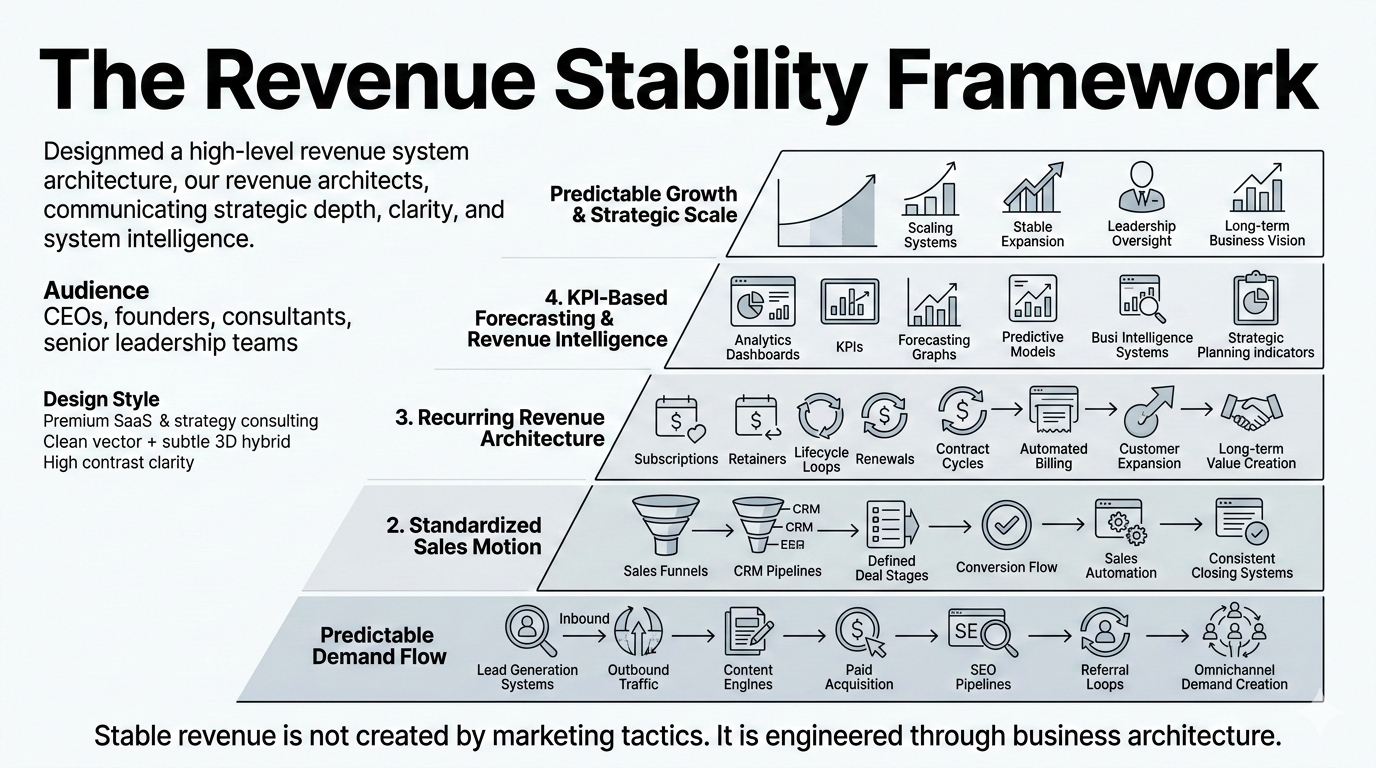
The Revenue Stability Framework (High-Level Model)
Stable companies do not rely on tactics.
They rely on revenue systems.
At a strategic level, revenue stability is built on five interconnected pillars:
| Pillar | Strategic Purpose | Business Impact |
|---|---|---|
| Predictable Demand Flow | Create steady inbound | Stable pipeline |
| Standardized Sales Motion | Control deal progression | Consistent conversion |
| Recurring Revenue Layer | Stabilize baseline income | Reduced volatility |
| KPI-Based Forecasting | Predict outcomes | Leadership clarity |
| Quarterly Revenue Architecture | Align execution | Sustainable growth |
This structure replaces chaos with logic.
Not effort.
Not hacks.
Not marketing tricks.
But system intelligence.
What Stable Revenue Actually Looks Like in Real Businesses
Stable revenue does not mean flat revenue.
It means:
Controlled monthly variance
Predictable deal velocity
Clear forecasting visibility
Confident planning cycles
Calm operational execution
Founders experience:
Mental clarity
Financial confidence
Strategic patience
Hiring certainty
Leadership stability
Stable revenue allows founders to move from firefighting mode to architect mode, where growth becomes intentional rather than emotional.
Why Predictable Systems Build Strong Companies
Revenue spikes feel good.
They create dopamine, relief, and temporary confidence.
But revenue systems build companies.
Stability creates:
Scale
Valuation
Operational calm
Strategic clarity
Predictable revenue is not a marketing outcome.
It is a leadership decision.
Founders who intentionally design revenue architecture outperform those who chase monthly spikes — every time.
If you think…
If your revenue goes up and down every month, the problem isn’t effort — it’s structure.
We help founders diagnose and rebuild revenue systems so growth becomes predictable instead of emotional, strategic instead of reactive, and scalable instead of fragile.
If you want clarity on what’s breaking your revenue flow — and what direction the fix requires — let’s have a strategic conversation.