
When founders ask me about ecommerce website development cost, the conversation usually begins with a simple assumption: “It’s just a website that sells products.”
But once we unpack what actually powers a modern ecommerce business, that assumption quickly changes.
An ecommerce platform today is not just a storefront. It is a digital commerce engine connecting product management, payments, logistics, marketing systems, customer data, and analytics into a single ecosystem designed to generate sales consistently.
Businesses across the United States, Canada, the United Kingdom, Europe, and Australia are investing heavily in ecommerce platforms because consumer behavior has fundamentally shifted. People now expect to discover products, compare options, and complete purchases online—often within minutes.
For founders and small businesses entering this space, understanding the cost to build an ecommerce website early in the planning stage helps avoid costly mistakes and ensures the platform is built with scalability in mind.
Before discussing pricing, however, it helps to understand how ecommerce platforms actually work behind the scenes.
Why E-commerce Is No Longer Optional for Businesses
Over the past decade, digital commerce has moved from being an optional sales channel to becoming a core revenue engine for modern businesses.
Retailers that once relied entirely on physical stores are now building online storefronts capable of reaching customers globally, allowing them to operate far beyond the limitations of geography.
This transformation has been accelerated by several factors:
• consumer preference for online shopping
• mobile-first purchasing behavior
• global logistics networks
• digital payment adoption
Because of this shift, businesses investing in ecommerce website development are not simply launching websites—they are building digital sales infrastructures that operate 24 hours a day.
For entrepreneurs launching new ventures or retailers transitioning online, the most common question becomes:
What does it actually cost to build a professional ecommerce platform capable of supporting real business growth?
The answer begins with understanding the structure of an ecommerce system.
How an E-commerce Website Actually Works
Many business owners initially assume that an ecommerce website functions like a typical company website with product pages added on top.
In reality, a modern online store platform operates as a connected system of technologies working together to manage products, process transactions, and deliver customer experiences.
The core structure of an ecommerce platform can be visualized as a layered ecosystem.
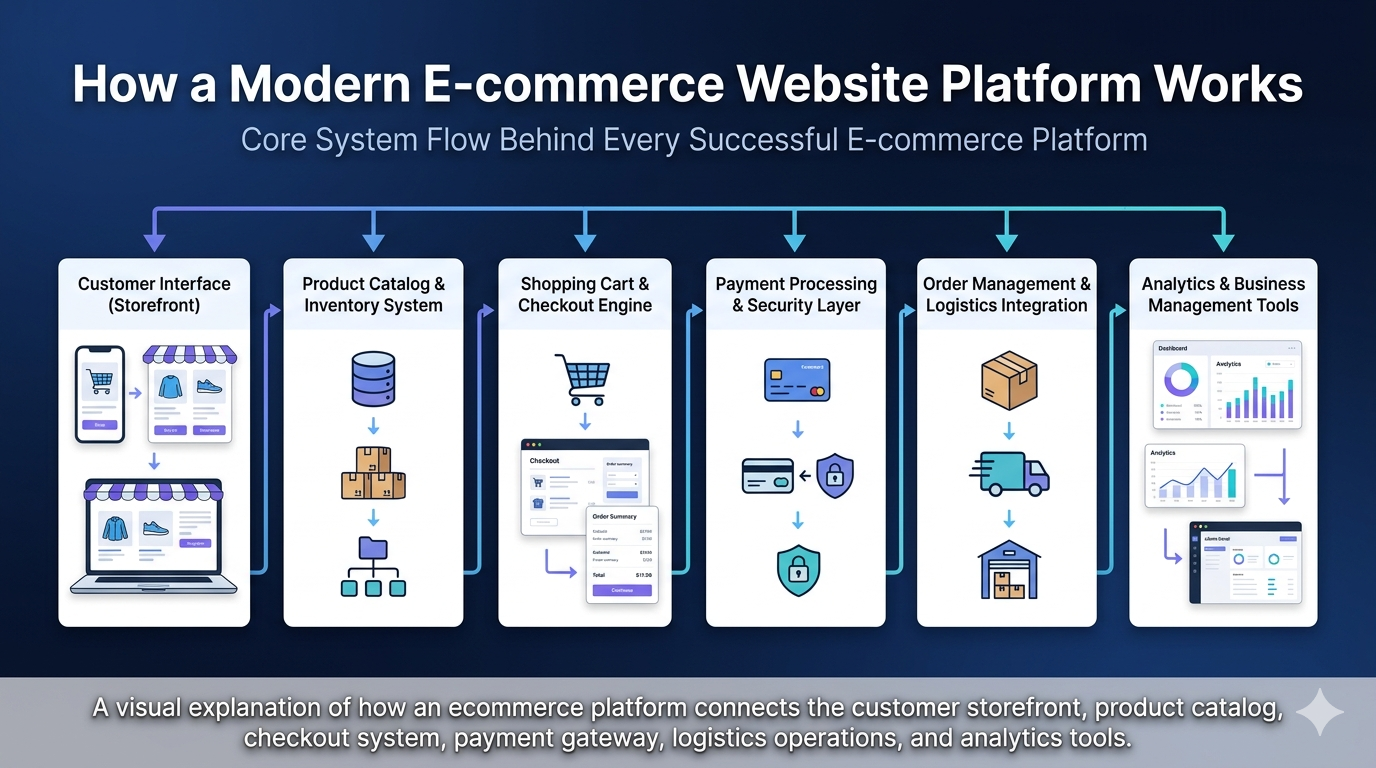
Each layer performs a specific role in enabling digital commerce operations.
| Platform Component | Business Role | Why It Matters |
|---|---|---|
| Customer Storefront | Displays products and enables shopping | Influences customer experience and conversions |
| Product Management System | Handles inventory, product data, and pricing | Keeps store operations organized |
| Checkout & Payment System | Processes purchases securely | Ensures smooth transactions |
| Order & Logistics System | Manages shipping and fulfillment | Connects ecommerce with real-world delivery |
| Analytics & Reporting | Tracks sales and customer behavior | Guides strategic decisions |
Because of this multi-layer structure, ecommerce website structure is far more complex than a simple marketing website.
Understanding this ecosystem helps explain why development costs vary widely.
Cost to Build an E-commerce Website in 2026 (Average Pricing)
One of the most common questions entrepreneurs ask is:
What is the average ecommerce website development cost?
The reality is that pricing varies depending on the complexity of the platform, the scale of the product catalog, and the level of customization required.
Below is a simplified overview of typical online store development cost ranges in 2026.
| Ecommerce Project Type | Typical Scope | Estimated Development Cost |
|---|---|---|
| Basic Ecommerce Store | Small business stores with essential product and checkout features | $3,000 – $15,000 |
| Mid-Level Ecommerce Website | Custom design, integrations, and advanced features | $15,000 – $60,000 |
| Scalable Ecommerce Platform | Enterprise-grade systems designed for high transaction volume | $60,000 – $200,000+ |
These ranges reflect typical industry pricing across markets such as the US, UK, Canada, and Europe, where ecommerce platforms must support advanced security, payment processing, and user experience expectations.
The key point founders should understand is that ecommerce platform cost is not determined by design alone.
The real cost depends on the operational complexity of the business.
Key Factors That Affect E-commerce Website Development Cost
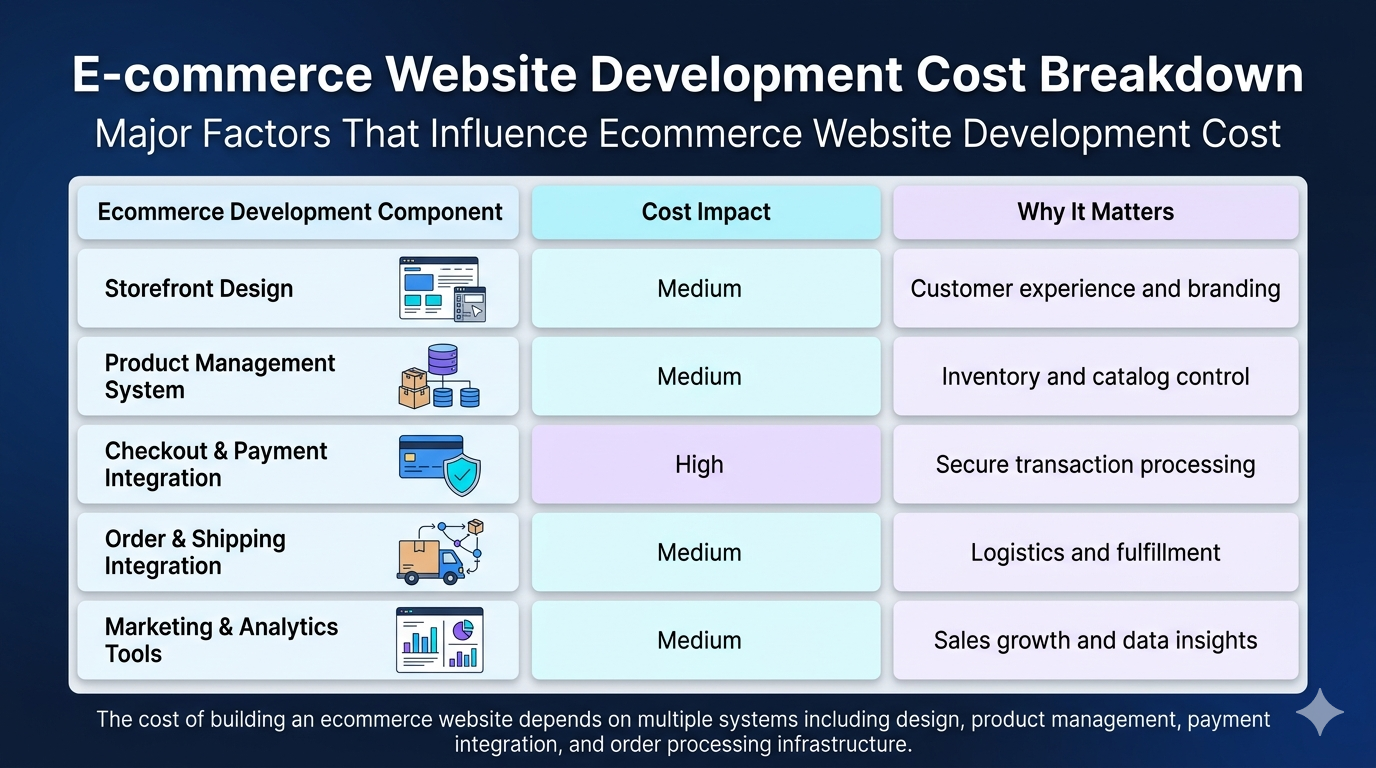
When planning ecommerce platform development, several factors directly influence the total investment required.
These factors usually emerge from the operational requirements of the business rather than the website itself.
| Cost Factor | Business Impact |
|---|---|
| Website Design & UX | Influences user trust and conversion rates |
| Product Catalog Size | Larger inventories require stronger management systems |
| Custom Features & Integrations | Systems such as CRM, shipping APIs, or ERP integrations increase complexity |
| Security & Payment Systems | Secure transactions are essential for customer trust |
For example, a startup selling 20 products may require a relatively simple platform, while a retailer managing thousands of SKUs across multiple markets will need a far more advanced infrastructure.
This is why online store cost factors differ significantly between businesses.
Essential Features Every Successful E-commerce Website Needs
A common mistake many founders make when planning an ecommerce platform is focusing primarily on design aesthetics while overlooking the functional elements that actually drive sales.
Successful ecommerce platforms prioritize features that improve user experience, trust, and purchasing convenience.
Below are essential ecommerce website features that modern online stores require.
| Feature | Purpose |
|---|---|
| Mobile-Optimized Product Pages | Ensures smooth shopping experiences on smartphones |
| Secure Checkout Process | Builds customer confidence during payment |
| Customer Accounts | Allows buyers to track orders and manage purchases |
| Advanced Search & Filters | Helps customers quickly find relevant products |
These online store features directly influence conversion rates.
A beautifully designed store that lacks an efficient checkout process or intuitive product search can easily lose potential customers.
Technology Stack Used to Build Modern E-commerce Platforms
When businesses begin exploring ecommerce technology stack options, they typically encounter several development approaches.
Each approach offers different levels of flexibility, scalability, and cost.
| Platform Type | Typical Use Case |
|---|---|
| Shopify | Ideal for startups launching quickly |
| WooCommerce | Popular for small businesses using WordPress |
| Custom Ecommerce Development | Used by companies requiring advanced scalability |
In recent years, modern ecommerce architectures have also introduced concepts such as headless ecommerce platforms, which separate the customer-facing storefront from backend commerce systems.
This approach allows businesses to deliver faster and more flexible digital experiences across websites, mobile apps, and other digital channels.
Additionally, cloud infrastructure and API integrations now play a significant role in enabling ecommerce platforms to scale as businesses grow.
Hidden Costs Founders Often Ignore
One of the biggest surprises for many businesses launching ecommerce stores is discovering that the true ecommerce budget extends far beyond initial development.
Several operational costs often appear after the platform is live.
| Hidden Cost | Explanation |
|---|---|
| Hosting & Infrastructure | Servers required to keep the store running smoothly |
| Payment Gateway Fees | Transaction charges applied to each purchase |
| Marketing & SEO | Necessary for attracting customers |
| Maintenance & Updates | Ongoing technical improvements and security patches |
These expenses are part of the long-term ecommerce maintenance cost that businesses must plan for when launching digital commerce platforms.
Ignoring them can create budget pressure later.
How Startups Can Build an E-commerce Website with a Lower Budget
Startups entering the ecommerce space often face financial constraints, which makes strategic planning even more important.
One effective approach is launching with a Minimum Viable Store (MVP)—a simplified version of the ecommerce platform focused on essential selling functionality.
Rather than investing heavily in complex systems immediately, startups can validate demand and refine their business model before expanding the platform.
Other elements of a strong ecommerce startup strategy include:
• focusing on core product categories first
• choosing scalable ecommerce platforms
• prioritizing features that directly impact sales
This approach allows founders to control development investment while still building a strong digital commerce foundation.
Common Mistakes Businesses Make When Launching Online Stores
Despite the growth of ecommerce, many businesses struggle to generate consistent sales after launching their platforms.
Often the issue is not the technology itself, but strategic mistakes made during the planning stage.
| Mistake | Business Impact |
|---|---|
| Prioritizing Design Over Conversions | Attractive stores that fail to generate sales |
| Ignoring SEO & Organic Traffic | Heavy reliance on paid marketing |
| Complex Checkout Processes | Customers abandon carts before purchasing |
These ecommerce conversion problems can significantly reduce revenue potential even when the store looks professionally designed.
Successful ecommerce platforms focus on simplifying the buying journey and building trust with customers.
The Real Cost of E-commerce Is Not the Website
When founders begin researching cost to build ecommerce website, they are often thinking about the development budget.
But after years of observing ecommerce businesses launch and scale, one insight becomes clear.
The real challenge is not building the website.
The real challenge is building a digital sales system that consistently generates revenue.
A successful ecommerce platform requires:
• conversion-focused website design
• strong product positioning
• trust-driven user experience
• consistent marketing and traffic acquisition
The website itself is simply the foundation of a larger ecommerce growth engine.
For businesses serious about building a profitable online store, the smartest approach is to consult experienced ecommerce platform development experts who can design a system aligned with long-term business goals.
Because the right ecommerce strategy does not just build a website.
It builds a sustainable digital commerce business.
Frequently Asked Questions (FAQ)
1. How much does it cost to build an ecommerce website?
The ecommerce website development cost varies depending on the size of the store, the number of products, and the level of customization required.
For most businesses in markets such as the United States, Canada, the United Kingdom, Europe, and Australia, the typical cost ranges are:
| Ecommerce Store Type | Estimated Cost |
|---|---|
| Small business ecommerce store | $3,000 – $15,000 |
| Mid-level ecommerce platform | $15,000 – $60,000 |
| Advanced scalable ecommerce system | $60,000 – $200,000+ |
However, the final cost to build ecommerce website depends on the business model, integrations, security requirements, and long-term scalability needs.
For an accurate estimate, it’s best to consult ecommerce development experts who can evaluate the specific platform requirements.
2. What factors affect ecommerce website development cost?
Several business and technical factors influence the online store development cost, including:
• website design and user experience
• number of products and categories
• custom features and integrations
• payment gateway and security systems
• logistics and shipping integrations
Because every ecommerce business operates differently, the ecommerce development pricing can vary significantly from one project to another.
3. What features are essential for a successful ecommerce website?
A successful ecommerce platform requires more than just product pages.
The most important ecommerce website features include:
| Feature | Why It Matters |
|---|---|
| Mobile-friendly design | Most ecommerce traffic comes from smartphones |
| Secure checkout system | Builds customer trust during payments |
| Customer accounts and order tracking | Improves post-purchase experience |
| Advanced search and product filters | Helps customers find products quickly |
These online store features directly impact customer satisfaction and conversion rates.
4. Which ecommerce platform is best for startups?
The best ecommerce platforms depend on the goals and budget of the business.
Many startups choose platforms such as:
• Shopify for quick ecommerce launches
• WooCommerce for flexible WordPress-based stores
• Custom ecommerce development for scalable platforms
Choosing the right ecommerce technology stack should always align with long-term growth plans rather than just the initial development cost.
5. What are the hidden costs of building an ecommerce website?
Many founders focus only on the initial build cost and overlook ongoing operational expenses.
Common hidden ecommerce costs include:
| Hidden Expense | Description |
|---|---|
| Website hosting and infrastructure | Required to keep the store running smoothly |
| Payment gateway transaction fees | Charges applied to each order |
| Marketing and SEO | Needed to attract customers to the store |
| Platform maintenance and updates | Ongoing technical improvements |
These costs form part of the long-term ecommerce maintenance cost that businesses must plan for.
6. How long does it take to develop an ecommerce website?
The development timeline depends on the complexity of the project.
Typical timelines include:
| Project Type | Development Time |
|---|---|
| Basic ecommerce store | 3 – 6 weeks |
| Mid-level ecommerce platform | 2 – 4 months |
| Large custom ecommerce system | 4 – 8 months |
The timeline may vary depending on the number of features, integrations, and design requirements.
7. Can startups build an ecommerce website with a small budget?
Yes. Many startups launch ecommerce platforms by focusing on a Minimum Viable Store (MVP).
This approach involves building a simplified ecommerce store with essential selling features first, then expanding the platform gradually as the business grows.
A smart ecommerce startup strategy allows founders to validate product demand before investing heavily in advanced infrastructure.
Need Help Planning Your Ecommerce Website?
If you are planning to build an ecommerce store or scale an existing online business, understanding the true ecommerce platform development cost requires analyzing your specific business model and technical requirements.
Our development team works with startups, retailers, and entrepreneurs to design scalable ecommerce platforms aligned with their growth goals.
If you want a clear estimate for your ecommerce website development cost, you can connect directly with our ecommerce specialists for a consultation.
Contact us today or schedule a call with our development team to discuss your ecommerce platform and receive a detailed cost estimate.