Introduction: Why German Startups Struggle With Website Decisions
Choosing between a custom vs template website in Germany has become one of the most misunderstood and underestimated decisions for early-stage and scaling startups across Berlin, Munich, Hamburg, Frankfurt, and Cologne, especially in 2026, where digital maturity, investor expectations, SEO performance, and compliance standards are significantly higher than just a few years ago.
For many founders, the website is initially seen as a branding task or a marketing checkbox — something that needs to look good, load fast, and support early traction — yet in reality, it quickly becomes a core business infrastructure layer, directly affecting customer acquisition, product credibility, sales conversions, operational scalability, investor confidence, and long-term valuation.
At the same time, Germany’s startup ecosystem is shaped by a distinct business mindset, one that values efficiency, technical precision, regulatory compliance, and long-term sustainability over short-term speed, which makes the decision between template website for startups in Germany and custom website development in Germany far more strategic than simply comparing price tags.
Most German founders face three competing pressures:
Launch fast to test market fit
Keep costs under control
Build something scalable that won’t collapse under growth
Balancing these forces is difficult, especially when website development costs in Germany are relatively higher than offshore markets, and when GDPR compliance, Core Web Vitals performance, and SEO for startups in Germany are no longer optional but mandatory.
This guide breaks down everything founders need to know — cost, scalability, ROI, SEO impact, compliance, and investor expectations — to help German startups make a decision that aligns with both short-term survival and long-term growth.
What Is a Template Website? (Germany Context + Cost Range in EUR)
A template website uses pre-built themes, layouts, and structural components offered by platforms like WordPress, Webflow, Shopify, Wix, or Squarespace, enabling startups to deploy a functional website quickly with minimal technical complexity.
In Germany, template websites are commonly adopted during pre-seed and MVP stages, especially within the Berlin startup ecosystem, where speed-to-market and experimentation often take priority during early validation cycles.
Typical Use Cases in Germany
Template websites are most commonly used by:
Bootstrapped founders
Solo entrepreneurs and consultants
Early-stage SaaS MVPs
Market validation projects
Local service startups
Startup Website Cost in Germany (Template-Based)
| Type | Cost Range (EUR) | Delivery Timeline |
|---|---|---|
| DIY Template Setup | €300 – €1,000 | 1–5 days |
| Professionally Customized Template | €1,200 – €4,000 | 1–3 weeks |
| Advanced Template + GDPR + SEO Setup | €2,500 – €6,000 | 2–4 weeks |
Advantages of Template Websites for German Startups
Low upfront investment, ideal for validation
Fast deployment, accelerating go-to-market
Easy content management
Wide plugin ecosystems
Structural Limitations That Surface Over Time
Bloated codebase impacting Core Web Vitals
Plugin dependency creating security risks
Limited SEO customization
Performance bottlenecks under traffic
Scalability restrictions
Increasing maintenance burden
In German markets — particularly in Munich tech startups and Frankfurt fintech sectors, where performance, compliance, and reliability are non-negotiable — these limitations often become business risks rather than technical inconveniences.
What Is a Custom Website? (Development Process in Germany)
A custom website is architected, designed, and developed from scratch to align precisely with a startup’s business model, user journeys, SEO objectives, compliance requirements, and long-term scaling plans, offering a far higher degree of flexibility and strategic control.
Custom Website Development Process in Germany
Business & Product Discovery
Deep analysis of goals, users, competitors, and monetization logic.UX Strategy & Conversion Planning
Mapping funnels, user journeys, behavioral flows, and trust signals.Technical Architecture Design
Backend structure, cloud infrastructure, database modeling, integrations.Custom UI/UX Design
Brand-aligned layouts, micro-interactions, accessibility optimization.Development & Integrations
API development, CMS integration, automation workflows.SEO & Performance Engineering
Core Web Vitals optimization, schema markup, crawl architecture.GDPR Compliance Implementation
Cookie consent logic, hosting alignment, data processing workflows.
Custom Website Development Cost in Germany (EUR)
| Website Type | Cost Range (EUR) | Timeline |
|---|---|---|
| Startup Landing Website | €4,000 – €9,000 | 3–6 weeks |
| SaaS Website Platform | €8,000 – €18,000 | 6–12 weeks |
| Enterprise / Marketplace Website | €15,000 – €40,000+ | 3–6 months |
Custom websites reflect Germany’s engineering-first philosophy, where stability, reliability, and scalability are prioritized over short-term shortcuts.
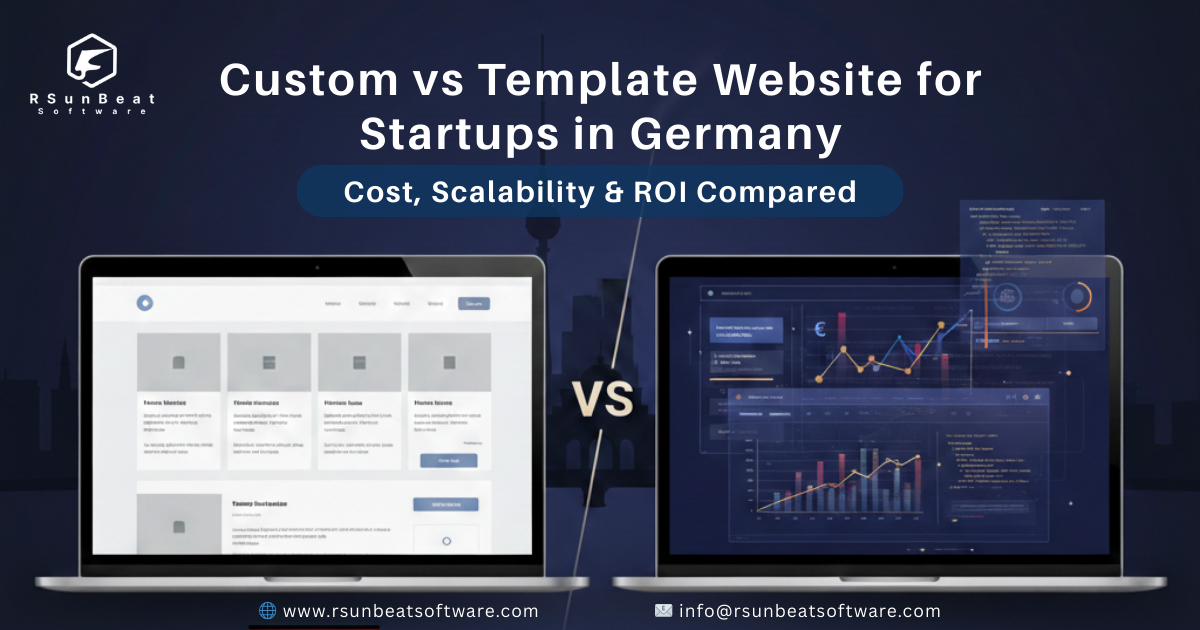
Cost Comparison in Germany (Custom vs Template)
| Factor | Template Website | Custom Website |
|---|---|---|
| Initial Cost | €300 – €6,000 | €4,000 – €40,000+ |
| Time to Launch | Very Fast | Moderate |
| Flexibility | Low–Medium | High |
| Scalability | Limited | High |
| SEO Potential | Moderate | Excellent |
| Core Web Vitals | Often Weak | Optimized |
| GDPR Compliance | Plugin-Based | Built-In |
| Long-Term ROI | Low–Medium | High |
| Maintenance Cost | Rising | Predictable |
Key Insight:
Template websites reduce initial capital burn, while custom websites reduce long-term operational friction, technical debt, and rebuilding costs.
Scalability & Startup Growth (Investor Expectations in Germany)
German investors assess startups not just on ideas and traction, but on technical maturity, scalability readiness, and infrastructure robustness.
In cities like Berlin and Munich, where SaaS, AI, fintech, and deep-tech funding is concentrated, investors increasingly evaluate:
Technical architecture
Security posture
Performance benchmarks
Compliance readiness
Scalability pathways
Why Scalability Matters Early
German startups aiming to expand across the EU must prepare for:
Multi-language systems
Cross-border compliance
Heavy traffic growth
Enterprise onboarding
Integration complexity
A template-based foundation often becomes a structural ceiling, forcing expensive rebuilds just as growth accelerates.
ROI Comparison: Short-Term vs Long-Term Value
Short-Term ROI (0–6 Months)
Template Websites
Minimal upfront investment
Rapid deployment
MVP-friendly
Limited SEO leverage
Custom Websites
Higher initial spend
Strong brand positioning
SEO groundwork
Conversion optimization
Long-Term ROI (12–36 Months)
Template Websites
Rising maintenance cost
Performance degradation
SEO stagnation
Architectural rebuilds
Custom Websites
Compounding organic growth
Stable performance
Higher conversion rates
Lower total ownership cost
Website ROI in Germany Reality:
Startups that invest early in scalable website architecture typically achieve 30–60% lower long-term operational costs and significantly higher organic acquisition efficiency.
SEO & Performance in Google Germany (Core Web Vitals + Technical SEO)
Ranking on google.de demands more than good content — it requires technical excellence.
Core Web Vitals Benchmarks
LCP < 2.5s
FID < 100ms
CLS < 0.1
Template websites often struggle due to:
Plugin overload
Unoptimized themes
Heavy JavaScript bundles
Custom websites enable:
Lean architecture
Performance-first design
Advanced caching
CDN-based delivery
SEO Advantages of Custom Websites
Clean crawl structure
Advanced schema markup
Logical internal linking
Precise page-level optimization
Superior indexation control
For SEO for startups in Germany, custom architecture consistently outperforms templates in high-competition sectors.
When to Choose Template (MVP, Bootstrapped Founders)
Template websites are suitable when:
You’re testing an idea
Budget is highly constrained
Speed matters more than scale
SEO is not yet critical
Product scope is narrow
Typical German Scenarios
Pre-seed Berlin SaaS validation
Freelancers building brand presence
Market experiments
Local service MVPs
Here, templates reduce risk and allow lean experimentation.
When to Choose Custom (Funded Startups, SaaS, Scaling EU)
Custom websites are ideal when:
You have funding
SEO is core to growth
Product complexity is increasing
You plan EU expansion
Investors are evaluating technical maturity
Typical German Scenarios
Munich SaaS companies
Frankfurt fintech startups
Berlin AI and health-tech firms
Hamburg logistics startups
In these environments, custom website development in Germany becomes a growth engine, not a cost center.
Expert Insight: What German Founders Often Underestimate
Many founders delay custom architecture, assuming they can rebuild later.
In practice:
Rebuild costs are 2–4× higher
SEO authority resets
Conversion rates drop during migrations
Engineering complexity multiplies
Smart founders view website architecture as long-term business infrastructure, not marketing collateral.
Final Verdict for German Startups
The decision between custom vs template website Germany ultimately depends on stage, ambition, and growth trajectory.
Early validation → Template
Funded scaling → Custom
Germany’s business culture rewards precision, planning, and structural foresight, and startups that design for scalability early typically outperform competitors across SEO, conversions, investor trust, and operational efficiency.
Frequently Asked Questions (Schema-Ready)
Q1: What is the average startup website cost in Germany?
Startup website costs in Germany range from €300 for templates to €40,000+ for enterprise-grade custom platforms, depending on complexity and scalability.
Q2: Is a custom website worth it for early-stage startups?
For funded startups and SaaS companies, custom websites deliver higher long-term ROI, better SEO performance, and scalable infrastructure, making them worth the investment.
Q3: Are template websites GDPR compliant in Germany?
Template websites rely heavily on plugins for GDPR compliance, increasing risk. Custom websites embed privacy-by-design principles directly into architecture.
Q4: Which website type ranks better in Google Germany?
Custom websites consistently outperform templates due to Core Web Vitals optimization, structured data, clean code, and scalable SEO foundations.
Q5: Should SaaS startups in Germany invest in custom websites?
Yes. SaaS startups benefit significantly from custom UX, SEO optimization, security architecture, and scalable backend systems.