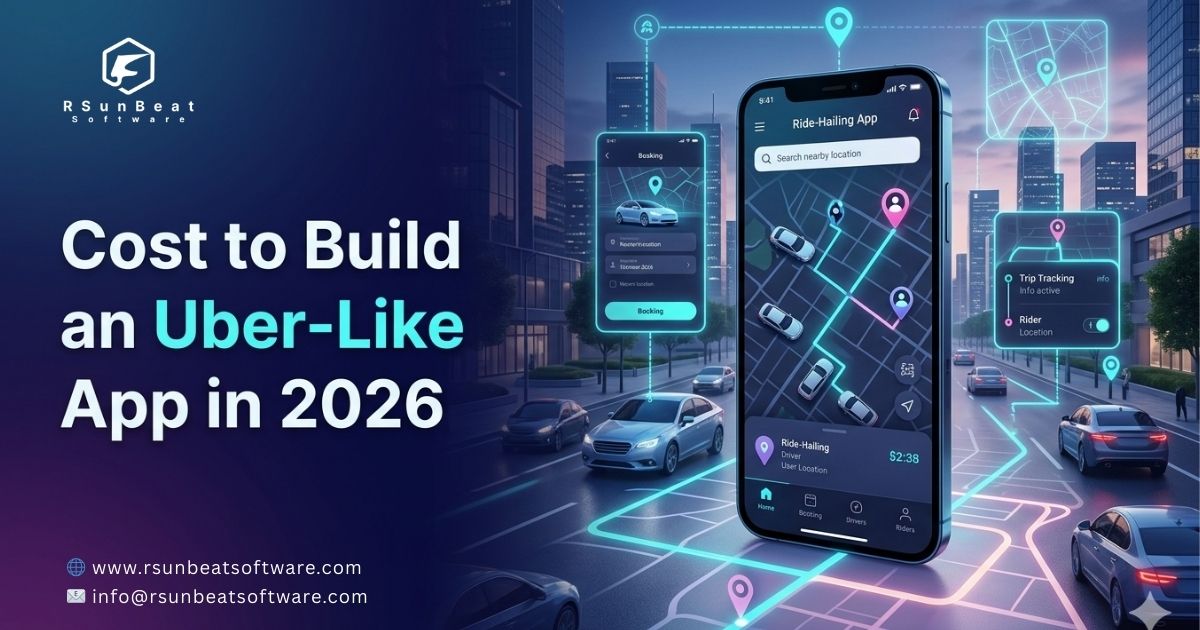
When founders begin researching Uber-like app development cost, the question often appears simple on the surface: How much money does it take to build a ride-sharing app like Uber?
However, after years of observing how startups approach digital platforms, I can confidently say that the real conversation is rarely about the mobile application alone. The real question founders are trying to answer is much deeper:
What level of investment is required to launch a scalable ride-sharing platform that can compete in a real mobility market?
A ride-sharing system is not a single application. It is a multi-layer digital ecosystem that connects passengers, drivers, and platform operators through real-time infrastructure, intelligent matching systems, and secure payment processing.
This is why the Uber-like app development cost in 2026 varies dramatically depending on the product scope, the scale of the mobility network being built, the geographic market being targeted, and the long-term operational strategy of the startup.
Before discussing the numbers, it is important to understand why entrepreneurs around the world continue to explore ride-sharing platforms.
Why So Many Startups Want to Build an Uber-Like App in 2026
Over the last decade, ride-sharing platforms have transformed urban transportation across the globe, and even today the on-demand mobility industry continues expanding in cities across the USA, UK, Europe, UAE, and Australia, creating opportunities for new startups that want to introduce specialized transportation services or localized ride networks.
What makes the Uber-like app business model so attractive is the structure of the platform itself.
Ride-sharing platforms operate as two-sided marketplaces, where technology acts as the bridge connecting passengers who need transportation with drivers who provide mobility services.
This structure enables a powerful business dynamic.
Once both sides of the marketplace begin interacting regularly, the platform generates continuous transactions, and the company earns revenue from each ride.
Below is a simplified diagram that explains how ride-sharing marketplaces operate.

Because of this structure, the success of a ride-sharing platform depends not only on the technology but also on market adoption, driver supply, rider demand, and operational efficiency.
This is why startups researching ride sharing app development must think beyond the application itself and focus on the full mobility ecosystem.
How Uber-Like Apps Actually Work
A ride-sharing platform may appear simple to users who only see the mobile interface, but behind the scenes the system is composed of several interconnected digital components that operate simultaneously.
The architecture typically includes multiple applications and infrastructure layers working together in real time.
The table below illustrates the primary components of a ride sharing app platform.
| Platform Component | Role in the System | Strategic Importance |
|---|---|---|
| Rider Mobile Application | Allows passengers to request rides, track drivers, and make payments | Core user interface for customers |
| Driver Mobile Application | Enables drivers to accept trips and navigate routes | Manages driver operations |
| Admin Management Dashboard | Allows platform operators to monitor rides and manage drivers | Operational control center |
| Real-Time Matching Engine | Connects nearby drivers with passenger requests instantly | Critical for ride efficiency |
| GPS Tracking System | Provides live location tracking for safety and navigation | Essential for real-time mobility |
What makes taxi app development unique compared with typical mobile apps is the need for constant synchronization between these components.
For example, when a passenger requests a ride, the system must instantly analyze driver availability, calculate distances, determine estimated arrival times, and initiate communication between both parties.
This entire process occurs in seconds, which explains why building a reliable ride sharing app platform requires sophisticated backend infrastructure.

Cost to Build an Uber-Like App in 2026 (Average Budget)
One of the most frequently searched queries among startup founders is the Uber-like app development cost, yet the answer varies widely depending on the scope of the product and the scale of the marketplace being built.
Some startups launch small city-level ride platforms, while others attempt to build large systems capable of supporting thousands of simultaneous users.
The following table provides a realistic overview of taxi app development cost ranges in 2026.
| App Type | Product Scope | Estimated Development Cost |
|---|---|---|
| Basic MVP Ride-Sharing App | Core rider and driver apps with essential booking functionality | $50,000 – $120,000 |
| Mid-Level Taxi Marketplace Platform | Additional features such as ratings, payments, and analytics | $120,000 – $300,000 |
| Advanced Uber-Style Platform | Real-time scaling infrastructure, analytics, and operational tools | $300,000 – $700,000+ |
These numbers reflect typical industry budgets, but actual costs depend on the complexity of the system, the number of features implemented, and the technology stack selected during the product planning phase.
For many founders researching Uber clone app cost, the most important realization is that the first version of the product is only the beginning of the platform’s lifecycle.
Operating the platform requires continuous investment in infrastructure, updates, and market expansion.

Key Features That Affect Uber-Like App Development Cost
Not all ride-sharing apps require the same level of technological sophistication, which is why the ride sharing app development cost varies depending on the features included in the platform.
Certain capabilities significantly increase development complexity because they rely on real-time data processing and advanced backend systems.
Below is a structured breakdown of ride sharing app features that influence development cost.
| Feature | Function | Impact on Development |
|---|---|---|
| GPS Location Tracking | Provides real-time driver and rider location | Requires continuous geolocation data |
| Ride Matching System | Connects passengers with nearby drivers | Needs real-time algorithms |
| Payment Gateway Integration | Processes digital payments securely | Requires compliance and security layers |
| Driver Rating System | Builds trust and accountability in the platform | Requires data storage and moderation |
| Dynamic Pricing Algorithm | Adjusts fares during peak demand | Requires demand-supply analysis |
Because these features operate simultaneously, taxi booking app development involves building systems capable of processing real-time events across thousands of devices.
This is why ride-sharing platforms require careful product architecture planning before development begins.
Technology Stack Used to Build Taxi Apps
The taxi app technology stack forms the foundation of the platform’s performance, scalability, and long-term maintainability.
Rather than being a single tool, the stack includes multiple layers working together to support both the mobile applications and backend infrastructure.
The following diagram illustrates the typical architecture used in ride sharing app development.

Each layer plays a critical role in enabling the platform to handle ride requests, process payments, and track vehicles in real time.
When founders research taxi app technology stack options, they are essentially deciding how the platform will scale as user demand increases.
Uber-Like App Development Cost by Region
Another important factor influencing mobile app development cost by country is the geographic location of the development team.
Engineering rates vary significantly across different global markets due to differences in labor costs, technology ecosystems, and industry demand.
The table below highlights average development rates in major regions.
| Region | Average Development Rate |
|---|---|
| USA & Canada | $100 – $200 per hour |
| UK & Western Europe | $80 – $150 per hour |
| UAE & Australia | $70 – $130 per hour |
| Offshore Development (Asia) | $25 – $60 per hour |
Because of these differences, many startups exploring taxi booking app development choose offshore development teams to reduce early product investment while still accessing experienced engineers.
However, selecting the right development partner requires careful evaluation of expertise, communication processes, and product strategy alignment.
Hidden Costs Most Founders Don’t Expect
One of the most overlooked aspects of Uber-like app development cost is the operational expense required to maintain and scale the platform after launch.
Many founders initially budget for development but fail to account for ongoing infrastructure and operational costs.
The table below highlights common hidden mobile app development costs.
| Hidden Cost | Explanation |
|---|---|
| Cloud Infrastructure | Servers required to manage real-time ride tracking |
| Payment Gateway Fees | Transaction charges for each ride payment |
| App Store Fees | Distribution costs on mobile platforms |
| Platform Maintenance | Continuous updates, bug fixes, and feature improvements |
| Customer Support Systems | Tools required to manage rider and driver issues |
For many mobility platforms, mobile app maintenance cost can represent 15–25% of the original development investment each year, particularly as the user base grows.
This is why successful startups approach ride-sharing platforms as long-term digital businesses rather than short-term software projects.
How Startups Reduce Taxi App Development Costs
Although the numbers associated with ride sharing app development can appear intimidating, many startups successfully launch mobility platforms by using strategic development approaches.
One of the most effective strategies is launching with an MVP app development strategy, which focuses on building only the essential features required to validate market demand.
Rather than building a fully complex system immediately, startups introduce a simplified version of the platform and expand it gradually based on real user feedback.
Common cost-reduction strategies include:
• launching in a single city
• prioritizing core ride-booking features
• using cross-platform mobile development frameworks
• expanding infrastructure only after market traction
This approach allows startups to test their mobility concept while maintaining financial control.

Common Mistakes Founders Make When Building Ride-Sharing Apps
Even though ride-sharing platforms appear attractive, many startups encounter challenges because of strategic mistakes made during the early planning stage.
One of the most common ride sharing startup mistakes is attempting to replicate Uber directly without offering a unique value proposition.
Successful startups usually focus on solving specific transportation problems, such as airport mobility, corporate transportation networks, electric vehicle fleets, or city-specific taxi services.
Other common mistakes include:
| Strategic Mistake | Consequence |
|---|---|
| Ignoring Driver Acquisition Strategy | Platform lacks enough drivers to serve demand |
| Building Technology Before Market Validation | Product launches without users |
| Underestimating Operational Complexity | Difficulty managing driver networks |
| Copying Existing Platforms | Lack of competitive differentiation |
Technology alone cannot guarantee success in the mobility industry.
The real challenge lies in balancing driver supply, rider demand, and operational efficiency.
The Real Cost Isn’t the App — It’s the Business Model
After analyzing hundreds of startup discussions around Uber-like app development cost, one pattern becomes clear.
Most founders initially focus on the technology budget, but the real investment required to build a successful ride-sharing platform goes far beyond the mobile application itself.
The real challenge is building a two-sided marketplace that continuously attracts riders and drivers while maintaining operational sustainability.
Technology can always be developed.
But a successful mobility platform requires:
• strong market strategy
• operational execution
• driver network development
• continuous product iteration
This is why experienced founders rarely launch large platforms immediately.
Instead, they start small.
They validate the market.
Then they scale the platform once demand becomes clear.
Because in the world of mobility startups, success rarely comes from simply building an app.
It comes from building a sustainable digital transportation ecosystem that can grow with the market.