

Why App Development Cost Is One of the Biggest Questions for Founders
When founders begin exploring the idea of launching a mobile application, one of the first questions that naturally comes to mind is simple yet complex at the same time: what is the real cost to build a mobile app, and more importantly, how should a business realistically plan its app development budget without underestimating the technical, operational, and strategic layers involved in turning a concept into a functioning digital product.
In my experience working with startups and growing companies, many founders initially assume that building an app is similar to building a website—define a few features, hire developers, launch the product, and the system begins generating value. The reality is very different.
A modern mobile application is not just a piece of software installed on a smartphone; it is a digital platform composed of multiple interconnected systems, including backend infrastructure, user authentication, security layers, payment processing, analytics, notification systems, and continuous updates that ensure the product remains functional and competitive as technology evolves.
Because of this, the mobile app development cost in 2026 varies significantly depending on product complexity, technology architecture, development team expertise, and the strategic decisions made during the early stages of product planning.
Understanding these variables early helps founders avoid one of the most common mistakes in startup product development—building something expensive before validating whether the market truly needs it.
Average Cost to Build a Mobile App in 2026
While every product is different, industry trends provide useful benchmarks that help founders estimate realistic app development pricing ranges.
The following table provides a simplified overview of how mobile app development cost typically varies depending on the scale and complexity of the application.
| App Type | Typical Features | Estimated Cost Range |
|---|---|---|
| Simple Utility App | Basic functionality, limited backend systems, simple UI | $10,000 – $40,000 |
| MVP Startup App | Core features, user authentication, backend infrastructure | $40,000 – $120,000 |
| Full-Scale Mobile Platform | Advanced workflows, integrations, real-time data | $120,000 – $350,000 |
| Enterprise Mobile Application | Complex infrastructure, integrations, security compliance | $200,000 – $500,000+ |
This breakdown illustrates an important reality that many founders discover during product planning: the difference between building a simple application and building a scalable digital product can represent a multiple-fold increase in investment.
For this reason, experienced startups rarely begin by building a complete product. Instead, they begin with an MVP development strategy, which allows them to validate assumptions before expanding the platform.
Key Factors That Affect Mobile App Development Cost
The cost to develop an app is not determined by a single factor but by a combination of product design decisions, technical architecture, and business requirements that shape the development process.
The diagram below illustrates the primary drivers behind mobile app development factors.
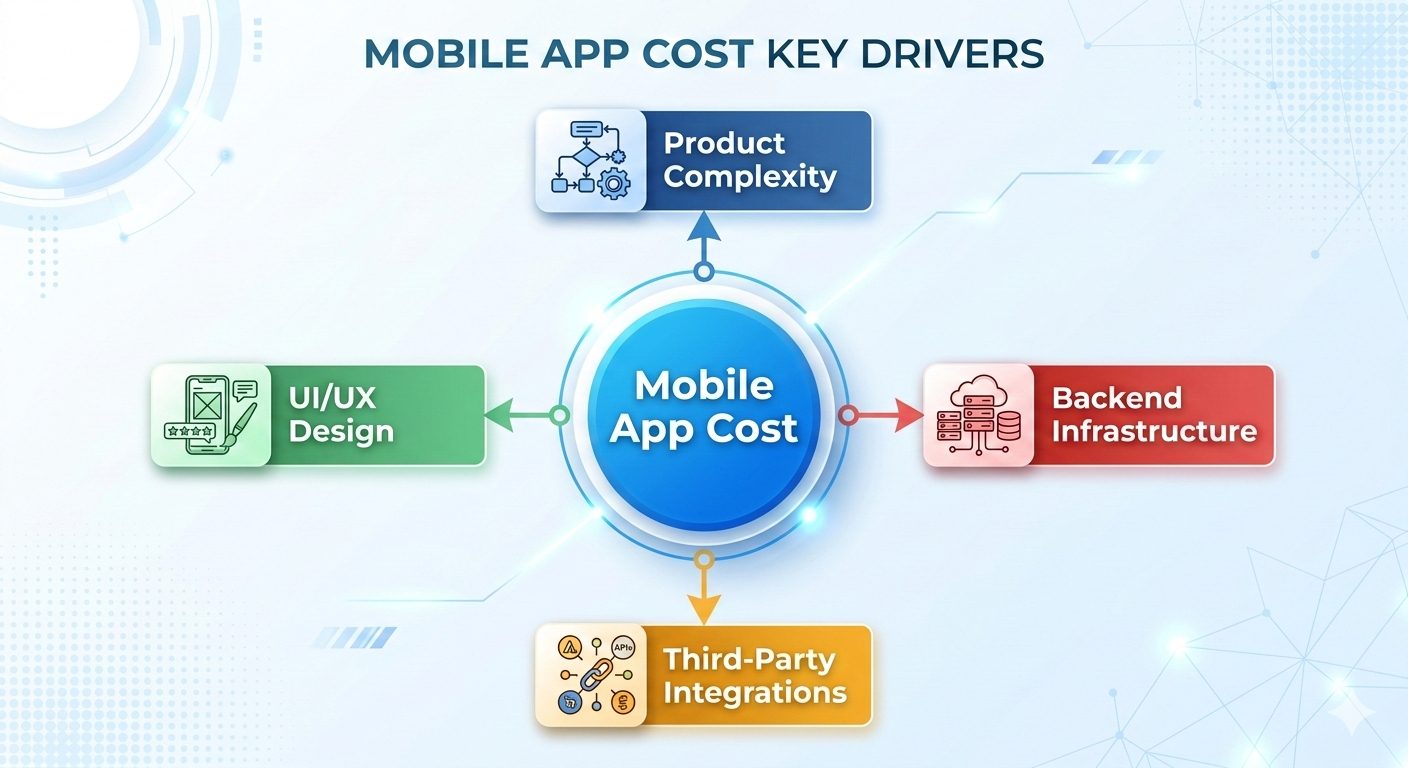
Each of these elements influences the overall app development cost breakdown.
Product Complexity
The more sophisticated the product functionality becomes, the more development time and engineering expertise are required. For example, an app that allows users to read articles will require significantly less infrastructure than a platform that manages transactions, real-time communication, and personalized user experiences.
UI/UX Design Requirements
User experience plays a crucial role in determining whether an application succeeds or fails in the market. Advanced interface design, custom animations, and optimized user journeys often require additional design and development work, which directly impacts the mobile app development cost.
Backend Infrastructure
Many founders initially focus on the mobile interface, but the majority of the system complexity actually exists in the backend architecture, which manages user accounts, databases, APIs, notifications, and integrations with external services.
Third-Party Integrations
Modern mobile applications often integrate with payment gateways, mapping services, messaging tools, analytics platforms, and cloud infrastructure. Each integration increases development effort and expands the technical scope of the project.
Cost Breakdown by App Type
Another useful way to estimate the cost to build a mobile app is by analyzing how different product categories require different levels of engineering effort. When founders search for the cost to build an app like Uber, they often discover that the underlying platform includes far more complexity than expected, including real-time GPS tracking, payment systems, dynamic pricing algorithms, and large-scale data infrastructure.
This is why marketplace and platform applications tend to fall within the higher end of the mobile app development cost 2026 spectrum.
Mobile App Development Cost by Platform
Another strategic decision that significantly impacts the app development budget is the choice of platform.
Some companies build applications exclusively for a single ecosystem, while others aim to reach users across multiple platforms simultaneously.
| Platform | Description | Typical Cost Range |
|---|---|---|
| iOS Development | Apps designed specifically for Apple devices | $40K – $250K+ |
| Android Development | Apps optimized for the Android ecosystem | $50K – $250K+ |
| Cross-Platform Development | Apps built using frameworks like Flutter or React Native | $40K – $200K+ |
The cross-platform app development cost is often lower than building two completely separate native applications, which is why many startups choose this approach when launching their first product.

Cost Breakdown by Development Stage
Mobile app development is not a single activity but a sequence of structured stages that collectively shape the final product.
The table below summarizes the typical mobile app development process.
| Development Stage | Purpose |
|---|---|
| Product Research & Strategy | Validating the business idea and defining core features |
| UI/UX Design | Creating wireframes, user journeys, and visual design |
| Development & Engineering | Building the mobile interface and backend systems |
| Testing & Quality Assurance | Ensuring the product performs reliably across devices |
| Launch & Maintenance | Deploying the product and supporting long-term updates |
Each stage contributes to the overall app development pricing, and skipping early strategic phases often leads to costly revisions later in the project.
Mobile App Development Cost by Region
Another major factor influencing mobile app development cost by region is the geographic location of the development team.
Different markets offer different combinations of expertise, hourly rates, and project management structures.
| Region | Average Hourly Rate |
|---|---|
| North America | $100 – $200 per hour |
| Western Europe | $70 – $150 per hour |
| Eastern Europe | $40 – $90 per hour |
| Asia (Offshore Development) | $20 – $50 per hour |
Many businesses explore offshore app development cost options to reduce development expenses, although selecting the right development partner remains essential to ensure product quality and communication efficiency.
Hidden Costs of Mobile App Development
One of the most common budgeting mistakes founders make is focusing only on the initial development cost while overlooking the ongoing expenses required to maintain and scale a mobile platform.
Common Hidden Costs
| Cost Category | Description |
|---|---|
| App Maintenance | Regular updates, bug fixes, and performance optimization |
| Cloud Infrastructure | Server hosting, databases, and cloud services |
| App Store Fees | Distribution costs for Apple App Store and Google Play |
| Security & Compliance | Data protection, encryption, regulatory compliance |
Typically, mobile app maintenance cost represents 15%–25% of the original development cost per year, which makes long-term planning essential for startups launching digital products.
How Startups Can Reduce App Development Costs
While mobile app development can require significant investment, there are strategic approaches that allow startups to control costs without compromising product quality.
The diagram below summarizes several high-level strategies that help reduce app development budget pressure.
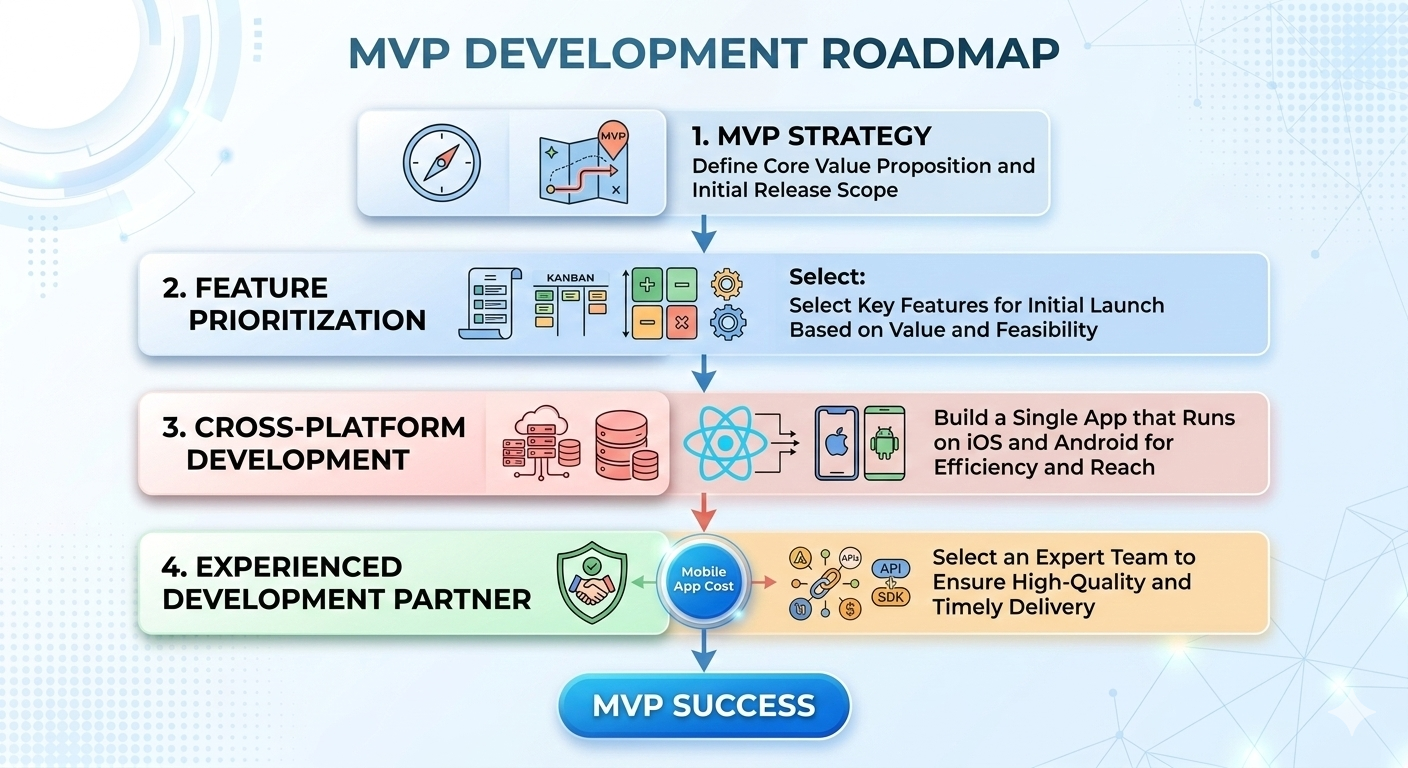
Start with an MVP
An MVP development strategy allows startups to release a simplified version of their product that focuses on solving the core user problem while avoiding unnecessary features during the early stages.
Prioritize Core Features
Many founders attempt to include every potential feature in the first version of their product, which dramatically increases development complexity and cost.
Successful startups usually launch with a focused set of core capabilities.
Consider Cross-Platform Development
Using cross-platform technologies allows businesses to reach both iOS and Android users without duplicating development effort.
Choose the Right Development Partner
Perhaps the most important factor is selecting a product development partner who understands both the technical and strategic aspects of building scalable digital platforms.
The Real Cost of an App Isn’t Development — It’s Building the Wrong Product
After observing how many startups approach mobile product development, one insight becomes increasingly clear.
Most founders spend significant time worrying about the cost to build a mobile app, yet the greatest financial risk is not the development investment itself.
The real risk is building a product that fails to solve a meaningful problem.
Smart founders approach mobile development differently.
They start with a clear problem.
They validate the idea.
They build gradually, learning from real users rather than assumptions.
Because in the long run, the real objective is not simply launching an application.
The goal is building a scalable digital product capable of evolving into a sustainable business, and that journey almost always benefits from the guidance of experienced product strategists and development experts who understand both the technology and the market dynamics shaping modern digital platforms.