The cloud kitchen industry has moved far beyond experimentation. In 2026, cloud kitchens are one of the fastest-scaling food business models globally, driven by changing consumer behavior, rising delivery demand, and the increasing cost pressure on traditional restaurants. However, the real differentiator between successful cloud kitchen brands and those that struggle is no longer food quality alone—it is technology execution.
At the center of this transformation is cloud kitchen app development. A well-built cloud kitchen app does more than accept orders. It automates operations, optimizes margins, centralizes multi-brand management, and provides data intelligence that traditional kitchens simply cannot access. This guide is written for founders, restaurant chains, and food-tech startups who want clarity on features, cost, business models, and technology decisions before investing.
What Is a Cloud Kitchen App?
A cloud kitchen app is a digital ecosystem designed to manage delivery-first food businesses without dine-in operations. Unlike traditional restaurant software, cloud kitchen software solutions are built to handle high order volumes, multiple brands, centralized kitchens, and automated workflows.
The key distinction between cloud kitchens and aggregator platforms is ownership. Aggregators control customer data, commissions, and visibility. A custom cloud kitchen app gives brands full control over their customers, pricing strategy, promotions, kitchen workflows, and operational data.
In 2026, a cloud kitchen app is no longer a simple ordering system. It acts as a multi-brand kitchen management platform, integrating ordering, kitchen execution, logistics, analytics, and growth planning into a single system. For virtual kitchens, dark kitchens, and enterprise restaurant chains, the app becomes the business itself.
How Does a Cloud Kitchen App Work? (End-to-End Flow)
Understanding how a cloud kitchen app works requires looking beyond the user interface and into operational automation.
The process starts when a customer places an order through the customer app or web platform. The system instantly checks menu availability, kitchen capacity, and delivery feasibility before confirming the order. Advanced platforms use intelligent routing logic to assign orders to the most efficient kitchen location based on distance, workload, and preparation time.
Once confirmed, the order is sent to the Kitchen Order Management System (KOMS). Here, orders are automatically prioritized, categorized by preparation station, and scheduled to meet delivery timelines. Kitchen staff do not manually track tickets—the system orchestrates everything in real time.
After preparation, the app coordinates with delivery partners, whether third-party services or in-house fleets. Customers receive real-time updates, while the admin dashboard captures data on preparation time, delivery efficiency, cancellations, and customer behavior.
This end-to-end automation is what allows cloud kitchens to scale without proportional increases in staff or operational chaos.
Must-Have Features in a Cloud Kitchen App (2026 Ready)
Customer App Features
The customer app directly impacts acquisition and retention. In 2026, users expect speed, clarity, and personalization. Essential features include real-time menu updates, smart recommendations, order tracking, multiple payment options, and personalized offers based on ordering history. Loyalty programs and wallet integrations are no longer optional—they significantly improve repeat order rates.
Kitchen Panel Features
The kitchen panel is the operational backbone. Automated order sequencing, preparation timers, ingredient alerts, and staff task assignment help kitchens operate efficiently even during peak demand. For multi-brand kitchens, brand-level segregation prevents cross-brand confusion and maintains quality consistency.
Admin Dashboard Features
The admin dashboard determines scalability. Features like multi-location management, commission control, analytics, role-based access, menu optimization tools, and financial reporting enable founders to run cloud kitchens like technology-driven businesses rather than manual operations.
Modern cloud kitchen app features are designed to protect margins, reduce waste, and enable data-driven decisions.
Cloud Kitchen App Business Models Explained
Choosing the right business model influences both revenue strategy and technical architecture.
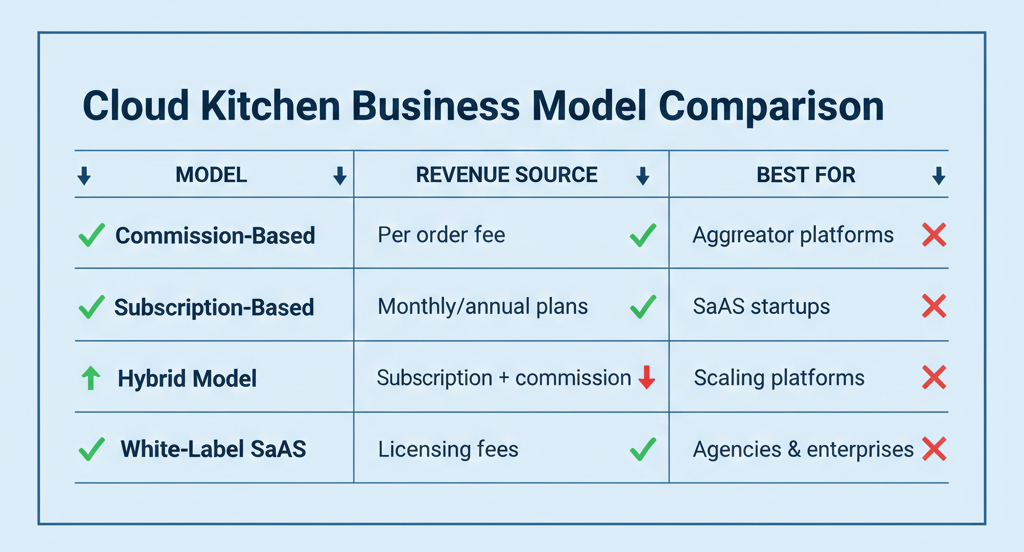
The commission-based model is commonly used by aggregator-style platforms that onboard multiple kitchens and earn per-order commissions. This model requires high transaction volume and strong vendor acquisition.
The subscription-based model is popular for SaaS-style cloud kitchen software, where restaurants pay monthly or annual fees for access to kitchen management tools, analytics, and CRM features. This model offers predictable recurring revenue.
The hybrid model, combining subscriptions with transaction fees, balances cash flow and scalability and is widely adopted by growing platforms.
The white-label cloud kitchen app model allows companies to license their platform to restaurants or brands, enabling rapid expansion without managing kitchen operations directly. This model is particularly effective for food-tech startups and agencies.
Startups often prefer subscription or hybrid models, while enterprises lean toward white-label and fully customized deployments.
Cloud Kitchen App Development Cost (Complete Breakdown)
One of the most critical questions founders ask is: How much does cloud kitchen app development cost?
The answer depends on scope, complexity, and scalability goals.
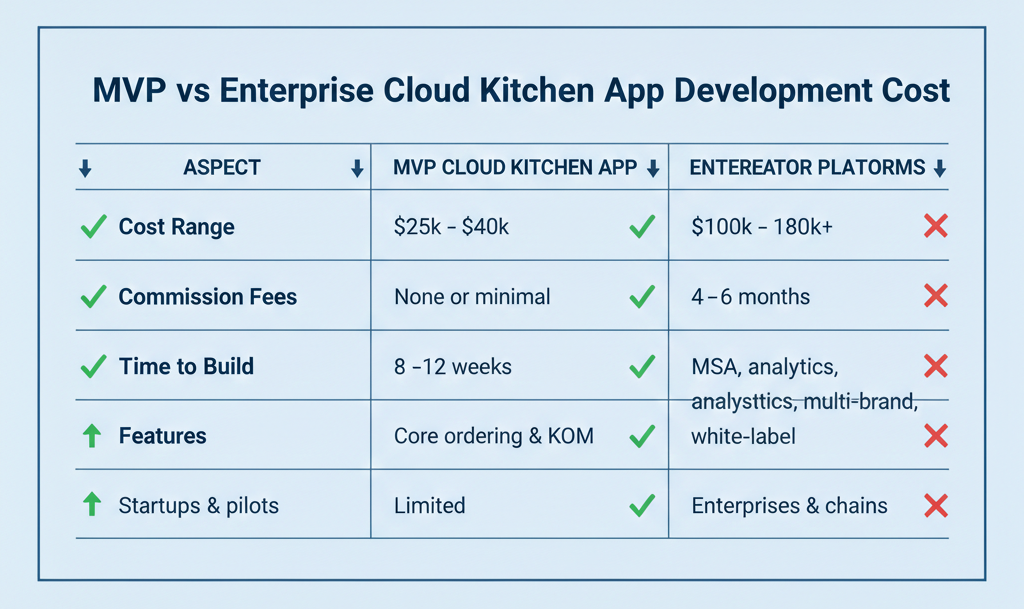
A basic MVP cloud kitchen app with customer ordering, kitchen panel, and admin dashboard typically costs $25,000 to $40,000. This version focuses on core workflows without advanced analytics or automation.
A mid-level platform with multi-brand support, CRM integration, real-time analytics, and delivery APIs generally ranges from $45,000 to $80,000.
An enterprise-grade cloud kitchen software solution—with AI forecasting, white-label capabilities, multi-city operations, and custom integrations—can range from $100,000 to $180,000 or more.
Key cost drivers include feature depth, supported platforms, third-party integrations, security requirements, scalability architecture, and development region. While US-based development teams are more expensive, offshore teams can reduce costs when managed with strong technical oversight.
Best Tech Stack for Cloud Kitchen App Development
Technology choices should be driven by performance and scalability, not trends.
Cross-platform frameworks like Flutter or React Native enable faster development for iOS and Android while maintaining performance. Backend systems built with Node.js or Python support real-time processing and scalability.
Cloud infrastructure on AWS or Google Cloud provides elasticity during peak demand, while microservices architecture allows independent scaling of ordering, payments, and analytics modules.
Databases such as PostgreSQL or MongoDB manage transactional and operational data efficiently, while integrations with payment gateways, delivery partners, and CRM systems complete the ecosystem.
A well-chosen tech stack ensures the platform can grow without costly rewrites.
User Panels Explained: Admin, Vendor & Customer
Each user panel serves a strategic role.
The Admin Panel controls pricing, commissions, kitchen performance, user roles, and analytics. It provides visibility into operations and supports strategic decisions.
The Vendor/Kitchen Panel focuses on execution. Automated workflows reduce preparation errors, optimize staff utilization, and improve delivery accuracy.
The Customer Panel drives growth. Speed, UX clarity, and trust signals determine whether users become repeat customers.
Balanced development across all panels ensures long-term sustainability.
Common Challenges in Cloud Kitchen Apps (and Smart Solutions)
Many cloud kitchen platforms struggle with inaccurate demand forecasting, delivery delays, and operational inefficiencies. These issues often stem from poor system architecture rather than operational mistakes.
AI-powered forecasting helps kitchens plan inventory and staffing. Smart order routing reduces delivery times. Modular architecture enables feature upgrades without downtime.
Successful platforms in 2026 are built to anticipate problems through data, not react after losses occur.
Future Trends in Cloud Kitchen Apps (2026 & Beyond)
The future of cloud kitchens lies in intelligence and automation.
AI-driven menu optimization, predictive analytics, automated vendor onboarding, and data-led expansion planning are becoming standard. Voice-assisted kitchen controls, IoT-enabled equipment monitoring, and hyper-personalized customer experiences are emerging differentiators.
Cloud kitchens that treat data as a strategic asset will outperform competitors relying on manual processes.
How to Choose the Right Cloud Kitchen App Development Company
Choosing the right cloud kitchen app development company is a strategic decision, not a cost comparison exercise.
Look for partners with proven food-tech experience, scalable architecture expertise, integration capabilities, and long-term support. Cloud kitchen platforms evolve constantly—your technology partner must evolve with you.
If you’re planning to build or scale a cloud kitchen platform in 2026, choosing the right technology partner can define your success—not just your launch.
Cloud kitchens are no longer just food businesses—they are technology companies operating in the food industry. The right cloud kitchen app can unlock scalability, efficiency, and profitability that traditional models cannot achieve.
Why Choose RSunBeat Software for Cloud Kitchen App Development?
RSunBeat Software specializes in custom cloud kitchen app development for startups, restaurant chains, and enterprise food brands looking to build scalable, data-driven kitchen platforms. Unlike generic app developers, RSunBeat brings deep food-tech domain expertise, ensuring every feature is designed to improve operational efficiency, reduce costs, and support multi-brand growth.
The team focuses on building enterprise-ready cloud kitchen software solutions, including customer apps, kitchen order management systems, and powerful admin dashboards. Each platform is architected for scalability, security, and performance, allowing businesses to launch quickly and expand without technical limitations.
RSunBeat’s approach emphasizes long-term value, offering post-launch support, performance optimization, and feature enhancements as your cloud kitchen evolves. Whether you’re launching a virtual kitchen startup or modernizing an enterprise food operation, RSunBeat delivers technology that grows with your business.
If you’re planning to build or scale a cloud kitchen platform in 2026, choosing the right technology partner can define your operational efficiency, margins, and long-term success. Working with a team that understands food-tech workflows, scalability challenges, and real-world kitchen operations can make all the difference.
Frequently Asked Questions About Cloud Kitchen App Development
Q1. What is a cloud kitchen app, and why is it important in 2026?
A cloud kitchen app is a digital platform that manages online food ordering, kitchen operations, delivery coordination, and analytics for delivery-only restaurants. In 2026, cloud kitchens rely heavily on technology to automate operations, control margins, and scale multiple brands efficiently without physical dine-in spaces.
Q2. How much does cloud kitchen app development cost in 2026?
Cloud kitchen app development costs typically range from $25,000 for an MVP to $150,000+ for enterprise-grade platforms, depending on features, platforms, integrations, scalability requirements, and the development team’s location.
Q3. What are the must-have features in a cloud kitchen app?
Essential cloud kitchen app features include customer ordering and tracking, kitchen order management (KOMS), real-time analytics, multi-brand management, admin dashboards, payment integration, delivery partner integration, and automated reporting.
Q4. Which cloud kitchen business model works best for startups?
Subscription-based or hybrid business models work best for startups, as they provide predictable revenue while allowing flexibility in scaling operations without heavy commission dependency.
Q5. Can a cloud kitchen app support multiple brands and locations?
Yes. Modern cloud kitchen software solutions are designed to support multi-brand and multi-location operations, allowing centralized management while maintaining brand-specific menus, pricing, and workflows.
Q6. How long does it take to build a cloud kitchen app?
An MVP cloud kitchen app can be built in 8–12 weeks, while a fully customized, enterprise-grade solution typically takes 4–6 months, depending on complexity and integrations.
Q7. What is the difference between a cloud kitchen app and food aggregator apps?
Food aggregators control customer data, commissions, and visibility. A custom cloud kitchen app gives businesses full ownership of customers, pricing, branding, and operational data, leading to higher margins and long-term growth.