AI Voice Calling Software has rapidly moved from experimental innovation to a core business system for modern sales and customer support teams. As organizations scale across markets, languages, and time zones, traditional call centers are struggling to keep pace with rising customer expectations, operational costs, and demand for instant engagement.
In 2025, businesses are increasingly turning to AI-powered voice calling solutions to automate conversations, improve response times, reduce costs, and deliver consistent customer experiences—without sacrificing personalization or compliance. This guide explains how AI voice calling software works, where it delivers the most value, and how enterprises can adopt it strategically.
What Is AI Voice Calling Software & Why Businesses Are Adopting It
AI voice calling software is an intelligent communication system that can autonomously make and receive phone calls, understand human speech, respond conversationally, and perform business actions such as updating CRMs, booking appointments, or resolving support requests. Unlike basic automation tools, AI calling platforms are designed to handle real, unscripted conversations at scale.
AI Voice Calling Software Explained
At a technical level, AI voice calling software combines conversational AI, speech recognition, and decision logic to replicate—and in many cases outperform—traditional human-driven call workflows. These systems are capable of understanding intent, context, sentiment, and conversation history in real time, allowing them to adapt responses dynamically rather than following rigid scripts.
From a business perspective, AI voice calling software is being adopted to:
Reduce dependency on large call center teams
Improve lead response time and conversion rates
Provide 24/7 customer availability
Standardize customer interactions across regions
AI Call Bots vs IVR vs Human Agents
Many businesses still confuse AI call bots with older IVR systems. The difference is substantial.
IVR systems rely on menu-based navigation and keypad inputs, which often frustrate users and lead to high drop-off rates.
Human agents offer empathy and judgment but come with high costs, inconsistent quality, and scalability limitations.
AI call bots use natural language understanding and conversational intelligence to engage users fluidly, ask follow-up questions, and complete tasks autonomously.
Why AI Calling Software Is Replacing Traditional Call Centers
Traditional call centers face challenges that are becoming increasingly difficult to justify, including rising labor costs, agent burnout, long wait times, and inconsistent customer experiences. AI calling software addresses these issues directly by automating repetitive interactions and enabling human agents to focus on complex or high-value conversations.
Search demand reflects this shift clearly:
USA & Canada: High interest in AI voice bots for sales automation and outbound calling
UK & Europe: Growing demand for GDPR-compliant AI customer support solutions
India: Large-scale adoption for cost-efficient outbound and inbound calling
UAE & Singapore: Multilingual AI voice systems for service-heavy industries
How AI Call Bots Work (Technology Behind Voice AI)
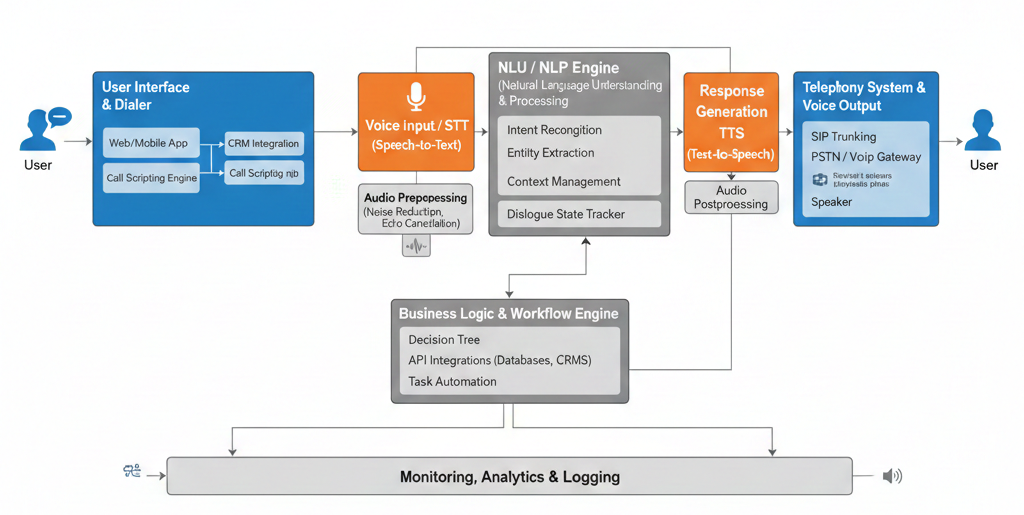
Speech-to-Text, Text-to-Speech & Large Language Models
At the core of every AI voice calling system is a tightly synchronized technology stack designed to process spoken language in real time, interpret meaning accurately, and respond in a way that sounds natural rather than robotic.
It starts with Speech-to-Text (STT) engines, which continuously convert live audio into structured text while the caller is still speaking, handling variations in accents, speech speed, regional dialects, background noise, and even imperfect audio quality from mobile networks. Modern STT systems do not just “hear words”; they detect sentence boundaries, pauses, emphasis, and corrections, which becomes critical for understanding what the caller actually means rather than what they literally say.
Once the speech is transcribed, Large Language Models (LLMs) take over as the cognitive layer of the system. These models analyze the text in context, referencing previous conversation turns, caller intent, and business-specific knowledge to determine what the caller is trying to achieve. This is where the conversation shifts from automation to intelligence—LLMs allow the AI to respond logically, handle follow-up questions, manage ambiguity, and avoid sounding like it’s reading from a script. If a user changes their mind mid-sentence or adds new information, the model recalculates intent instantly.
The response generated by the AI is then passed to Text-to-Speech (TTS) engines, which convert text back into spoken language that feels human, confident, and trustworthy. High-quality TTS systems control tone, pacing, pronunciation, emotional neutrality or warmth, and even subtle pauses, because how something is said often matters as much as what is said—especially in sales and customer support conversations.
What truly determines performance is not the strength of STT, LLM, or TTS individually, but how seamlessly these components work together under strict real-time constraints, without noticeable lag or conversational friction.
Real-Time Conversation Handling
Voice interactions are fundamentally different from chat-based automation, because humans expect immediate responses and natural turn-taking when they speak. AI call bots must operate within milliseconds, not seconds, to avoid breaking trust or sounding artificial.
To achieve this, modern voice AI systems are engineered to:
Detect pauses, interruptions, and speech overlaps accurately, so the AI does not talk over the caller or cut them off unnaturally
Respond fast enough to maintain conversational momentum, preventing awkward silences that signal “automation” to the user
Adapt responses dynamically when callers switch topics mid-call, correct themselves, or ask layered questions
This real-time orchestration—listening, thinking, and speaking simultaneously—is one of the main reasons voice AI is significantly more complex than text-based chatbots, both technically and operationally.
AI Decision-Making & Intent Recognition
Advanced AI call bots are not driven by static scripts or rigid decision trees. Instead, they rely on intent recognition models that continuously evaluate what the caller wants, how urgent the request is, and what the best next action should be.
These systems combine multiple signals in real time, including conversational context, CRM data, call history, user sentiment, and predefined business rules, to decide whether to continue the conversation, ask clarifying questions, route the call to a human agent, or trigger an automated workflow such as booking an appointment or creating a support ticket.
From a business perspective, this is where voice AI delivers real value—every response is aligned not only with the caller’s intent but also with revenue goals, service quality standards, and operational efficiency. The result is a system that sounds human, thinks strategically, and acts consistently at scale.

Business Use Cases of AI Voice Calling Software
AI Voice Calling for Sales Automation
Sales teams are increasingly adopting AI voice calling software to remove friction from outbound prospecting, accelerate inbound lead engagement, and ensure follow-ups happen consistently—without depending on human availability or manual dialing. In high-velocity environments like B2B SaaS, real estate, financial services, and education, the first conversation often determines whether a lead converts or disappears, and AI call bots excel at responding instantly, asking structured qualification questions, and routing high-intent prospects to the right sales representative at the right moment.
Unlike traditional auto-dialers, AI voice systems can adapt the conversation based on prospect responses, detect buying signals in real time, and capture structured data directly into the CRM, which gives sales teams cleaner pipelines and higher-quality opportunities. The result is not just more calls, but smarter conversations that scale without increasing headcount.
AI Call Bots for Customer Support
In customer support operations, AI voice bots play a critical role in handling repetitive, high-volume inquiries that would otherwise overwhelm human agents and inflate operational costs. Common scenarios include order status checks, account verification, subscription changes, service requests, policy information, and basic troubleshooting, all of which can be resolved accurately through conversational automation.
By resolving these routine issues autonomously, businesses significantly reduce ticket backlogs, shorten average handle time, and improve first-call resolution rates. More importantly, human support agents are freed to focus on complex, emotionally sensitive, or high-value cases where empathy and nuanced decision-making matter most, leading to better customer satisfaction without increasing staffing pressure.
Lead Qualification, Follow-Ups & Appointment Booking
One of the highest-ROI applications of AI voice calling software lies in automated lead qualification and appointment scheduling, where consistency and speed directly influence revenue outcomes. AI call bots can ask predefined yet adaptive questions, evaluate responses as the conversation unfolds, and determine lead readiness based on scoring logic aligned with business goals.
Once a lead meets qualification criteria, the AI can seamlessly book appointments, schedule callbacks, send confirmations, or trigger follow-up sequences without any human intervention. This capability is especially valuable in healthcare, professional services, real estate, and local businesses, where missed calls or delayed follow-ups often translate into lost opportunities. The automation ensures no lead is forgotten, no inquiry goes unanswered, and no booking depends on manual coordination.
Outbound & Inbound AI Calling Workflows
AI voice calling software supports both inbound and outbound workflows, allowing businesses to design end-to-end calling strategies that align with operational needs and customer expectations.
For inbound calls, AI can manage intelligent call routing, classify issues based on intent, provide instant resolutions, or escalate calls to human agents with full context when required.
For outbound campaigns, AI handles tasks such as payment reminders, subscription renewals, feedback collection, post-service surveys, re-engagement calls, and promotional outreach, all while maintaining a natural conversational tone and compliance with predefined rules.
When orchestrated correctly, these workflows transform calling from a cost center into a scalable, data-driven system that delivers measurable impact across sales, support, and customer experience.

Benefits of AI Calling Software for Sales & Support Teams
Cost Reduction & Operational Efficiency
AI calling software delivers immediate and measurable cost savings by automating high-volume, repeatable voice interactions that traditionally require large human teams to manage. By handling routine inquiries, outbound follow-ups, and basic qualification calls autonomously, businesses reduce cost per call and cost per resolution while also shortening average handling times across the board.
Beyond direct labor savings, operational efficiency improves because AI systems work without fatigue, shift constraints, or performance variance, ensuring consistent service quality throughout the day. This allows organizations to optimize human agent allocation, reduce overtime expenses, and redirect skilled staff toward higher-value conversations that genuinely require human judgment.
24/7 AI-Powered Customer Engagement
Modern customers expect instant responses regardless of time zone, business hours, or seasonal demand spikes, and AI voice agents make round-the-clock engagement a practical reality rather than an operational burden. AI calling software remains available 24/7, handling after-hours inquiries, weekend calls, and sudden call surges without the need for additional staffing or extended shifts.
For global businesses or companies serving distributed markets, this continuous availability ensures no lead, support request, or urgent issue goes unanswered, improving customer trust while maintaining predictable operating costs. The result is a support and sales operation that feels always-on, without being always expensive.
Higher Conversions & Faster Response Time
Speed is a decisive factor in both sales and customer experience, and AI calling software excels at eliminating response delays that cause leads to disengage or customers to become frustrated. AI voice systems respond instantly to inbound inquiries and initiate outbound follow-ups within minutes, not hours or days, which dramatically reduces lead leakage and increases the likelihood of successful engagement.
By maintaining consistent follow-up cadence and immediate first-contact responses, businesses see higher conversion rates, shorter sales cycles, and improved customer satisfaction. The advantage compounds over time, as faster engagement builds momentum across pipelines and support queues alike.
Scalable AI Call Center Solutions
Traditional call centers scale linearly—more calls require more agents, more supervisors, and higher overhead—while AI call center solutions scale elastically, adapting to demand without proportional cost increases. Businesses can launch large outbound campaigns, enter new geographic regions, or support rapid growth without rebuilding their operational infrastructure from scratch.
This elasticity allows organizations to experiment, expand, and respond to market changes quickly, all while maintaining consistent service quality. As volumes grow, AI systems absorb the load, giving leadership teams the confidence to scale aggressively without sacrificing efficiency or customer experience.
Core Features of AI Voice Calling Software
One of the defining capabilities of modern AI voice calling software is human-like conversational flow, where responses adapt dynamically to user input instead of following rigid, prewritten scripts. The AI listens actively, understands intent in context, and adjusts its tone, phrasing, and follow-up questions based on how the conversation unfolds, which makes interactions feel natural rather than automated and significantly improves user comfort and engagement.
Multilingual and accent support is another critical feature, especially for businesses operating across regions such as India, Europe, and the Middle East, where linguistic diversity and accent variations are the norm rather than the exception. Advanced voice AI systems are trained to recognize and respond accurately across multiple languages and speech patterns, ensuring clarity, reducing misunderstandings, and delivering a consistent experience regardless of who is calling or where they are located.
Equally important are call recording, transcription, and analytics, which turn every voice interaction into actionable business intelligence. Calls are automatically recorded and transcribed in real time, allowing teams to track performance, monitor quality, meet compliance requirements, and identify recurring issues or conversion patterns. Over time, these insights enable continuous optimization of both conversation flows and operational strategies.
Finally, deep integrations with CRM, helpdesk, and sales platforms ensure that AI voice calling software does not operate in isolation. Every interaction, data point, and outcome is pushed directly into existing business systems, keeping customer records up to date, triggering workflows automatically, and giving sales and support teams full context before any human follow-up occurs. This level of integration transforms voice AI from a standalone tool into a core component of the company’s revenue and service infrastructure.
AI Voice Calling Software vs Traditional Call Centers
AI Call Bots vs Human Agents
AI call bots excel in areas where speed, consistency, and scalability matter most, such as handling large call volumes, responding instantly, and following defined processes without deviation. They deliver uniform service quality across thousands of interactions, never get fatigued, and can operate continuously without performance drops during peak hours.
Human agents, on the other hand, remain essential for situations that require emotional intelligence, nuanced judgment, or complex problem-solving. They are better equipped to handle sensitive conversations, negotiate exceptions, and build deeper relationships when context, empathy, and flexibility are critical. The most effective customer engagement strategies recognize that AI and humans are not competitors, but complementary strengths within the same system.
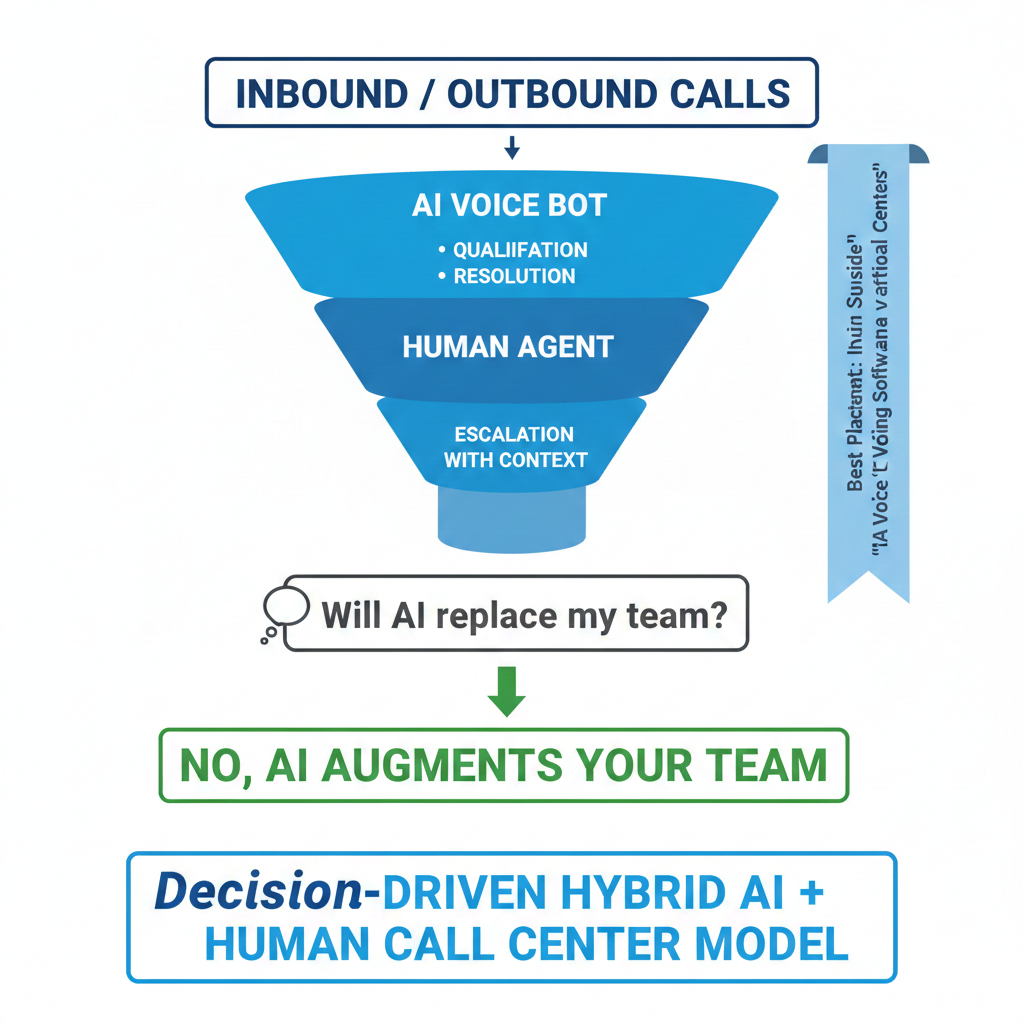
Hybrid AI + Human Call Center Model
In a hybrid call center model, AI voice agents manage first-touch interactions and routine tasks, such as initial inquiries, basic qualification, information retrieval, and simple resolutions. This creates an efficient front line that filters, categorizes, and prepares conversations before involving a human agent.
When escalation is needed, human agents receive the call with full context, including conversation history, intent analysis, and relevant customer data, allowing them to focus on resolution rather than repetition. This approach reduces operational strain, improves agent productivity, and delivers a smoother customer experience, because callers are not forced to repeat themselves or wait unnecessarily.
When AI Calling Software Is the Best Fit
AI calling software is particularly well suited for environments where call volumes are high, interactions follow repeatable patterns, response speed directly affects outcomes, and cost optimization is a strategic priority. It is ideal for organizations that need to scale outreach or support quickly, maintain consistent service quality, and reduce dependency on large agent teams without compromising customer satisfaction.
In these scenarios, AI does not replace human capability—it amplifies it—by absorbing volume, accelerating response times, and creating the operational flexibility that traditional call centers struggle to achieve.

Cost, Security & Compliance of AI Calling Software
AI Voice Calling Software Pricing Models
AI voice calling software pricing is typically structured around a combination of call volume, feature depth, supported languages, and integration complexity, which allows vendors to align costs with actual usage rather than fixed infrastructure. Common models include per-minute or per-call billing for flexible scaling, subscription-based tiers for predictable monthly spend, and enterprise licensing for organizations running high-volume or mission-critical operations.
For growing businesses, usage-based pricing offers the freedom to test campaigns and workflows without heavy upfront commitments, while larger enterprises often prefer negotiated contracts that bundle advanced features, priority support, and service-level guarantees into a single commercial agreement. Understanding how pricing scales with volume is critical, because the long-term ROI of voice AI depends on predictable cost behavior as call traffic increases.
MVP vs Enterprise AI Call Bots
MVP-level AI call bots are designed for speed and experimentation, enabling teams to deploy quickly with limited workflows, basic integrations, and predefined conversation logic. These solutions are ideal for validating use cases, testing customer response, or automating a narrow set of interactions without significant engineering effort.
Enterprise-grade AI call bots, however, are built for complexity and scale. They offer deeper customization, advanced analytics, role-based access controls, high availability infrastructure, and integration with multiple internal systems. For regulated industries or large customer bases, enterprise solutions also provide the governance, monitoring, and control needed to operate voice AI as a core business system rather than a pilot project.
Data Security, GDPR & Compliance Readiness
Security and compliance are non-negotiable considerations for any organization deploying AI voice calling software, especially when conversations involve personal, financial, or health-related information. Enterprise buyers must ensure that all call data is encrypted in transit and at rest, stored securely, and accessible only through controlled permissions.
Equally important is consent management, which includes informing callers about call recording, honoring opt-in and opt-out requirements, and maintaining audit trails for regulatory review. Compliance with frameworks such as GDPR, HIPAA, and regional telecom regulations is essential, not only to avoid penalties but to build trust with customers. A compliant AI calling platform should make these safeguards part of its architecture, not optional add-ons.
How to Choose the Right AI Voice Calling Software Provider
The first and most important step is to evaluate voice quality, latency, and intent accuracy under real-world conditions, not polished demos. AI voice systems must perform reliably across poor network connections, varied accents, background noise, and unpredictable caller behavior. Even small delays or misinterpreted intent can break conversational flow, reduce trust, and negatively impact conversions or support outcomes, so live testing with actual call scenarios is essential.
Equally critical is the ability to assess integration depth with existing systems, including CRM platforms, helpdesk tools, marketing automation software, and internal databases. A strong provider ensures that every call automatically updates records, triggers workflows, and preserves context, eliminating manual data entry and preventing information silos that slow teams down.
Security cannot be treated as an afterthought, which makes it necessary to review the vendor’s security certifications and compliance posture in detail. This includes understanding how call data is encrypted, stored, and accessed, as well as verifying alignment with regulatory frameworks relevant to your industry and region. A provider’s security maturity often reflects how well the platform will scale in regulated or enterprise environments.
Finally, decision-makers should understand the vendor’s roadmap for future voice AI capabilities, because the technology is evolving rapidly. Providers investing in ongoing model improvements, conversation intelligence, and deeper automation will offer far more long-term value than those focused solely on current features.
Custom AI Call Bot vs SaaS Platforms
Choosing between a SaaS-based AI calling platform and a custom-built AI call bot depends largely on business complexity, scale, and strategic goals. SaaS platforms deliver faster time-to-value, standardized features, and lower upfront costs, making them ideal for companies that want to deploy quickly and validate use cases with minimal engineering effort.
Custom AI call bots, however, offer significantly greater flexibility, allowing enterprises to tailor conversation logic, integrations, data handling, and compliance controls to their exact needs. For organizations with complex workflows, high call volumes, or strict regulatory requirements, custom solutions often deliver stronger long-term ROI despite higher initial investment.
Future Trends in AI Voice Calling (2025+)
Looking ahead, AI voice calling is moving beyond reactive conversations toward systems that understand emotional cues, adapt tone based on sentiment, and respond with greater contextual awareness. Voice AI is also converging with chat, messaging, and visual interfaces to create multimodal experiences where conversations seamlessly shift across channels.
Perhaps most importantly, the next generation of voice AI will include autonomous agents capable of handling entire workflows end to end—from initial contact to resolution—without human involvement. Businesses that choose forward-looking providers today will be better positioned to adopt these capabilities as they mature.

Final Perspective
AI voice calling software has matured into a proven and scalable solution that enables organizations to control costs, accelerate response times, and deliver consistent, high-quality customer experiences across regions and time zones. By automating high-volume interactions and supporting human teams with real-time intelligence, voice AI transforms calling from a resource-heavy function into a predictable, performance-driven system.
For businesses where voice communication directly influences revenue, retention, or customer trust, adopting AI voice calling is no longer an optional enhancement or a future consideration. It is a strategic move that strengthens competitive positioning, increases operational resilience, and prepares the organization for a market where speed, availability, and personalization define success.